AI Powered Learning Platforms That Upgrade Your Online Courses
AI Powered Learning Platforms That Upgrade Your Online Courses
AI Powered Learning Platforms That Upgrade Your Online Courses
Feb 10, 2026
Feb 10, 2026
Feb 10, 2026
Let’s be honest, an AI-powered learning platform is much more than just a place to host videos. Think of it as an intelligent system that acts like a personal tutor for every single one of your students. It uses artificial intelligence to personalise content, answer questions around the clock, and give you deep insights into how your learners are really doing.
This is the shift from a rigid, one-size-fits-all model to a living, adaptive learning experience.
The Shift From Static Courses to Dynamic Learning
For years, "online education" meant uploading a PDF or a video and calling it a day. Every learner followed the exact same path, and as an instructor, you were probably stuck answering the same handful of questions over and over again. This old-school approach almost guarantees student disengagement and creates a huge administrative headache for coaches and creators.
But a fundamental change is happening, all thanks to AI-powered learning platforms.
Imagine the difference between handing someone a textbook versus giving them a dedicated, one-on-one tutor. The book is static; it presents the information in the same way for everyone. The tutor, on the other hand, listens, adapts, and steps in with help exactly when it's needed most. That’s the leap we're now seeing in online education.
From Content Repository to Intelligent Partner
Traditional Learning Management Systems (LMS) were basically digital filing cabinets. They stored your content, sure, but they did very little to actually improve the learning process itself. The new wave of AI platforms transforms this passive library into an active, intelligent partner in teaching.
These systems are built to solve the biggest pain points for modern educators and entrepreneurs:
Student Disengagement: AI keeps learners locked in and moving forward by personalising their journey and offering instant support.
Repetitive Questions: A smart AI teaching assistant, trained on your own content, handles all the common queries, freeing you up for more meaningful interactions.
Scalability Challenges: You can finally give hundreds or even thousands of students the same level of personal attention you'd give a small group.
This isn't just another trend; it's a massive market shift. The demand for smarter, more adaptive educational tools is exploding because everyone—from creators to learners—is looking for more efficient and effective ways to teach and learn.
The Growing Demand for Smart Education
The market data tells the same story. In India alone, the Applied AI in Education market is on track to hit USD 5,865.72 million by 2035, all driven by the massive need for personalised learning solutions. We’ve already seen how this technology can slash operational inefficiencies by up to 40% and boost course completion rates by 15-20%.
This guide will walk you through everything you need to know, from the core features that matter to how to choose the right platform for your business. You might also find our broader look at the transformative role of AI in education a useful next step.
What Exactly Is an AI-Powered Learning Platform?
To get what AI-powered learning platforms are all about, let’s start with something you already know: a traditional Learning Management System (LMS). For years, an LMS has worked like a digital filing cabinet. You upload your course videos, PDFs, and quizzes, and it neatly organises everything for your students to access.
It’s a perfectly functional model, but it’s completely passive. The platform just holds your content; it doesn't interact with it or your students. It's the digital equivalent of handing every student the exact same textbook and telling them to get on with it. There’s no intelligence, no adaptation, and certainly no real-time support baked in.
The Brain That Brings Your Content to Life
Now, imagine giving that digital filing cabinet a brain. That’s exactly what the 'AI' part does. It turns your static library of content into an active, responsive teaching partner that works for you. This AI isn't some flashy gimmick; it's a system built to understand the substance of what you teach, right down to the details.
This means the platform doesn't just store your videos; it watches them. It doesn't just host your documents; it reads them. By processing every piece of your unique course material, the AI learns your specific expertise, your tone, and the way you explain concepts.
An AI-powered learning platform is not just a place to host courses. It’s an intelligent ecosystem that learns from your content to act as an extension of you, providing personalised support to every learner, 24/7.
This fundamental shift moves your online academy from a one-way broadcast of information into a genuine two-way, interactive experience.
From Manual Support to an Automated Teaching Team
Think about the leap from a basic cloud drive to a fully automated, intelligent assistant. A cloud drive stores your files, but a smart assistant understands what’s inside them and can use that information to help you. That’s the upgrade an AI-powered platform gives you.
Instead of you personally answering the same beginner questions day in and day out, the AI steps in. It has already learned the correct answers directly from your content and can deliver them instantly, in a conversational style that reflects your teaching voice.
This has a few powerful implications for you as a creator or coach:
It buys back your time: All the repetitive admin and support tasks are handled automatically. This frees you up to focus on high-impact work, like creating new content or building your community.
It scales your presence: You can provide near-instant, personal-feeling support to hundreds or even thousands of students at the same time—something that’s physically impossible for one person to do.
It improves the student experience: Learners get their questions answered the moment they ask. This stops them from getting frustrated, reduces drop-off rates, and keeps their learning momentum high.
Ultimately, these platforms use AI to build a smarter, more scalable, and more supportive educational environment. They turn your expertise into an interactive resource that works for your students around the clock, creating better outcomes for them and a much more sustainable business for you.
The Core Features That Redefine Online Learning
Under the hood of any truly effective AI powered learning platform are a few core features that work together to create a smarter, more responsive educational experience. These aren't just small upgrades; they represent a fundamental shift in how online learning is delivered and managed.
By automating support, personalising content, providing deep insights, and protecting your work, these platforms turn a static course library into a living, breathing teaching ecosystem. Let's break down the four essential pillars that make this possible, moving beyond the buzzwords to see how they actually work for creators and coaches in the real world.
The AI Teaching Assistant: Your 24/7 Support Expert
Imagine having an expert on your team who has perfectly memorised every single word of your course materials—every video, every PDF, every lesson. Now, imagine this expert is available 24/7 to answer student questions instantly, using your exact teaching style. That’s precisely what an AI Teaching Assistant does.
This feature uses Natural Language Processing (NLP) to understand and respond to student queries based only on your course content. It's not some generic chatbot pulling answers from the internet; it's a highly specialised assistant trained exclusively on your knowledge.
For a business coach: A student asks, "What are the key steps in the sales funnel you mentioned in Module 2?" The AI can provide a precise, detailed answer pulled directly from that lesson. This saves the coach hours of answering the same questions over and over.
For a language tutor: If a learner is confused about a specific grammar rule, the AI can explain it using the exact examples and frameworks the tutor provided. This ensures consistency and reinforces the core lesson.
This kind of instant, reliable support keeps learners from getting stuck, builds their confidence, and dramatically cuts down on your admin workload.
Personalised Learning Paths: Adapting to Individual Progress
One of the biggest game changers in AI-powered learning is the ability to offer dynamic experiences using advanced content personalization strategies. Instead of forcing every student down the same rigid path, the system intelligently adapts the journey based on individual performance and needs.
This is made possible by algorithms that track learner progress, quiz results, and engagement levels. From there, the platform can recommend supplementary materials, suggest reviewing a specific module, or even unlock advanced content for those who are flying ahead.
The goal of personalisation is to ensure every learner receives the right content at the right time. This approach keeps students challenged but not overwhelmed, which is crucial for maintaining momentum and achieving higher completion rates.
This infographic shows how the AI platform sits on top of a traditional learning system to add this layer of intelligence.
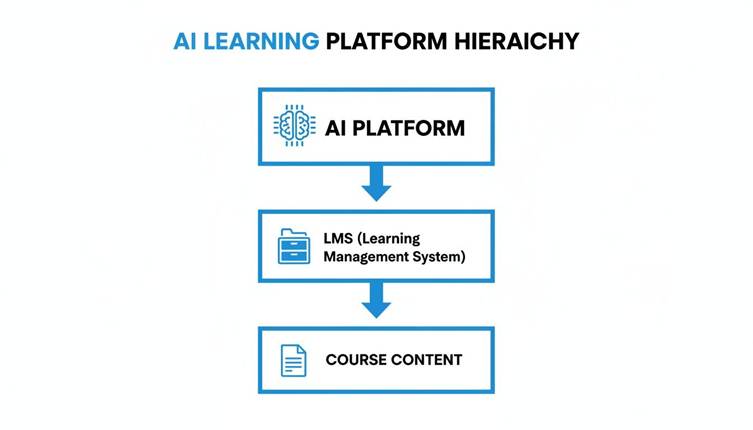
As you can see, the AI layer doesn't just host the content—it actively interprets and manages it, turning a simple library into an intelligent learning environment.
Advanced Analytics: Revealing What Drives Success
For any educator, data is one of the most valuable assets you have. Traditional platforms might tell you who completed a course, but AI-powered analytics go much, much deeper. They reveal the "why" behind student behaviour, giving you actionable insights to improve your content and outcomes.
You can pinpoint exactly where learners are dropping off, which quiz questions cause the most trouble, or what content is the most engaging. A wellness instructor, for example, might discover that 70% of students abandon their programme during a particularly tough nutrition module. Armed with this data, they can refine that section to make it more accessible and supportive. You can explore more about these kinds of platform capabilities and their impact here.
This is where the market's rapid growth becomes significant. India's AI in Education market is projected to reach USD 1,140.3 million by 2030, driven by a massive demand for better engagement. With over 9.5 million online education enrolments, platforms using analytics and gamification can increase user satisfaction by up to 15%.
Intelligent Content Protection: Safeguarding Your Work
As a creator, your content is your business. Protecting your intellectual property is non-negotiable. Modern AI powered learning platforms integrate sophisticated security measures to prevent unauthorised sharing, downloading, and distribution of your valuable materials. This goes far beyond a simple login and password.
Key protection features often include:
Dynamic Watermarking: Placing unique, user-specific watermarks on videos to deter screen recording.
DRM Encryption: Securing content delivery so it cannot be easily downloaded or saved.
Domain Restrictions: Ensuring your courses can only be accessed from your approved website.
Access Controls: Limiting concurrent logins to prevent password sharing among users.
To really see the difference, this table breaks down how these intelligent features stack up against a standard LMS.
Traditional LMS vs AI Powered Learning Platform
Feature | Traditional LMS | AI Powered Learning Platform |
Student Support | Manual (forums, email) | Automated 24/7 AI Teaching Assistant |
Learning Path | Linear, one-size-fits-all | Adaptive and personalised to each learner |
Analytics | Basic completion rates | Deep insights on engagement and drop-off points |
Content Security | Basic login protection | Advanced (DRM, watermarking, access limits) |
These core components work together to create an environment that is not only more effective for learners but also more secure and efficient for you. They are the engine driving the next generation of online education.
How to Choose the Right AI Platform for Your Business
Picking the right AI learning platform isn't about ticking boxes on a feature list. It's about finding a partner that gets your business, protects your content, and is ready to grow with you. A quick decision here can backfire, leading to security holes or a clunky student experience that defeats the whole purpose of your investment.
To cut through the marketing fluff, you need a clear framework. Let's focus on what really matters for your long-term success: security, AI control, integrations, and pricing. These are the make-or-break factors.
Prioritise Security and IP Protection
Let's be blunt: your content is your business. For any course creator, protecting that intellectual property (IP) is non-negotiable. The platform you choose needs to be a digital fortress, because a simple password isn't going to cut it anymore.
You need a platform with serious, multi-layered security built to stop unauthorised access, downloads, and sharing. This is the difference between a basic video host and a professional-grade academy that actually safeguards your hard work and revenue.
Before you even think about signing up, ask any potential platform these direct questions:
How do you stop people from illegally downloading my videos? You want to hear them talk about things like DRM encryption and secure, stream-only delivery.
Can you add dynamic watermarks to my videos? This is a huge deterrent. It puts a unique identifier on the screen, so if content ever leaks, it’s tied directly back to a specific user's account.
Do you offer domain restrictions? This is a simple but powerful tool that ensures your embedded courses only play on your authorised website, stopping thieves from embedding them elsewhere.
What about account sharing? Look for features that limit how many people can be logged into a single account at the same time.
The need for this level of security is only getting more intense. The AI in K-12 Education market in India, for example, is rocketing ahead at a 47.6% CAGR, part of a global industry that's expected to hit USD 13,617 million by 2035. For an independent creator in a market that hot, enterprise-grade security isn't a luxury—it's essential for survival. Learn more about the rapid growth of AI in education.
Evaluate AI Accuracy and Control
The "AI" in an AI-powered platform needs to be a digital clone of you. Its job is to scale your expertise and teaching style, not to start spitting out generic or, worse, incorrect information from the internet. A poorly trained AI can confuse your students and instantly damage the credibility you've worked so hard to build.
This is why you need absolute control.
The best systems are what you'd call "closed-loop." This means the AI is trained only on the content you provide—your videos, your PDFs, your notes. It should never, ever pull answers from a random Google search. This is the only way to guarantee that every answer aligns perfectly with your curriculum and maintains your brand's unique voice.
Here’s what you need to ask about the AI itself:
Is the AI trained only on my course materials? The answer has to be a hard "yes." No exceptions.
Can I review and edit what the AI knows or the answers it gives? Fine-grained control lets you polish the AI's accuracy until it's perfect.
What happens if a student asks a question the AI can't answer from my content? There needs to be a smooth, simple process for escalating that question directly to you.
Can I set the AI's personality and tone to match my brand? This small detail makes a huge difference in creating an authentic experience for your students.
Analyse Seamless Integrations
Your learning platform doesn't live on an island. It has to play nice with all the other tools you use to run your business—your payment gateways, your email marketing software, and your community platform. If the integrations are clunky or non-existent, you're signing yourself up for hours of frustrating manual work and a disjointed experience for your customers.
A platform with a solid integration ecosystem automates the busywork. When a new student signs up, they should automatically land on your email list and get an invite to your private community, all without you lifting a finger.
Focus your questions on these key connections:
Which payment gateways do you support? Make sure it works with providers that are common in your region, like Stripe or Razorpay.
Do you have direct integrations with popular email platforms? Look for the big names like Mailchimp, ConvertKit, or ActiveCampaign.
Is there a Zapier integration? Zapier is the ultimate connector. It’s a powerful backup that lets you link to thousands of other apps if a direct integration isn’t available.
How deep do the integrations actually go? Is it just a simple, one-way data push, or does it allow for more complex, two-way communication between the apps?
Making the right choice here is a foundational decision for your online education business. By methodically looking at these key areas, you can choose a solution that not only works for you today but is ready to scale with you for years to come.
Real-World Examples for Course Creators and Coaches

It’s one thing to talk about features, but it’s another to see how AI-powered learning platforms actually work for real people. This is where it all clicks. Let’s get practical and look at a few scenarios that show the shift from manual overload to smart, scalable impact.
These aren't just hypotheticals. They’re grounded in the everyday frustrations that limit growth for so many creators and coaches. Each example paints a clear "before" and "after" picture, making it easy to see how this could apply to your own business.
The Fitness Instructor Drowning in DMs
Before AI: A fantastic fitness instructor runs a popular online programme, but he's completely buried in messages. His inbox is a constant flood of questions about exercise modifications, nutrition plans, and recovery tips. He spends three to four hours every single day answering the same things over and over, which leaves him no time to create new content or build his community. Worse, his response times are slowing, and student satisfaction is starting to slip.
After AI: He brings his content onto an AI platform and trains its AI Teaching Assistant on every workout video, nutrition guide, and recovery protocol he’s ever made. Now, when a student asks, "What’s a good substitute for a barbell squat if I have knee pain?" the AI instantly gives them three approved alternatives pulled directly from his material.
The change is immediate and massive:
Time Reclaimed: He gets back over 20 hours per week. He now uses that time to host live Q&A sessions and build out an advanced programme.
Happier Students: Learners get instant, accurate answers 24/7. They feel supported, their confidence grows, and they get better results.
Business Growth: With his time freed up, he can double the number of students he serves without sacrificing quality.
The Language Tutor Building a Practice Playground
Before AI: A language tutor has a great self-paced Spanish course, but she has a big problem: students have no way to practice. They watch the videos but can't get feedback on their grammar or sentence structure without booking expensive one-on-one time. This lack of real-time application means a lot of students lose momentum and drop off after the first few modules.
After AI: She moves her course into an AI platform. Now, she can create interactive exercises where students type responses in Spanish. The AI, trained on her specific grammar rules and vocabulary lists, gives instant corrections and explanations, almost like a real conversation partner.
This simple change turns a passive viewing experience into an active, hands-on learning environment. The AI becomes a tireless practice partner, giving students a safe space to try, fail, and improve without the fear of making mistakes in front of a real person.
This is critical for language learning. It creates a judgement-free zone for the trial and error that true mastery requires. For creators wanting to make their content more dynamic, checking out different AI tools for creators can spark some great ideas for boosting engagement.
The Business Coach Who Automated the Basics
Before AI: A business coach runs a high-ticket group programme. Her problem? The first few live calls are always bogged down by basic, repetitive questions about her core frameworks. It slows the whole group down and stops her from diving into the high-level, personalised strategy her clients actually paid for. She's spending her most valuable time on low-level support.
After AI: She puts all her foundational content onto an AI platform and makes it a prerequisite for joining the live programme. The AI assistant fields every preliminary question about her methods, terminology, and initial steps. New clients get to absorb the basics at their own pace and arrive at the first live call ready to go.
This completely transforms the dynamic:
Elevated Coaching: Live sessions are now 100% focused on advanced strategy, solving unique client challenges, and fostering high-value discussions.
Better Client Outcomes: Clients show up prepared and aligned, which means they implement faster and see results sooner.
Scalable Model: She can now grow her coaching groups with confidence, knowing the AI will handle the initial onboarding burden.
As you can see, AI-powered learning platforms aren’t about replacing the expert. They’re about amplifying your reach so you can make a bigger impact. To dig deeper into this, check out our guide on the essentials of AI course creation.
A Simple Guide to Implementing Your AI Learning Platform
Making the leap from choosing an AI learning platform to actually launching it can feel daunting. But it doesn't have to be.
The best approach is a thoughtful, phased rollout. Success isn't about flipping a switch overnight; it’s about setting up the system for quality, gathering real feedback, and only then scaling up your efforts.
The very first step—and honestly, the most critical—is curating the knowledge you feed the AI. The intelligence of your AI Teaching Assistant is a direct mirror of the content it learns from.
It’s a simple principle: quality in, quality out. Before you upload a single file, take the time to review, update, and organise your course materials. Are your videos, documents, and guides clear, accurate, and consistent? This initial effort pays off big time, ensuring the AI provides reliable and helpful answers from day one and building immediate trust with your students.
Customise Your Platform and Brand Experience
Once your knowledge base is ready, it's time to make the platform truly yours. Your online academy should feel like a natural extension of your brand, not some generic third-party tool. This is where you inject your personality and professional identity into the learner's journey.
Most modern platforms offer white-label features, and you should use them all:
Upload your logo and apply your brand colours across the entire platform.
Customise email notifications and automated messages so they sound like you.
Design branded certificates of completion to add a professional touch that learners will value.
This consistency creates a seamless, trustworthy environment. It reinforces your authority and makes the underlying technology feel completely invisible.
Remember, the AI is a powerful tool designed to augment your expertise, not replace it. Your brand, your voice, and your unique teaching style should always remain at the forefront of the learning experience.
Pilot With a Small Group for Feedback
Before you announce this to your entire audience, run a pilot programme. Pick a small, trusted group of students and think of it as a beta test for your new, supercharged academy. This controlled launch is the best way to get invaluable, real-world feedback.
You can gather insights on everything from the AI's responsiveness to the overall user journey. Ask your pilot group specific questions about their interactions and use what they tell you to make crucial adjustments. This step lets you iron out any wrinkles and builds your own confidence before the full rollout.
Finally, with a refined system in place, you can build a marketing strategy to announce your upgraded offering. Highlight the new benefits, like 24/7 support and a much more personalised learning journey. This builds excitement and clearly communicates the added value you’re providing, setting the stage for a successful launch that elevates both learner outcomes and your own efficiency.
Answering Your Top Questions About AI in Learning
Switching to an AI-powered platform is a big move, and it's natural to have questions. Let's be honest, you're probably wondering about the cost, the complexity, and whether a bot can really represent your teaching style.
Here are some straight answers to the most common questions we hear from creators and coaches.
Will an AI Teaching Assistant Make My Courses Feel Impersonal?
Not at all. A common myth is that AI creates a cold, robotic experience. The opposite is actually true.
Think of a well-designed AI assistant as a perfect clone of your knowledge, trained only on your specific content. It can even learn and adopt your unique teaching style and voice. Its job isn't to replace you, but to handle all the repetitive, factual questions instantly—the ones that take up your time but don't require your personal genius.
This frees you up to engage with students on a deeper, more strategic level. The AI handles the "what" and "where," so you can focus on the "why" and "how." It actually enhances your presence by making sure your students feel supported 24/7, even when you're offline.
The AI becomes an extension of you, scaling your ability to support every single learner without diluting your personal touch. It reinforces your expertise with every answer, making your brand stronger.
Are AI-Powered Learning Platforms Too Expensive for Solo Creators?
This is a big concern, but many modern platforms are built specifically for solo creators and small businesses. Forget massive enterprise contracts; the best tools offer flexible pricing designed to grow with you.
Most have free trials or entry-level plans that give you everything you need to get started. But the real question isn't about cost it's about the return on your investment.
Here’s where you’ll see the value:
Less Admin, More Creating: Think of all the hours you spend answering the same basic questions over and over. An AI assistant gives that time back to you.
Better Student Results: Instant support keeps students from getting stuck. When they have answers right away, they stay engaged, motivated, and are far more likely to complete your course.
Scalable Growth: You can serve hundreds, or even thousands, of students without your workload exploding. The AI handles the support, so you don't have to hire a big team.
When you look at it this way, the platform often pays for itself very quickly.
Do I Need to Be a Tech Expert to Use an AI Learning Platform?
Absolutely not. If you can use email or social media, you can run an AI learning platform.
The best platforms are designed for creators and educators, not software developers. They come with intuitive interfaces, simple drag-and-drop course builders, and straightforward settings to customise the AI. The whole point is to make this powerful technology accessible.
Your job is to be an expert in your field. The platform’s job is to handle all the technical heavy lifting so you can focus on what you do best: creating amazing content and changing lives.
Ready to see how an AI-powered platform can simplify your work and scale your impact? With Skolasti, you can launch a fully branded academy with a 24/7 AI Teaching Assistant, built-in content protection, and all the integrations you need. Teach smarter, not harder.
Sign up today and explore all our features to see how easy it is to launch your platform. Whether you are looking to streamline your teaching or maximize your revenue, we provide the tools to help you scale effortlessly.
Let’s be honest, an AI-powered learning platform is much more than just a place to host videos. Think of it as an intelligent system that acts like a personal tutor for every single one of your students. It uses artificial intelligence to personalise content, answer questions around the clock, and give you deep insights into how your learners are really doing.
This is the shift from a rigid, one-size-fits-all model to a living, adaptive learning experience.
The Shift From Static Courses to Dynamic Learning
For years, "online education" meant uploading a PDF or a video and calling it a day. Every learner followed the exact same path, and as an instructor, you were probably stuck answering the same handful of questions over and over again. This old-school approach almost guarantees student disengagement and creates a huge administrative headache for coaches and creators.
But a fundamental change is happening, all thanks to AI-powered learning platforms.
Imagine the difference between handing someone a textbook versus giving them a dedicated, one-on-one tutor. The book is static; it presents the information in the same way for everyone. The tutor, on the other hand, listens, adapts, and steps in with help exactly when it's needed most. That’s the leap we're now seeing in online education.
From Content Repository to Intelligent Partner
Traditional Learning Management Systems (LMS) were basically digital filing cabinets. They stored your content, sure, but they did very little to actually improve the learning process itself. The new wave of AI platforms transforms this passive library into an active, intelligent partner in teaching.
These systems are built to solve the biggest pain points for modern educators and entrepreneurs:
Student Disengagement: AI keeps learners locked in and moving forward by personalising their journey and offering instant support.
Repetitive Questions: A smart AI teaching assistant, trained on your own content, handles all the common queries, freeing you up for more meaningful interactions.
Scalability Challenges: You can finally give hundreds or even thousands of students the same level of personal attention you'd give a small group.
This isn't just another trend; it's a massive market shift. The demand for smarter, more adaptive educational tools is exploding because everyone—from creators to learners—is looking for more efficient and effective ways to teach and learn.
The Growing Demand for Smart Education
The market data tells the same story. In India alone, the Applied AI in Education market is on track to hit USD 5,865.72 million by 2035, all driven by the massive need for personalised learning solutions. We’ve already seen how this technology can slash operational inefficiencies by up to 40% and boost course completion rates by 15-20%.
This guide will walk you through everything you need to know, from the core features that matter to how to choose the right platform for your business. You might also find our broader look at the transformative role of AI in education a useful next step.
What Exactly Is an AI-Powered Learning Platform?
To get what AI-powered learning platforms are all about, let’s start with something you already know: a traditional Learning Management System (LMS). For years, an LMS has worked like a digital filing cabinet. You upload your course videos, PDFs, and quizzes, and it neatly organises everything for your students to access.
It’s a perfectly functional model, but it’s completely passive. The platform just holds your content; it doesn't interact with it or your students. It's the digital equivalent of handing every student the exact same textbook and telling them to get on with it. There’s no intelligence, no adaptation, and certainly no real-time support baked in.
The Brain That Brings Your Content to Life
Now, imagine giving that digital filing cabinet a brain. That’s exactly what the 'AI' part does. It turns your static library of content into an active, responsive teaching partner that works for you. This AI isn't some flashy gimmick; it's a system built to understand the substance of what you teach, right down to the details.
This means the platform doesn't just store your videos; it watches them. It doesn't just host your documents; it reads them. By processing every piece of your unique course material, the AI learns your specific expertise, your tone, and the way you explain concepts.
An AI-powered learning platform is not just a place to host courses. It’s an intelligent ecosystem that learns from your content to act as an extension of you, providing personalised support to every learner, 24/7.
This fundamental shift moves your online academy from a one-way broadcast of information into a genuine two-way, interactive experience.
From Manual Support to an Automated Teaching Team
Think about the leap from a basic cloud drive to a fully automated, intelligent assistant. A cloud drive stores your files, but a smart assistant understands what’s inside them and can use that information to help you. That’s the upgrade an AI-powered platform gives you.
Instead of you personally answering the same beginner questions day in and day out, the AI steps in. It has already learned the correct answers directly from your content and can deliver them instantly, in a conversational style that reflects your teaching voice.
This has a few powerful implications for you as a creator or coach:
It buys back your time: All the repetitive admin and support tasks are handled automatically. This frees you up to focus on high-impact work, like creating new content or building your community.
It scales your presence: You can provide near-instant, personal-feeling support to hundreds or even thousands of students at the same time—something that’s physically impossible for one person to do.
It improves the student experience: Learners get their questions answered the moment they ask. This stops them from getting frustrated, reduces drop-off rates, and keeps their learning momentum high.
Ultimately, these platforms use AI to build a smarter, more scalable, and more supportive educational environment. They turn your expertise into an interactive resource that works for your students around the clock, creating better outcomes for them and a much more sustainable business for you.
The Core Features That Redefine Online Learning
Under the hood of any truly effective AI powered learning platform are a few core features that work together to create a smarter, more responsive educational experience. These aren't just small upgrades; they represent a fundamental shift in how online learning is delivered and managed.
By automating support, personalising content, providing deep insights, and protecting your work, these platforms turn a static course library into a living, breathing teaching ecosystem. Let's break down the four essential pillars that make this possible, moving beyond the buzzwords to see how they actually work for creators and coaches in the real world.
The AI Teaching Assistant: Your 24/7 Support Expert
Imagine having an expert on your team who has perfectly memorised every single word of your course materials—every video, every PDF, every lesson. Now, imagine this expert is available 24/7 to answer student questions instantly, using your exact teaching style. That’s precisely what an AI Teaching Assistant does.
This feature uses Natural Language Processing (NLP) to understand and respond to student queries based only on your course content. It's not some generic chatbot pulling answers from the internet; it's a highly specialised assistant trained exclusively on your knowledge.
For a business coach: A student asks, "What are the key steps in the sales funnel you mentioned in Module 2?" The AI can provide a precise, detailed answer pulled directly from that lesson. This saves the coach hours of answering the same questions over and over.
For a language tutor: If a learner is confused about a specific grammar rule, the AI can explain it using the exact examples and frameworks the tutor provided. This ensures consistency and reinforces the core lesson.
This kind of instant, reliable support keeps learners from getting stuck, builds their confidence, and dramatically cuts down on your admin workload.
Personalised Learning Paths: Adapting to Individual Progress
One of the biggest game changers in AI-powered learning is the ability to offer dynamic experiences using advanced content personalization strategies. Instead of forcing every student down the same rigid path, the system intelligently adapts the journey based on individual performance and needs.
This is made possible by algorithms that track learner progress, quiz results, and engagement levels. From there, the platform can recommend supplementary materials, suggest reviewing a specific module, or even unlock advanced content for those who are flying ahead.
The goal of personalisation is to ensure every learner receives the right content at the right time. This approach keeps students challenged but not overwhelmed, which is crucial for maintaining momentum and achieving higher completion rates.
This infographic shows how the AI platform sits on top of a traditional learning system to add this layer of intelligence.
As you can see, the AI layer doesn't just host the content—it actively interprets and manages it, turning a simple library into an intelligent learning environment.
Advanced Analytics: Revealing What Drives Success
For any educator, data is one of the most valuable assets you have. Traditional platforms might tell you who completed a course, but AI-powered analytics go much, much deeper. They reveal the "why" behind student behaviour, giving you actionable insights to improve your content and outcomes.
You can pinpoint exactly where learners are dropping off, which quiz questions cause the most trouble, or what content is the most engaging. A wellness instructor, for example, might discover that 70% of students abandon their programme during a particularly tough nutrition module. Armed with this data, they can refine that section to make it more accessible and supportive. You can explore more about these kinds of platform capabilities and their impact here.
This is where the market's rapid growth becomes significant. India's AI in Education market is projected to reach USD 1,140.3 million by 2030, driven by a massive demand for better engagement. With over 9.5 million online education enrolments, platforms using analytics and gamification can increase user satisfaction by up to 15%.
Intelligent Content Protection: Safeguarding Your Work
As a creator, your content is your business. Protecting your intellectual property is non-negotiable. Modern AI powered learning platforms integrate sophisticated security measures to prevent unauthorised sharing, downloading, and distribution of your valuable materials. This goes far beyond a simple login and password.
Key protection features often include:
Dynamic Watermarking: Placing unique, user-specific watermarks on videos to deter screen recording.
DRM Encryption: Securing content delivery so it cannot be easily downloaded or saved.
Domain Restrictions: Ensuring your courses can only be accessed from your approved website.
Access Controls: Limiting concurrent logins to prevent password sharing among users.
To really see the difference, this table breaks down how these intelligent features stack up against a standard LMS.
Traditional LMS vs AI Powered Learning Platform
Feature | Traditional LMS | AI Powered Learning Platform |
Student Support | Manual (forums, email) | Automated 24/7 AI Teaching Assistant |
Learning Path | Linear, one-size-fits-all | Adaptive and personalised to each learner |
Analytics | Basic completion rates | Deep insights on engagement and drop-off points |
Content Security | Basic login protection | Advanced (DRM, watermarking, access limits) |
These core components work together to create an environment that is not only more effective for learners but also more secure and efficient for you. They are the engine driving the next generation of online education.
How to Choose the Right AI Platform for Your Business
Picking the right AI learning platform isn't about ticking boxes on a feature list. It's about finding a partner that gets your business, protects your content, and is ready to grow with you. A quick decision here can backfire, leading to security holes or a clunky student experience that defeats the whole purpose of your investment.
To cut through the marketing fluff, you need a clear framework. Let's focus on what really matters for your long-term success: security, AI control, integrations, and pricing. These are the make-or-break factors.
Prioritise Security and IP Protection
Let's be blunt: your content is your business. For any course creator, protecting that intellectual property (IP) is non-negotiable. The platform you choose needs to be a digital fortress, because a simple password isn't going to cut it anymore.
You need a platform with serious, multi-layered security built to stop unauthorised access, downloads, and sharing. This is the difference between a basic video host and a professional-grade academy that actually safeguards your hard work and revenue.
Before you even think about signing up, ask any potential platform these direct questions:
How do you stop people from illegally downloading my videos? You want to hear them talk about things like DRM encryption and secure, stream-only delivery.
Can you add dynamic watermarks to my videos? This is a huge deterrent. It puts a unique identifier on the screen, so if content ever leaks, it’s tied directly back to a specific user's account.
Do you offer domain restrictions? This is a simple but powerful tool that ensures your embedded courses only play on your authorised website, stopping thieves from embedding them elsewhere.
What about account sharing? Look for features that limit how many people can be logged into a single account at the same time.
The need for this level of security is only getting more intense. The AI in K-12 Education market in India, for example, is rocketing ahead at a 47.6% CAGR, part of a global industry that's expected to hit USD 13,617 million by 2035. For an independent creator in a market that hot, enterprise-grade security isn't a luxury—it's essential for survival. Learn more about the rapid growth of AI in education.
Evaluate AI Accuracy and Control
The "AI" in an AI-powered platform needs to be a digital clone of you. Its job is to scale your expertise and teaching style, not to start spitting out generic or, worse, incorrect information from the internet. A poorly trained AI can confuse your students and instantly damage the credibility you've worked so hard to build.
This is why you need absolute control.
The best systems are what you'd call "closed-loop." This means the AI is trained only on the content you provide—your videos, your PDFs, your notes. It should never, ever pull answers from a random Google search. This is the only way to guarantee that every answer aligns perfectly with your curriculum and maintains your brand's unique voice.
Here’s what you need to ask about the AI itself:
Is the AI trained only on my course materials? The answer has to be a hard "yes." No exceptions.
Can I review and edit what the AI knows or the answers it gives? Fine-grained control lets you polish the AI's accuracy until it's perfect.
What happens if a student asks a question the AI can't answer from my content? There needs to be a smooth, simple process for escalating that question directly to you.
Can I set the AI's personality and tone to match my brand? This small detail makes a huge difference in creating an authentic experience for your students.
Analyse Seamless Integrations
Your learning platform doesn't live on an island. It has to play nice with all the other tools you use to run your business—your payment gateways, your email marketing software, and your community platform. If the integrations are clunky or non-existent, you're signing yourself up for hours of frustrating manual work and a disjointed experience for your customers.
A platform with a solid integration ecosystem automates the busywork. When a new student signs up, they should automatically land on your email list and get an invite to your private community, all without you lifting a finger.
Focus your questions on these key connections:
Which payment gateways do you support? Make sure it works with providers that are common in your region, like Stripe or Razorpay.
Do you have direct integrations with popular email platforms? Look for the big names like Mailchimp, ConvertKit, or ActiveCampaign.
Is there a Zapier integration? Zapier is the ultimate connector. It’s a powerful backup that lets you link to thousands of other apps if a direct integration isn’t available.
How deep do the integrations actually go? Is it just a simple, one-way data push, or does it allow for more complex, two-way communication between the apps?
Making the right choice here is a foundational decision for your online education business. By methodically looking at these key areas, you can choose a solution that not only works for you today but is ready to scale with you for years to come.
Real-World Examples for Course Creators and Coaches
It’s one thing to talk about features, but it’s another to see how AI-powered learning platforms actually work for real people. This is where it all clicks. Let’s get practical and look at a few scenarios that show the shift from manual overload to smart, scalable impact.
These aren't just hypotheticals. They’re grounded in the everyday frustrations that limit growth for so many creators and coaches. Each example paints a clear "before" and "after" picture, making it easy to see how this could apply to your own business.
The Fitness Instructor Drowning in DMs
Before AI: A fantastic fitness instructor runs a popular online programme, but he's completely buried in messages. His inbox is a constant flood of questions about exercise modifications, nutrition plans, and recovery tips. He spends three to four hours every single day answering the same things over and over, which leaves him no time to create new content or build his community. Worse, his response times are slowing, and student satisfaction is starting to slip.
After AI: He brings his content onto an AI platform and trains its AI Teaching Assistant on every workout video, nutrition guide, and recovery protocol he’s ever made. Now, when a student asks, "What’s a good substitute for a barbell squat if I have knee pain?" the AI instantly gives them three approved alternatives pulled directly from his material.
The change is immediate and massive:
Time Reclaimed: He gets back over 20 hours per week. He now uses that time to host live Q&A sessions and build out an advanced programme.
Happier Students: Learners get instant, accurate answers 24/7. They feel supported, their confidence grows, and they get better results.
Business Growth: With his time freed up, he can double the number of students he serves without sacrificing quality.
The Language Tutor Building a Practice Playground
Before AI: A language tutor has a great self-paced Spanish course, but she has a big problem: students have no way to practice. They watch the videos but can't get feedback on their grammar or sentence structure without booking expensive one-on-one time. This lack of real-time application means a lot of students lose momentum and drop off after the first few modules.
After AI: She moves her course into an AI platform. Now, she can create interactive exercises where students type responses in Spanish. The AI, trained on her specific grammar rules and vocabulary lists, gives instant corrections and explanations, almost like a real conversation partner.
This simple change turns a passive viewing experience into an active, hands-on learning environment. The AI becomes a tireless practice partner, giving students a safe space to try, fail, and improve without the fear of making mistakes in front of a real person.
This is critical for language learning. It creates a judgement-free zone for the trial and error that true mastery requires. For creators wanting to make their content more dynamic, checking out different AI tools for creators can spark some great ideas for boosting engagement.
The Business Coach Who Automated the Basics
Before AI: A business coach runs a high-ticket group programme. Her problem? The first few live calls are always bogged down by basic, repetitive questions about her core frameworks. It slows the whole group down and stops her from diving into the high-level, personalised strategy her clients actually paid for. She's spending her most valuable time on low-level support.
After AI: She puts all her foundational content onto an AI platform and makes it a prerequisite for joining the live programme. The AI assistant fields every preliminary question about her methods, terminology, and initial steps. New clients get to absorb the basics at their own pace and arrive at the first live call ready to go.
This completely transforms the dynamic:
Elevated Coaching: Live sessions are now 100% focused on advanced strategy, solving unique client challenges, and fostering high-value discussions.
Better Client Outcomes: Clients show up prepared and aligned, which means they implement faster and see results sooner.
Scalable Model: She can now grow her coaching groups with confidence, knowing the AI will handle the initial onboarding burden.
As you can see, AI-powered learning platforms aren’t about replacing the expert. They’re about amplifying your reach so you can make a bigger impact. To dig deeper into this, check out our guide on the essentials of AI course creation.
A Simple Guide to Implementing Your AI Learning Platform
Making the leap from choosing an AI learning platform to actually launching it can feel daunting. But it doesn't have to be.
The best approach is a thoughtful, phased rollout. Success isn't about flipping a switch overnight; it’s about setting up the system for quality, gathering real feedback, and only then scaling up your efforts.
The very first step—and honestly, the most critical—is curating the knowledge you feed the AI. The intelligence of your AI Teaching Assistant is a direct mirror of the content it learns from.
It’s a simple principle: quality in, quality out. Before you upload a single file, take the time to review, update, and organise your course materials. Are your videos, documents, and guides clear, accurate, and consistent? This initial effort pays off big time, ensuring the AI provides reliable and helpful answers from day one and building immediate trust with your students.
Customise Your Platform and Brand Experience
Once your knowledge base is ready, it's time to make the platform truly yours. Your online academy should feel like a natural extension of your brand, not some generic third-party tool. This is where you inject your personality and professional identity into the learner's journey.
Most modern platforms offer white-label features, and you should use them all:
Upload your logo and apply your brand colours across the entire platform.
Customise email notifications and automated messages so they sound like you.
Design branded certificates of completion to add a professional touch that learners will value.
This consistency creates a seamless, trustworthy environment. It reinforces your authority and makes the underlying technology feel completely invisible.
Remember, the AI is a powerful tool designed to augment your expertise, not replace it. Your brand, your voice, and your unique teaching style should always remain at the forefront of the learning experience.
Pilot With a Small Group for Feedback
Before you announce this to your entire audience, run a pilot programme. Pick a small, trusted group of students and think of it as a beta test for your new, supercharged academy. This controlled launch is the best way to get invaluable, real-world feedback.
You can gather insights on everything from the AI's responsiveness to the overall user journey. Ask your pilot group specific questions about their interactions and use what they tell you to make crucial adjustments. This step lets you iron out any wrinkles and builds your own confidence before the full rollout.
Finally, with a refined system in place, you can build a marketing strategy to announce your upgraded offering. Highlight the new benefits, like 24/7 support and a much more personalised learning journey. This builds excitement and clearly communicates the added value you’re providing, setting the stage for a successful launch that elevates both learner outcomes and your own efficiency.
Answering Your Top Questions About AI in Learning
Switching to an AI-powered platform is a big move, and it's natural to have questions. Let's be honest, you're probably wondering about the cost, the complexity, and whether a bot can really represent your teaching style.
Here are some straight answers to the most common questions we hear from creators and coaches.
Will an AI Teaching Assistant Make My Courses Feel Impersonal?
Not at all. A common myth is that AI creates a cold, robotic experience. The opposite is actually true.
Think of a well-designed AI assistant as a perfect clone of your knowledge, trained only on your specific content. It can even learn and adopt your unique teaching style and voice. Its job isn't to replace you, but to handle all the repetitive, factual questions instantly—the ones that take up your time but don't require your personal genius.
This frees you up to engage with students on a deeper, more strategic level. The AI handles the "what" and "where," so you can focus on the "why" and "how." It actually enhances your presence by making sure your students feel supported 24/7, even when you're offline.
The AI becomes an extension of you, scaling your ability to support every single learner without diluting your personal touch. It reinforces your expertise with every answer, making your brand stronger.
Are AI-Powered Learning Platforms Too Expensive for Solo Creators?
This is a big concern, but many modern platforms are built specifically for solo creators and small businesses. Forget massive enterprise contracts; the best tools offer flexible pricing designed to grow with you.
Most have free trials or entry-level plans that give you everything you need to get started. But the real question isn't about cost it's about the return on your investment.
Here’s where you’ll see the value:
Less Admin, More Creating: Think of all the hours you spend answering the same basic questions over and over. An AI assistant gives that time back to you.
Better Student Results: Instant support keeps students from getting stuck. When they have answers right away, they stay engaged, motivated, and are far more likely to complete your course.
Scalable Growth: You can serve hundreds, or even thousands, of students without your workload exploding. The AI handles the support, so you don't have to hire a big team.
When you look at it this way, the platform often pays for itself very quickly.
Do I Need to Be a Tech Expert to Use an AI Learning Platform?
Absolutely not. If you can use email or social media, you can run an AI learning platform.
The best platforms are designed for creators and educators, not software developers. They come with intuitive interfaces, simple drag-and-drop course builders, and straightforward settings to customise the AI. The whole point is to make this powerful technology accessible.
Your job is to be an expert in your field. The platform’s job is to handle all the technical heavy lifting so you can focus on what you do best: creating amazing content and changing lives.
Ready to see how an AI-powered platform can simplify your work and scale your impact? With Skolasti, you can launch a fully branded academy with a 24/7 AI Teaching Assistant, built-in content protection, and all the integrations you need. Teach smarter, not harder.
Sign up today and explore all our features to see how easy it is to launch your platform. Whether you are looking to streamline your teaching or maximize your revenue, we provide the tools to help you scale effortlessly.
Let’s be honest, an AI-powered learning platform is much more than just a place to host videos. Think of it as an intelligent system that acts like a personal tutor for every single one of your students. It uses artificial intelligence to personalise content, answer questions around the clock, and give you deep insights into how your learners are really doing.
This is the shift from a rigid, one-size-fits-all model to a living, adaptive learning experience.
The Shift From Static Courses to Dynamic Learning
For years, "online education" meant uploading a PDF or a video and calling it a day. Every learner followed the exact same path, and as an instructor, you were probably stuck answering the same handful of questions over and over again. This old-school approach almost guarantees student disengagement and creates a huge administrative headache for coaches and creators.
But a fundamental change is happening, all thanks to AI-powered learning platforms.
Imagine the difference between handing someone a textbook versus giving them a dedicated, one-on-one tutor. The book is static; it presents the information in the same way for everyone. The tutor, on the other hand, listens, adapts, and steps in with help exactly when it's needed most. That’s the leap we're now seeing in online education.
From Content Repository to Intelligent Partner
Traditional Learning Management Systems (LMS) were basically digital filing cabinets. They stored your content, sure, but they did very little to actually improve the learning process itself. The new wave of AI platforms transforms this passive library into an active, intelligent partner in teaching.
These systems are built to solve the biggest pain points for modern educators and entrepreneurs:
Student Disengagement: AI keeps learners locked in and moving forward by personalising their journey and offering instant support.
Repetitive Questions: A smart AI teaching assistant, trained on your own content, handles all the common queries, freeing you up for more meaningful interactions.
Scalability Challenges: You can finally give hundreds or even thousands of students the same level of personal attention you'd give a small group.
This isn't just another trend; it's a massive market shift. The demand for smarter, more adaptive educational tools is exploding because everyone—from creators to learners—is looking for more efficient and effective ways to teach and learn.
The Growing Demand for Smart Education
The market data tells the same story. In India alone, the Applied AI in Education market is on track to hit USD 5,865.72 million by 2035, all driven by the massive need for personalised learning solutions. We’ve already seen how this technology can slash operational inefficiencies by up to 40% and boost course completion rates by 15-20%.
This guide will walk you through everything you need to know, from the core features that matter to how to choose the right platform for your business. You might also find our broader look at the transformative role of AI in education a useful next step.
What Exactly Is an AI-Powered Learning Platform?
To get what AI-powered learning platforms are all about, let’s start with something you already know: a traditional Learning Management System (LMS). For years, an LMS has worked like a digital filing cabinet. You upload your course videos, PDFs, and quizzes, and it neatly organises everything for your students to access.
It’s a perfectly functional model, but it’s completely passive. The platform just holds your content; it doesn't interact with it or your students. It's the digital equivalent of handing every student the exact same textbook and telling them to get on with it. There’s no intelligence, no adaptation, and certainly no real-time support baked in.
The Brain That Brings Your Content to Life
Now, imagine giving that digital filing cabinet a brain. That’s exactly what the 'AI' part does. It turns your static library of content into an active, responsive teaching partner that works for you. This AI isn't some flashy gimmick; it's a system built to understand the substance of what you teach, right down to the details.
This means the platform doesn't just store your videos; it watches them. It doesn't just host your documents; it reads them. By processing every piece of your unique course material, the AI learns your specific expertise, your tone, and the way you explain concepts.
An AI-powered learning platform is not just a place to host courses. It’s an intelligent ecosystem that learns from your content to act as an extension of you, providing personalised support to every learner, 24/7.
This fundamental shift moves your online academy from a one-way broadcast of information into a genuine two-way, interactive experience.
From Manual Support to an Automated Teaching Team
Think about the leap from a basic cloud drive to a fully automated, intelligent assistant. A cloud drive stores your files, but a smart assistant understands what’s inside them and can use that information to help you. That’s the upgrade an AI-powered platform gives you.
Instead of you personally answering the same beginner questions day in and day out, the AI steps in. It has already learned the correct answers directly from your content and can deliver them instantly, in a conversational style that reflects your teaching voice.
This has a few powerful implications for you as a creator or coach:
It buys back your time: All the repetitive admin and support tasks are handled automatically. This frees you up to focus on high-impact work, like creating new content or building your community.
It scales your presence: You can provide near-instant, personal-feeling support to hundreds or even thousands of students at the same time—something that’s physically impossible for one person to do.
It improves the student experience: Learners get their questions answered the moment they ask. This stops them from getting frustrated, reduces drop-off rates, and keeps their learning momentum high.
Ultimately, these platforms use AI to build a smarter, more scalable, and more supportive educational environment. They turn your expertise into an interactive resource that works for your students around the clock, creating better outcomes for them and a much more sustainable business for you.
The Core Features That Redefine Online Learning
Under the hood of any truly effective AI powered learning platform are a few core features that work together to create a smarter, more responsive educational experience. These aren't just small upgrades; they represent a fundamental shift in how online learning is delivered and managed.
By automating support, personalising content, providing deep insights, and protecting your work, these platforms turn a static course library into a living, breathing teaching ecosystem. Let's break down the four essential pillars that make this possible, moving beyond the buzzwords to see how they actually work for creators and coaches in the real world.
The AI Teaching Assistant: Your 24/7 Support Expert
Imagine having an expert on your team who has perfectly memorised every single word of your course materials—every video, every PDF, every lesson. Now, imagine this expert is available 24/7 to answer student questions instantly, using your exact teaching style. That’s precisely what an AI Teaching Assistant does.
This feature uses Natural Language Processing (NLP) to understand and respond to student queries based only on your course content. It's not some generic chatbot pulling answers from the internet; it's a highly specialised assistant trained exclusively on your knowledge.
For a business coach: A student asks, "What are the key steps in the sales funnel you mentioned in Module 2?" The AI can provide a precise, detailed answer pulled directly from that lesson. This saves the coach hours of answering the same questions over and over.
For a language tutor: If a learner is confused about a specific grammar rule, the AI can explain it using the exact examples and frameworks the tutor provided. This ensures consistency and reinforces the core lesson.
This kind of instant, reliable support keeps learners from getting stuck, builds their confidence, and dramatically cuts down on your admin workload.
Personalised Learning Paths: Adapting to Individual Progress
One of the biggest game changers in AI-powered learning is the ability to offer dynamic experiences using advanced content personalization strategies. Instead of forcing every student down the same rigid path, the system intelligently adapts the journey based on individual performance and needs.
This is made possible by algorithms that track learner progress, quiz results, and engagement levels. From there, the platform can recommend supplementary materials, suggest reviewing a specific module, or even unlock advanced content for those who are flying ahead.
The goal of personalisation is to ensure every learner receives the right content at the right time. This approach keeps students challenged but not overwhelmed, which is crucial for maintaining momentum and achieving higher completion rates.
This infographic shows how the AI platform sits on top of a traditional learning system to add this layer of intelligence.
As you can see, the AI layer doesn't just host the content—it actively interprets and manages it, turning a simple library into an intelligent learning environment.
Advanced Analytics: Revealing What Drives Success
For any educator, data is one of the most valuable assets you have. Traditional platforms might tell you who completed a course, but AI-powered analytics go much, much deeper. They reveal the "why" behind student behaviour, giving you actionable insights to improve your content and outcomes.
You can pinpoint exactly where learners are dropping off, which quiz questions cause the most trouble, or what content is the most engaging. A wellness instructor, for example, might discover that 70% of students abandon their programme during a particularly tough nutrition module. Armed with this data, they can refine that section to make it more accessible and supportive. You can explore more about these kinds of platform capabilities and their impact here.
This is where the market's rapid growth becomes significant. India's AI in Education market is projected to reach USD 1,140.3 million by 2030, driven by a massive demand for better engagement. With over 9.5 million online education enrolments, platforms using analytics and gamification can increase user satisfaction by up to 15%.
Intelligent Content Protection: Safeguarding Your Work
As a creator, your content is your business. Protecting your intellectual property is non-negotiable. Modern AI powered learning platforms integrate sophisticated security measures to prevent unauthorised sharing, downloading, and distribution of your valuable materials. This goes far beyond a simple login and password.
Key protection features often include:
Dynamic Watermarking: Placing unique, user-specific watermarks on videos to deter screen recording.
DRM Encryption: Securing content delivery so it cannot be easily downloaded or saved.
Domain Restrictions: Ensuring your courses can only be accessed from your approved website.
Access Controls: Limiting concurrent logins to prevent password sharing among users.
To really see the difference, this table breaks down how these intelligent features stack up against a standard LMS.
Traditional LMS vs AI Powered Learning Platform
Feature | Traditional LMS | AI Powered Learning Platform |
Student Support | Manual (forums, email) | Automated 24/7 AI Teaching Assistant |
Learning Path | Linear, one-size-fits-all | Adaptive and personalised to each learner |
Analytics | Basic completion rates | Deep insights on engagement and drop-off points |
Content Security | Basic login protection | Advanced (DRM, watermarking, access limits) |
These core components work together to create an environment that is not only more effective for learners but also more secure and efficient for you. They are the engine driving the next generation of online education.
How to Choose the Right AI Platform for Your Business
Picking the right AI learning platform isn't about ticking boxes on a feature list. It's about finding a partner that gets your business, protects your content, and is ready to grow with you. A quick decision here can backfire, leading to security holes or a clunky student experience that defeats the whole purpose of your investment.
To cut through the marketing fluff, you need a clear framework. Let's focus on what really matters for your long-term success: security, AI control, integrations, and pricing. These are the make-or-break factors.
Prioritise Security and IP Protection
Let's be blunt: your content is your business. For any course creator, protecting that intellectual property (IP) is non-negotiable. The platform you choose needs to be a digital fortress, because a simple password isn't going to cut it anymore.
You need a platform with serious, multi-layered security built to stop unauthorised access, downloads, and sharing. This is the difference between a basic video host and a professional-grade academy that actually safeguards your hard work and revenue.
Before you even think about signing up, ask any potential platform these direct questions:
How do you stop people from illegally downloading my videos? You want to hear them talk about things like DRM encryption and secure, stream-only delivery.
Can you add dynamic watermarks to my videos? This is a huge deterrent. It puts a unique identifier on the screen, so if content ever leaks, it’s tied directly back to a specific user's account.
Do you offer domain restrictions? This is a simple but powerful tool that ensures your embedded courses only play on your authorised website, stopping thieves from embedding them elsewhere.
What about account sharing? Look for features that limit how many people can be logged into a single account at the same time.
The need for this level of security is only getting more intense. The AI in K-12 Education market in India, for example, is rocketing ahead at a 47.6% CAGR, part of a global industry that's expected to hit USD 13,617 million by 2035. For an independent creator in a market that hot, enterprise-grade security isn't a luxury—it's essential for survival. Learn more about the rapid growth of AI in education.
Evaluate AI Accuracy and Control
The "AI" in an AI-powered platform needs to be a digital clone of you. Its job is to scale your expertise and teaching style, not to start spitting out generic or, worse, incorrect information from the internet. A poorly trained AI can confuse your students and instantly damage the credibility you've worked so hard to build.
This is why you need absolute control.
The best systems are what you'd call "closed-loop." This means the AI is trained only on the content you provide—your videos, your PDFs, your notes. It should never, ever pull answers from a random Google search. This is the only way to guarantee that every answer aligns perfectly with your curriculum and maintains your brand's unique voice.
Here’s what you need to ask about the AI itself:
Is the AI trained only on my course materials? The answer has to be a hard "yes." No exceptions.
Can I review and edit what the AI knows or the answers it gives? Fine-grained control lets you polish the AI's accuracy until it's perfect.
What happens if a student asks a question the AI can't answer from my content? There needs to be a smooth, simple process for escalating that question directly to you.
Can I set the AI's personality and tone to match my brand? This small detail makes a huge difference in creating an authentic experience for your students.
Analyse Seamless Integrations
Your learning platform doesn't live on an island. It has to play nice with all the other tools you use to run your business—your payment gateways, your email marketing software, and your community platform. If the integrations are clunky or non-existent, you're signing yourself up for hours of frustrating manual work and a disjointed experience for your customers.
A platform with a solid integration ecosystem automates the busywork. When a new student signs up, they should automatically land on your email list and get an invite to your private community, all without you lifting a finger.
Focus your questions on these key connections:
Which payment gateways do you support? Make sure it works with providers that are common in your region, like Stripe or Razorpay.
Do you have direct integrations with popular email platforms? Look for the big names like Mailchimp, ConvertKit, or ActiveCampaign.
Is there a Zapier integration? Zapier is the ultimate connector. It’s a powerful backup that lets you link to thousands of other apps if a direct integration isn’t available.
How deep do the integrations actually go? Is it just a simple, one-way data push, or does it allow for more complex, two-way communication between the apps?
Making the right choice here is a foundational decision for your online education business. By methodically looking at these key areas, you can choose a solution that not only works for you today but is ready to scale with you for years to come.
Real-World Examples for Course Creators and Coaches
It’s one thing to talk about features, but it’s another to see how AI-powered learning platforms actually work for real people. This is where it all clicks. Let’s get practical and look at a few scenarios that show the shift from manual overload to smart, scalable impact.
These aren't just hypotheticals. They’re grounded in the everyday frustrations that limit growth for so many creators and coaches. Each example paints a clear "before" and "after" picture, making it easy to see how this could apply to your own business.
The Fitness Instructor Drowning in DMs
Before AI: A fantastic fitness instructor runs a popular online programme, but he's completely buried in messages. His inbox is a constant flood of questions about exercise modifications, nutrition plans, and recovery tips. He spends three to four hours every single day answering the same things over and over, which leaves him no time to create new content or build his community. Worse, his response times are slowing, and student satisfaction is starting to slip.
After AI: He brings his content onto an AI platform and trains its AI Teaching Assistant on every workout video, nutrition guide, and recovery protocol he’s ever made. Now, when a student asks, "What’s a good substitute for a barbell squat if I have knee pain?" the AI instantly gives them three approved alternatives pulled directly from his material.
The change is immediate and massive:
Time Reclaimed: He gets back over 20 hours per week. He now uses that time to host live Q&A sessions and build out an advanced programme.
Happier Students: Learners get instant, accurate answers 24/7. They feel supported, their confidence grows, and they get better results.
Business Growth: With his time freed up, he can double the number of students he serves without sacrificing quality.
The Language Tutor Building a Practice Playground
Before AI: A language tutor has a great self-paced Spanish course, but she has a big problem: students have no way to practice. They watch the videos but can't get feedback on their grammar or sentence structure without booking expensive one-on-one time. This lack of real-time application means a lot of students lose momentum and drop off after the first few modules.
After AI: She moves her course into an AI platform. Now, she can create interactive exercises where students type responses in Spanish. The AI, trained on her specific grammar rules and vocabulary lists, gives instant corrections and explanations, almost like a real conversation partner.
This simple change turns a passive viewing experience into an active, hands-on learning environment. The AI becomes a tireless practice partner, giving students a safe space to try, fail, and improve without the fear of making mistakes in front of a real person.
This is critical for language learning. It creates a judgement-free zone for the trial and error that true mastery requires. For creators wanting to make their content more dynamic, checking out different AI tools for creators can spark some great ideas for boosting engagement.
The Business Coach Who Automated the Basics
Before AI: A business coach runs a high-ticket group programme. Her problem? The first few live calls are always bogged down by basic, repetitive questions about her core frameworks. It slows the whole group down and stops her from diving into the high-level, personalised strategy her clients actually paid for. She's spending her most valuable time on low-level support.
After AI: She puts all her foundational content onto an AI platform and makes it a prerequisite for joining the live programme. The AI assistant fields every preliminary question about her methods, terminology, and initial steps. New clients get to absorb the basics at their own pace and arrive at the first live call ready to go.
This completely transforms the dynamic:
Elevated Coaching: Live sessions are now 100% focused on advanced strategy, solving unique client challenges, and fostering high-value discussions.
Better Client Outcomes: Clients show up prepared and aligned, which means they implement faster and see results sooner.
Scalable Model: She can now grow her coaching groups with confidence, knowing the AI will handle the initial onboarding burden.
As you can see, AI-powered learning platforms aren’t about replacing the expert. They’re about amplifying your reach so you can make a bigger impact. To dig deeper into this, check out our guide on the essentials of AI course creation.
A Simple Guide to Implementing Your AI Learning Platform
Making the leap from choosing an AI learning platform to actually launching it can feel daunting. But it doesn't have to be.
The best approach is a thoughtful, phased rollout. Success isn't about flipping a switch overnight; it’s about setting up the system for quality, gathering real feedback, and only then scaling up your efforts.
The very first step—and honestly, the most critical—is curating the knowledge you feed the AI. The intelligence of your AI Teaching Assistant is a direct mirror of the content it learns from.
It’s a simple principle: quality in, quality out. Before you upload a single file, take the time to review, update, and organise your course materials. Are your videos, documents, and guides clear, accurate, and consistent? This initial effort pays off big time, ensuring the AI provides reliable and helpful answers from day one and building immediate trust with your students.
Customise Your Platform and Brand Experience
Once your knowledge base is ready, it's time to make the platform truly yours. Your online academy should feel like a natural extension of your brand, not some generic third-party tool. This is where you inject your personality and professional identity into the learner's journey.
Most modern platforms offer white-label features, and you should use them all:
Upload your logo and apply your brand colours across the entire platform.
Customise email notifications and automated messages so they sound like you.
Design branded certificates of completion to add a professional touch that learners will value.
This consistency creates a seamless, trustworthy environment. It reinforces your authority and makes the underlying technology feel completely invisible.
Remember, the AI is a powerful tool designed to augment your expertise, not replace it. Your brand, your voice, and your unique teaching style should always remain at the forefront of the learning experience.
Pilot With a Small Group for Feedback
Before you announce this to your entire audience, run a pilot programme. Pick a small, trusted group of students and think of it as a beta test for your new, supercharged academy. This controlled launch is the best way to get invaluable, real-world feedback.
You can gather insights on everything from the AI's responsiveness to the overall user journey. Ask your pilot group specific questions about their interactions and use what they tell you to make crucial adjustments. This step lets you iron out any wrinkles and builds your own confidence before the full rollout.
Finally, with a refined system in place, you can build a marketing strategy to announce your upgraded offering. Highlight the new benefits, like 24/7 support and a much more personalised learning journey. This builds excitement and clearly communicates the added value you’re providing, setting the stage for a successful launch that elevates both learner outcomes and your own efficiency.
Answering Your Top Questions About AI in Learning
Switching to an AI-powered platform is a big move, and it's natural to have questions. Let's be honest, you're probably wondering about the cost, the complexity, and whether a bot can really represent your teaching style.
Here are some straight answers to the most common questions we hear from creators and coaches.
Will an AI Teaching Assistant Make My Courses Feel Impersonal?
Not at all. A common myth is that AI creates a cold, robotic experience. The opposite is actually true.
Think of a well-designed AI assistant as a perfect clone of your knowledge, trained only on your specific content. It can even learn and adopt your unique teaching style and voice. Its job isn't to replace you, but to handle all the repetitive, factual questions instantly—the ones that take up your time but don't require your personal genius.
This frees you up to engage with students on a deeper, more strategic level. The AI handles the "what" and "where," so you can focus on the "why" and "how." It actually enhances your presence by making sure your students feel supported 24/7, even when you're offline.
The AI becomes an extension of you, scaling your ability to support every single learner without diluting your personal touch. It reinforces your expertise with every answer, making your brand stronger.
Are AI-Powered Learning Platforms Too Expensive for Solo Creators?
This is a big concern, but many modern platforms are built specifically for solo creators and small businesses. Forget massive enterprise contracts; the best tools offer flexible pricing designed to grow with you.
Most have free trials or entry-level plans that give you everything you need to get started. But the real question isn't about cost it's about the return on your investment.
Here’s where you’ll see the value:
Less Admin, More Creating: Think of all the hours you spend answering the same basic questions over and over. An AI assistant gives that time back to you.
Better Student Results: Instant support keeps students from getting stuck. When they have answers right away, they stay engaged, motivated, and are far more likely to complete your course.
Scalable Growth: You can serve hundreds, or even thousands, of students without your workload exploding. The AI handles the support, so you don't have to hire a big team.
When you look at it this way, the platform often pays for itself very quickly.
Do I Need to Be a Tech Expert to Use an AI Learning Platform?
Absolutely not. If you can use email or social media, you can run an AI learning platform.
The best platforms are designed for creators and educators, not software developers. They come with intuitive interfaces, simple drag-and-drop course builders, and straightforward settings to customise the AI. The whole point is to make this powerful technology accessible.
Your job is to be an expert in your field. The platform’s job is to handle all the technical heavy lifting so you can focus on what you do best: creating amazing content and changing lives.
Ready to see how an AI-powered platform can simplify your work and scale your impact? With Skolasti, you can launch a fully branded academy with a 24/7 AI Teaching Assistant, built-in content protection, and all the integrations you need. Teach smarter, not harder.
Sign up today and explore all our features to see how easy it is to launch your platform. Whether you are looking to streamline your teaching or maximize your revenue, we provide the tools to help you scale effortlessly.