So, you want to create and sell courses online. Excellent choice. It’s about more than just sharing your knowledge; it's about turning your expertise into a structured, valuable experience that people are genuinely willing to pay for. This isn't just about making videos; it's about building an entire business around your unique skills.
This isn't just another guide. We're skipping the fluff and giving you a direct, actionable blueprint to take your idea from a concept in your head to a real, income-generating business. This step-by-step process ensures you build something people actually want to buy.
Your Roadmap to a Profitable Online Course Business
Let's be clear: the digital education space is booming. This is a massive opportunity for anyone with valuable skills to share. The secret is moving beyond just "making videos" and instead building a complete system—from validating your idea to supporting your students long after they enroll.
Think of this as a structured project. Each stage builds on the last, ensuring you don't pour weeks into creating something nobody actually wants. It's about being strategic from day one.
Understanding the Course Creation Lifecycle
This whole process can be broken down into four clear, manageable phases. Getting this right is the difference between a successful launch and a frustrating flop.
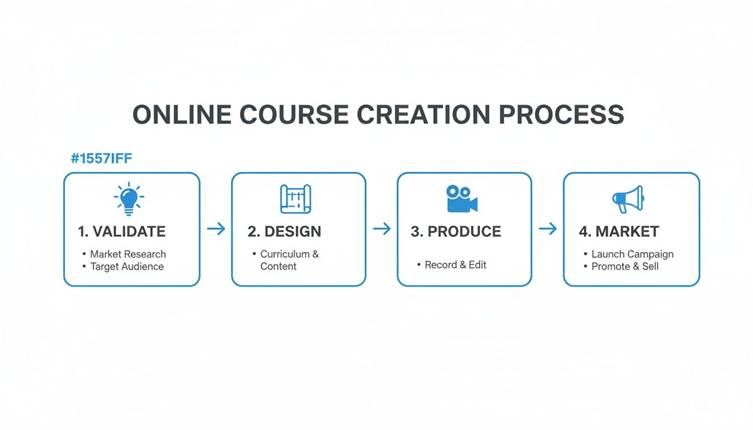
Notice how marketing isn’t just tacked on at the end? It’s a core part of the process that starts well before your course is even finished. That’s a pro tip right there.
To give you a bird's-eye view, here's how these phases fit together.
The Online Course Creation Lifecycle at a Glance
This table breaks down the essential phases of creating and selling your course, outlining the core objective and critical tasks for each stage.
Phase | Primary Objective | Key Actions |
Validate | Confirm market demand for your course idea before building it. | Market research, audience surveys, competitive analysis, pre-selling. |
Design | Create a structured and engaging learning path. | Outline curriculum, define learning outcomes, plan assessments, design content. |
Produce | Develop and record all your course materials. | Record videos, write text lessons, create quizzes, build downloadable resources. |
Market | Launch, sell, and deliver your course to the right audience. | Build a sales page, set pricing, run marketing campaigns, manage student onboarding. |
Following this lifecycle ensures you're building a product with your audience, not just for them.
Capitalizing on a Booming Market
The hunger for online learning is off the charts. Learners everywhere are looking for specialized skills, and they're willing to pay for quality instruction.
The secret to a profitable online course is simple: solve a specific problem for a specific audience. Your expertise is the solution they are actively searching for.
Take a look at the explosive growth in regional markets. In India, for example, the online education market is projected to rocket from USD 3.6 billion in 2025 to USD 23.9 billion by 2034. That’s a staggering growth rate of 23.28% annually.
This surge is driven by over 900 million internet users and massive smartphone adoption, making it easier than ever for people to learn on the go. You can find more insights about the Indian online education market and its potential online.
This journey is about building a sustainable business that genuinely helps people while giving you a scalable income stream. By following this roadmap, you’ll know exactly how to create and sell courses online the right way.
Finding and Validating Your Course Idea
Here’s the biggest mistake new course creators make: they spend months building a course based on what they think people want, only to launch to absolute silence.
A successful course isn’t born in a recording studio. It starts with an idea that solves a real, painful problem for a very specific group of people. If you want to create and sell courses online, you have to let the market guide you from day one. This means putting on your detective hat and doing some smart, low-cost market research.
Tune into Real Demand
Forget expensive surveys. Your future students are already online, talking about their frustrations, goals, and what’s holding them back. You just have to listen.
Spend time where your potential audience hangs out. This could be a Subreddit, a niche Facebook group, a professional community on LinkedIn, or an industry forum. Look for the patterns. What questions keep popping up? What are the common struggles? Phrases like "How do I..." or "I wish I knew how to..." are pure gold. These are your course ideas, served up on a platter.
Another great, and free, tool is Google Trends. You can use it to see what people are actively searching for. For instance, a financial advisor could compare search interest for "personal finance for freelancers" against "beginner's guide to stock investing." A clear trend or a sudden spike in search volume is a strong signal that you’re onto something.
The goal isn’t just to find a topic people are interested in. You need to find a problem they are actively trying—and willing to pay good money—to solve.
Think of this validation phase as your insurance policy. It stops you from wasting months of your life on a product nobody asked for.
Build Your Ideal Learner Persona
Once you’ve got a general topic, it’s time to get specific about who you’re teaching. Creating a learner persona is a simple but powerful exercise to understand your ideal student on a much deeper level.
Don’t just think about their age or location. Dig into what makes them tick.
What are their biggest pain points? For a course on freelance finance, this isn’t just "managing money." It's "inconsistent income makes budgeting impossible" or "I'm terrified of tax season."
What are their real goals? They might want to "finally save for a down payment" or simply "feel confident about their financial future for the first time."
What have they tried before that failed? Maybe they’ve downloaded confusing budgeting apps or read generic blog posts that just didn’t apply to their unique situation.
This persona becomes your North Star. Every lesson, every email, every sales page you write should speak directly to this one person's specific challenges and dreams.
The Power of a Minimum Viable Course
What's the ultimate way to know if your idea is a winner? Ask people to pay for it before you’ve built the whole thing.
This is the Minimum Viable Course (MVC) concept. Instead of disappearing for six months to create a 20-module masterpiece, you pre-sell a small, focused pilot workshop or a live webinar series. For example, you could offer a two-hour live workshop on "The Freelancer's Tax Survival Guide" for a fraction of the final course price.
This strategy is a game-changer.
It confirms paid demand. Getting pre-orders is the only validation that truly matters.
It generates cash flow. You can use this initial revenue to fund the production of the full course.
You get priceless feedback. Your first students will tell you exactly what they loved, what was confusing, and what else they need from you.
You collect your first testimonials. Social proof is everything when it comes time to launch the full-scale course.
This approach is incredibly relevant in a market like India's, where the professional online courses segment is set to explode. With a need to upskill over 400 million people by 2030, the demand for targeted, practical courses is off the charts. Pre-selling lets you tap into this demand fast. You can learn more about the Indian market for professional online courses to see just how big the opportunity is.
When you let the market build your course for you, you remove all the guesswork. You create something you know people are eager to buy. This groundwork is what separates a one-hit-wonder from a truly sustainable online education business. To get some inspiration, you can browse a variety of successful online course examples and see how other creators have built their offers.
Designing a Curriculum That Guarantees Results

Let’s be honest. The best online courses aren’t just a random collection of videos. They are carefully planned journeys designed to get results. A powerful curriculum is the absolute backbone of any course that promises a real transformation, turning students from passive viewers into active doers.
This is what separates a forgettable information dump from an experience that gets you glowing reviews and free word-of-mouth marketing. Your job is to guide students from point A (where they are now) to point B (where they want to be) as smoothly as possible. That means building a path that’s logical, engaging, and delivers small, tangible wins along the way.
Architecting Your Course with a Modular Approach
The fastest way to overwhelm a student is to throw a massive, complex topic at them all at once. The key is to break it all down into manageable, bite-sized pieces.
Think of your course not as one giant textbook, but as a series of interconnected modules. Each module then contains several short, focused lessons. This modular structure makes the entire learning process feel achievable. Instead of staring at a daunting list of 50 videos, your student sees a clear path through five or six key stages. Every completed module feels like a real accomplishment, building momentum that carries them all the way to the finish line.
For example, a graphic design instructor teaching a branding course wouldn’t just have one long module. They'd structure it something like this:
Module 1: Understanding Core Branding Principles
Module 2: Designing Your First Logo
Module 3: Choosing Your Colour Palette and Fonts
Module 4: Creating a Social Media Graphic Kit
Module 5: Building a Brand Style Guide
Each module is a significant milestone. To really nail this, you should explore proven instructional design best practices to build a curriculum that actually works.
Writing Powerful Learning Outcomes
Before you even think about recording a video or writing a lesson, you have to define what your students will be able to do after finishing each module. These are your learning outcomes—they are the promises you make to your students.
Good learning outcomes are specific and action-oriented. Stay away from vague statements like "Students will understand..." and use strong, active verbs instead.
A well-crafted learning outcome is a clear, measurable statement that articulates what a student should know, be able to do, or value as a result of a learning experience. It shifts the focus from what the instructor will teach to what the learner will achieve.
Here’s how you can turn a fuzzy goal into a powerful outcome for a logo design module:
Vague Goal: "Learn about logo design."
Powerful Outcome: "By the end of this module, you will be able to sketch three distinct logo concepts and use a design tool to create a professional vector version of your chosen idea."
See the difference? The second one gives students a crystal-clear vision of what they'll achieve, which is a huge motivator.
Enriching the Learning Experience
People learn in different ways. A course that is just a series of talking-head videos is guaranteed to leave some students behind. To create a truly sticky and engaging course, you need to mix things up and appeal to different learning styles.
Blending different types of content doesn't just keep things interesting; it reinforces key ideas through multiple angles, which dramatically improves how much your students remember and can apply.
Consider adding these elements into your modules:
Downloadable Checklists and Worksheets: These are tangible tools students can use immediately to put their new knowledge into practice.
Interactive Quizzes: Short, low-stakes quizzes are perfect for checking understanding and reinforcing the most important concepts.
Practical Assignments: Project-based tasks, like the ‘Designing Your First Logo’ example, are critical for moving students from theory to real-world application.
Peer-to-Peer Feedback: Creating a space for students to review each other's work builds a strong community and offers diverse perspectives.
When you build a curriculum that's structured, outcome-driven, and packed with varied content, you're not just selling information. You're creating an educational experience that delivers real, lasting value.
Producing Your Course and Protecting Your Content

With a solid curriculum mapped out, it's time to bring your course to life. This is where many creators freeze, picturing a Hollywood-style studio with intimidating cameras and lighting rigs. Let’s bust that myth right now.
You don’t need a massive budget to create polished, professional course materials. The goal is clarity and value, not a cinematic masterpiece. Your smartphone is more than capable of shooting excellent video, provided you get the lighting and audio right. You can always upgrade your gear later; don’t let a lack of equipment stop you from starting.
But getting your content recorded is only half the job. Once it exists, you have to protect it. Piracy is a real threat, and if your course videos are easily downloadable, they will be. This makes your choice of platform a critical business decision, not just a technical one.
Building Your Home Studio on a Budget
Creating professional-looking content is more about technique than expensive toys. A few smart investments in light and sound will give you a 90% better result than a pricey camera ever could on its own.
To make this practical, let's break down a few common setups for different budgets and needs. Most creators start at one level and gradually work their way up as their revenue grows.
Comparing Course Content Production Setups
Setup Level | Key Equipment | Pros | Cons |
The Starter | Smartphone, ring light, lavalier microphone | Extremely affordable and easy to set up. | Video quality can be limited in low light. |
The Prosumer | DSLR/Mirrorless camera, two softbox lights, USB microphone | High-quality video and audio, greater creative control. | Requires more technical knowledge and a larger budget. |
The Screencaster | Screen recording software (e.g., Loom, Camtasia), quality headset with microphone | Perfect for software tutorials and presentations. | Not ideal for building personal connection through face-to-camera video. |
One thing is non-negotiable, regardless of your setup: audio quality. Your students might forgive a slightly grainy video, but they will click away instantly if the audio is crackly, distant, or hard to understand. A simple clip-on lavalier microphone is probably the single best investment you can make for under ₹2,000.
Safeguarding Your Intellectual Property
You've poured countless hours of your expertise into creating this course. That's a serious investment. Protecting it is absolutely essential if you want to build a sustainable business. Just uploading your videos to an unsecured website is like leaving your shop doors wide open overnight.
This is where your platform's security features become your best friend. When you create and sell courses online, you need a system that actively defends your content from theft.
Think of content protection not as a barrier, but as a vault. It ensures that only paying, legitimate students can access the valuable transformation you've worked so hard to create.
Don’t settle for a platform without a multi-layered security approach. Look for these core features:
Digital Rights Management (DRM): This is the heavy lifter. DRM encrypts your video content, making it incredibly difficult for anyone to download or illegally share your files.
Dynamic Watermarking: A clever deterrent, this feature subtly overlays the viewer's user ID or email onto the video itself. If someone screen-records it, the leak can be traced directly back to their account.
Access Controls: This is the foundation. It simply ensures only enrolled students can view the course pages. Features like domain restrictions are also crucial, preventing others from embedding and playing your videos on unauthorized websites.
These aren't just buzzwords; they are fundamental tools for preserving the value and integrity of your work.
The Power of a White-Label Platform
Beyond security, the environment where your students learn has a huge psychological impact. A white-label platform lets you host your course on your own domain, with your own brand, colours, and logo.
Instead of sending students to a generic marketplace teeming with your competitors, you're inviting them into your own private academy. This simple shift instantly elevates the perceived value of your course. It feels more exclusive, more professional, and more trustworthy.
This tells your students they are enrolling in your world-class program, not just grabbing another course off a crowded digital shelf. It’s a subtle but powerful way to build brand authority and create loyal students who come back for more. You can find more great insights in these tips for creating a successful online course that truly stands apart.
Smart Strategies for Pricing and Marketing Your Course
So, you've built a high-value course and you're ready to go. Now for the exciting part—getting it into the hands of students who need it and turning all that hard work into a real business. To successfully create and sell courses online, you need a repeatable system for marketing and pricing that actually works.
This isn't about just posting on social media and hoping for the best. It’s about building genuine connections and proving your value long before you ever ask for a sale. A great launch starts months before you open the doors, focusing on an audience that trusts you and is genuinely excited to learn from you.
Building Buzz with a Pre-Launch Strategy
One of the most effective ways to secure sales on day one is by building a pre-launch email list. Think of this as your VIP group—people who have literally raised their hands and said, "Yes, I'm interested in what you're teaching."
Start with a simple landing page that gives a sneak peek of your upcoming course. You don't need a full-blown sales page yet. A compelling headline, a few bullet points about the transformation you're offering, and a sign-up form for the waitlist are all you need.
Once people are on that list, your job is to nurture that relationship. Send them valuable, exclusive content that gives them a taste of your teaching style. This could be a short email series, a behind-the-scenes look at you creating the course, or a free checklist. The goal is to build so much anticipation that when you finally open enrolment, they're ready and waiting to buy.
Using Lead Magnets to Build Trust
To grow that all-important email list, you need to offer something valuable in exchange for an email address. This is what we call a lead magnet. It’s a free piece of content that solves a small, specific problem for your ideal student.
A good lead magnet is the perfect entry point to your paid course.
Mini-Guide or eBook: If your course is on digital marketing, a free guide like "5 Steps to Writing High-Converting Ad Copy" is a perfect fit.
Webinar: Host a live training session that teaches one key concept from your course, then end with an invitation to join the full program.
Checklist or Template: A productivity coach could offer a downloadable "Ultimate Weekly Planning Template" to attract people desperate to get organized.
This approach builds immediate trust and positions you as an expert. By the time you launch, your audience already sees you as a credible source for solutions.
The most effective marketing feels like helping. When you generously share your expertise through free content, you attract an audience that is naturally aligned with your paid offerings.
Demystifying Course Pricing Models
Putting a price on your course can feel like a guessing game, but it doesn't have to be. The secret is to price based on the transformation you provide, not just the number of videos or hours of content. A course that helps someone land a new job or double their freelance income is worth far more than one teaching a casual hobby.
To make your course business profitable, it's essential to learn practical strategies on how to increase online sales. This means picking a pricing model that fits your business goals and your students' needs.
Consider these common structures:
One-Time Payment: This is the simplest model. Students pay a single fee for lifetime access. It’s straightforward and brings in immediate revenue.
Subscription or Membership: For ongoing content, community access, or regular updates, a recurring monthly or annual fee works brilliantly. This model creates predictable, stable revenue.
Tiered Packages: Offer different levels of access at different prices. A basic tier might be just the video lessons, while a premium tier could add group coaching calls, personal feedback, or exclusive templates.
For example, a yoga instructor could offer a premium package that includes weekly live Q&A sessions. That extra access and personalisation easily justifies a higher price point and appeals to students who want a more hands-on experience. If you're looking for more inspiration, exploring different online course pricing options can give you a clearer idea of what could work for your offer.
Ultimately, your marketing and pricing are two sides of the same coin. By building a pre-launch list, using lead magnets to establish your authority, and choosing a value-based pricing model, you create a powerful system that consistently attracts the right students and generates reliable income.
Scaling Your Business with Automation and Analytics
Making that first sale feels incredible. But the real goal is to build an education business that grows without burning you out. The secret isn’t working harder; it’s working smarter by using automation and data to scale your operations.
As more students enroll, the number of questions skyrockets. Answering the same things over and over is a massive time drain, pulling you away from creating new content or marketing what you already have. This is where the right tools are a complete game-changer.
Automate Student Support with AI
Imagine having a teaching assistant that works 24/7, answering student questions instantly and accurately using your own course material. That’s exactly what an AI Teaching Assistant does.
This isn't just about being efficient. It’s about creating a better learning experience. When a student gets stuck on a concept at 2 AM, they don’t have to wait until you’re online. They get an immediate, helpful answer that keeps them moving forward. This kind of instant support drastically improves student satisfaction and cuts down your support tickets, freeing you up to focus on what really matters.
Use Data to Improve and Refine
Your course platform’s analytics dashboard is a treasure trove of insights. To truly create and sell courses online for the long term, you have to get comfortable with your data. Don't be intimidated by the numbers; they're telling you the story of your students' experience.
Pay close attention to these key metrics:
Lesson Completion Rates: Which lessons are people flying through, and where are they dropping off? A sudden drop-off on a specific lesson is a huge red flag that the content might be too confusing, too long, or just plain boring.
Quiz Scores: Are students consistently getting the same questions wrong? That’s a clear sign you need to explain that topic better in the course.
Student Engagement: Are people actually using the discussion forums or community features? If not, you might need to actively prompt more interaction.
Your analytics aren't just statistics; they are direct, unfiltered feedback from your students. Use this data to spot weaknesses in your course, sharpen your marketing, and decide what to build next.
By checking in on these numbers regularly, you can stop guessing what needs fixing and start knowing where to put your energy.
Build a Community of Advocates
The final piece of the scaling puzzle is turning your happy students into your best marketing team. A vibrant community keeps learners engaged long after they’ve finished the last video.
Use built-in features like certificates of completion. They give students a real sense of achievement they can proudly share on places like LinkedIn, which is fantastic social proof for your course.
Even better, create a dedicated community space where graduates can connect, share their wins, and help out new students. An active community doesn’t just add value to your course—it creates a loyal following that will sing your praises and drive organic growth for years to come.
Frequently Asked Questions
Jumping into the world of online courses always brings up a few questions. We get it. Here are some straightforward answers to the things we hear most often from creators just like you.
How Long Does It Take to Create an Online Course?
Honestly, it varies wildly. You could probably knock out a simple mini-course in 25 to 50 hours. On the other hand, a detailed, multi-module flagship program with high production value could easily soak up 200 hours or more.
The real goal isn't just speed; it's efficiency. The single best way to streamline the work is to create a detailed curriculum outline before you hit record. We always recommend starting small. Launch a pilot course first to test your idea and your workflow before committing to a massive program.
Do I Need to Be a Tech Expert to Sell Courses?
Absolutely not. That’s a common myth.
Modern all-in-one platforms are built for creators and educators, not developers. They handle the tricky stuff—video hosting, payment gateways, and even website building—with simple drag-and-drop tools.
If you can send an email or post on social media, you have all the technical skills you need to get started. The technology is designed to get out of your way.
Your expertise is the product; the platform is just the delivery vehicle. Focus on creating high-quality content, and let the tools handle the technical heavy lifting for you.
What Is the Realistic Income Potential for Selling Courses?
Your earnings can be anything from a nice side income to a seven-figure business. What makes the difference? It really boils down to your niche, the size of your audience, your pricing, and—most importantly—your marketing.
A great way to set a realistic goal is to work backwards. Let's say you want to earn ₹4,00,000 a month and your course is priced at ₹20,000. That means you only need 20 enrolments. Thinking this way turns a big, scary income goal into a clear, achievable marketing target.
At the end of the day, consistent income comes from delivering real value and connecting with the right people who need what you know.
Ready to turn your expertise into a thriving online academy? With Skolasti, you get all the tools you need—from a secure, white-label platform and an AI Teaching Assistant to robust analytics and marketing integrations. Start building your course with Skolasti today.