How to Create Online Courses That Actually Sell
How to Create Online Courses That Actually Sell
How to Create Online Courses That Actually Sell
Feb 10, 2026
Feb 10, 2026
Feb 10, 2026

Before you even think about hitting record on a single video, you need to answer one question: will people actually pay for this?
This is the single biggest mistake I see aspiring creators make. They pour weeks, sometimes months, into building a course based on a passion, only to launch to the sound of crickets. The secret isn't a fancier camera or a slicker website; it’s about validating your idea first. You have to make sure there's real, tangible market demand before you build a single thing.
Validating Your Course Idea Before You Build
Jumping straight into course creation is a gamble you can't afford to take. The whole point isn’t just to share what you know; it’s to solve a painful, urgent problem for a specific group of people. Getting this foundation right means you’ll have buyers lined up from day one, instead of a passion project gathering digital dust.
The opportunity here is massive. Just look at the online learning market in India, which is expected to explode from USD 3.6 billion in 2025 to a staggering USD 23.9 billion by 2034. This boom is fuelled by cheap data and smartphones, turning every mobile into a potential classroom. For independent coaches, fitness pros, and tutors, this means a huge, hungry audience is waiting for courses that teach practical skills. You can dig into the market data over at imarcgroup.com.
Pinpoint an Urgent Problem
A great course idea doesn't start with what you're excited to teach. It starts with what your audience is desperate to solve. Your course needs to be a direct solution to a real pain point.
Don't think in broad strokes like "I'll teach digital marketing." Get specific. Think about problems like "how a local bakery owner can get their first 100 online orders using Instagram ads."
To find these problems, you need to become a detective in the communities where your ideal students already hang out.
Read Competitor Reviews: Forget the 5-star raves. Go straight to the 3-star reviews for existing courses in your niche. What are people complaining about? What do they say is missing? That’s your content gap, right there.
Lurk in Online Forums: Places like Reddit, Quora, and niche Facebook groups are goldmines. People aren't shy about sharing their frustrations. Pay close attention to the questions that pop up again and again and the exact words they use to describe their struggles.
Run Simple Polls: Use Instagram Stories, LinkedIn polls, or a quick email to your list. A yoga instructor could ask, "What's your #1 struggle with practicing at home?" with options like "A) No motivation," "B) I don't have space," or "C) Afraid of getting hurt."
This isn't about stealing ideas. It's about listening to the market's unmet needs. You’re looking for the patterns that scream "people will pay to solve this!"
Before you go all-in on your course idea, it's wise to run it through a simple validation checklist. This helps you move from "I think this is a good idea" to "I have evidence this is a good idea."
Course Idea Validation Checklist
Use this checklist to assess the viability and potential profitability of your online course idea before you start creating content.
Validation Checkpoint | Yes/No | Actionable Insight |
Is there a specific, identifiable audience? | If no, define who your "ideal student" is. Vague audiences get vague results. | |
Does the course solve an urgent, high-value problem? | If no, reframe your idea. People pay for solutions, not just information. | |
Are people already paying for solutions to this problem? | If no, this is a major red flag. Lack of competition can mean a lack of market. | |
Can you easily find this audience online? | If no, your marketing will be incredibly difficult and expensive. Find their hangouts. | |
Do you have credible expertise in this area? | If no, consider partnering with an expert or choosing a topic you can own. | |
Is the promised outcome clear and desirable? | If no, you need to define your learning outcomes. What will they be able to do? |
This isn't a pass/fail test, but a tool for clarity. If you're hitting "No" on multiple points, it's a sign you need to go back to the drawing board—and that's a good thing! It saves you from building something nobody wants to buy.
Crafting Clear Learning Outcomes
Once you’ve locked onto a problem, you need to promise a specific solution. That's where learning outcomes come in. These are the tangible, measurable results your students will walk away with after completing your course.
Learning outcomes are more than just a course outline; they are your marketing promises. They shift the focus from what you will teach to what your student will be able to do.
Forget vague promises like "Learn about social media." A powerful learning outcome sounds like this: "By the end of this course, you will be able to confidently create and schedule a one-month content calendar for Instagram that attracts your ideal client." See the difference?
These outcomes are the very skeleton of your curriculum. Every single video, worksheet, and quiz you create must serve one of these promises. They give your students a clear picture of the transformation they're buying, and they give you a focused roadmap for creating your content. When a potential student reads those outcomes, they should feel a sense of "Yes, that's exactly what I need!" That clarity is what turns a curious browser into a paying customer.
Designing a Truly Engaging Learning Experience
Once your course idea is validated, you get to switch hats from marketer to architect. This is where the real magic happens. A great online course is never just an information dump; it’s a carefully built journey that takes your students from where they are to where they want to be, keeping them hooked every step of the way.
Trust me, overwhelming students with a mountain of content right at the start is the fastest way to see them disappear.
The key is to break down your expertise into a logical, easy-to-digest format. Think about organising your knowledge into modules that build on each other, then slicing those modules into bite-sized lessons. Every single piece of content—a video, a worksheet, a quiz—needs a clear purpose that ties directly back to the learning outcomes you defined earlier. This simple rule ensures your students always feel like they're making progress.
This flowchart maps out the validation process we just covered, which is the essential foundation before you even think about building the learning journey.
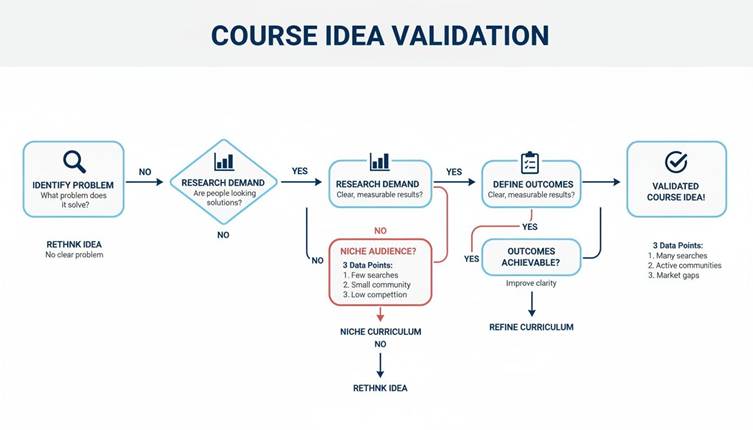
This visual just reinforces that an amazing learning experience starts long before you hit record—it begins with a deep, genuine understanding of your student’s problem.
Structuring Your Course Content
Your course structure is the skeleton that holds everything together. From my experience, one of the most effective and straightforward models is the Module-Lesson-Activity framework.
Here’s how it works:
Modules: Think of these as the main chapters of your course. Each module should tackle a high-level topic or a major milestone in your student's transformation. For a course like "Beginner's Yoga at Home," a module might be "Mastering Foundational Poses."
Lessons: Inside each module, you'll have several lessons. These are your specific, focused teaching moments, ideally kept between 5-15 minutes long. A lesson within our yoga module could be "The Correct Form for Downward-Facing Dog."
Activities: This is crucial. Every lesson should be backed up by a practical activity. It could be a simple quiz, a downloadable worksheet, a hands-on exercise, or a prompt for a discussion forum. This is how you shift students from just passively watching to actively learning.
For a deeper dive into the practical side of building your course, checking out guides on how to use software to create e-learning courses step by step can give you some great technical pointers. This layered approach stops students from feeling overwhelmed and gives them a clear sense of achievement as they tick off each part.
Choosing Your Delivery Model
How your students get your course is just as important as what's in it. You have three main options, and each one serves a different purpose.
To help you decide, let's compare the three primary models for delivering an online course. This choice will shape everything from student engagement to your own workload.
Delivery Model Comparison: Self-Paced vs. Cohort-Based vs. Blended
Feature | Self-Paced | Cohort-Based | Blended |
Pacing | Student-led, flexible schedule | Instructor-led, fixed schedule | Mix of self-paced and scheduled live sessions |
Community | Lower (often via forums) | High (live sessions, group projects) | Medium (combines both elements) |
Scalability | High (enrol anytime) | Medium (limited by cohort size) | High (core content is evergreen) |
Creator Effort | High upfront, low ongoing | High during the cohort | Balanced effort |
Choosing the right model is about matching your content and audience needs with the right format. The goal isn't to pick the "best" one, but the best one for you.
A self-paced model offers maximum flexibility and scalability, making it a dream for evergreen topics. On the flip side, a cohort-based model creates incredible community and accountability—perfect for high-ticket, transformative programmes where that peer support is a huge part of the value.
So, what's the right call? It really depends. A technical skills course might work perfectly in a self-paced format. But a leadership coaching programme would absolutely thrive on the live interaction of a cohort.
The blended model offers a powerful middle ground, giving you the best of both worlds: scalable, pre-recorded content combined with high-touch community moments. Your job is to pick the model that best delivers the transformation you promised your students. For more practical tips on this, check out these additional online course creation ideas.
Choosing the Right Platform to Host Your Course
You’ve poured your heart and soul into designing a fantastic learning experience. Now for the next big decision: where will your course live? This isn't just a technical question. The platform you choose shapes your brand, your students' experience, and, let's be honest, your bank account.
Think of it like this: are you renting a stall in a crowded, noisy market, or are you building your own boutique shop? Both can work, but only one gives you total control over your business's future.
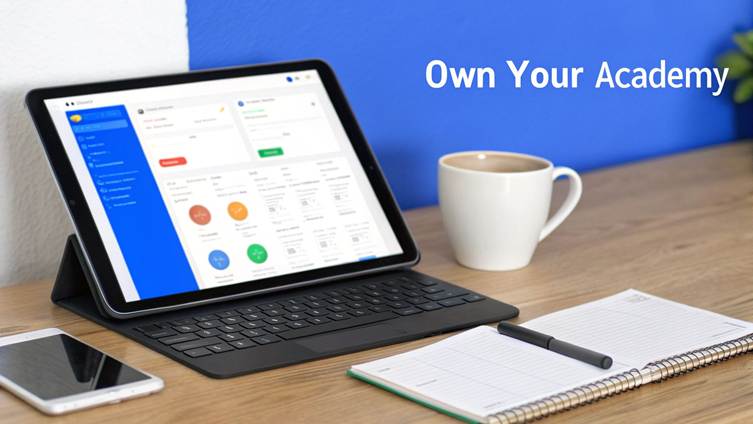
This section will give you a clear framework for picking a platform that doesn’t just host your content but helps you grow from a single course into a full-fledged online academy.
Marketplaces Versus White-Label Platforms
One of the first decisions you'll face is whether to use a course marketplace or a white-label platform.
Marketplaces are tempting. They list your course alongside thousands of others and promise access to their massive audience. The catch? They often take a huge cut of your revenue, and your brand gets lost in a sea of competitors. You become just another instructor on someone else's website.
A white-label platform, on the other hand, is your own branded academy. It’s your domain, your logo, your colours, and your rules. You’re not just renting space; you’re building an asset. You're building your own online school where you control the entire student journey.
This approach immediately positions you as a genuine authority in your field. More importantly, it lets you build a direct relationship with your audience—the key to long-term growth and selling more courses down the line.
Core Features You Cannot Compromise On
When you start comparing platforms, the feature lists can feel endless. To cut through the noise, focus on the absolute non-negotiables that directly impact your brand, your security, and your students' success.
Here’s what you absolutely must have:
Custom Branding: Your platform needs to be a blank slate. You should be able to upload your logo, set your own colour schemes, and use your own domain name. Anything less dilutes your brand.
Secure Payment Gateways: This is a big one. Make sure the platform integrates with trusted payment processors. It gives your students a secure checkout experience and gives you peace of mind.
Flexible Delivery Options: The technology should never dictate your teaching style. Whether you're running a self-paced course, a live cohort, or a blended model, your platform must support it seamlessly.
Intellectual Property Protection: Your course content is your most valuable asset. Look for features like dynamic watermarking, secure content delivery, and domain restrictions. These are critical for preventing piracy.
Choosing a platform is a long-term business decision. Prioritise a solution that lets you own your brand, your student data, and your revenue. This is the foundation that allows you to scale without headaches later.
Skimping on these core features will only create massive problems down the road, likely forcing a painful migration just as your business starts to take off. If you want to see how these elements come together in a real-world setup, you can explore the features of a modern academy platform to get a better idea.
Game-Changing Tools for Modern Creators
Beyond the basics, the best platforms today offer powerful tools that can set you apart and save you a mind-boggling amount of time. The most impactful innovation right now is the integrated AI Teaching Assistant.
Imagine having a support system that can instantly answer 80% of student questions, 24/7, based entirely on your course content. An AI assistant can handle all the common queries, like "Where's the worksheet for Module 2?" or "Can you explain that concept one more time?"
This frees you from the endless grind of repetitive support emails. Instead, you can focus on what actually grows your business: creating new content and marketing your courses.
This kind of smart support doesn't just lighten your workload; it dramatically improves the student experience. Learners get instant answers without waiting for you to reply, keeping them engaged and moving forward. It’s a tool that helps you teach smarter, not just harder—a key differentiator for today's most successful course creators.
Driving Student Completion and Building Community
Getting someone to sign up for your course is the starting line, not the finish. Let’s be honest, the real value—and the glowing testimonials that will fuel future sales—comes from seeing them through to the end.
Your success as an educator is measured by your students' success. This is where you shift from being a content creator to a community builder, turning passive viewers into an active group of accomplished learners.

A lot of creators think their job is done once the last video is uploaded. That’s a huge mistake. Without engagement, dropout rates soar. The secret is to build a supportive and interactive environment that keeps learners motivated from the first lesson right up to that final certificate.
Foster a Vibrant Learning Community
Online learning can feel isolating, and that loneliness is a major reason students lose momentum. Building a community isn't just a nice-to-have; it's a powerful tool for boosting completion rates. When students feel connected to you and their peers, they are far more likely to stick around.
An integrated discussion forum or a private members' area is the perfect place to start. You can get the ball rolling with simple tactics:
Welcome Prompts: Kick off a thread asking new students to introduce themselves and share what they’re most excited to learn.
Weekly Challenges: Post small, relevant challenges or questions tied to the week's content to get people talking.
Peer Feedback: Create a space where students can share their work and get constructive feedback from each other.
This turns a solo activity into a shared journey. It creates a hub where learners can ask questions, celebrate wins, and get support when they feel stuck, which dramatically improves the experience and makes your course feel infinitely more valuable.
Keep Students Motivated with Gamification
A little friendly competition and a visible sense of progress can work wonders. Gamification is just a fancy word for adding game-like elements to your course, and it’s a brilliant way to encourage consistent engagement.
You don't need to build a complex video game. Simple, effective gamification can include:
Points: Award points for completing lessons, passing quizzes, or participating in discussions.
Badges: Create cool digital badges that students unlock for hitting milestones, like finishing their first module or mastering a tough concept.
Leaderboards: A simple leaderboard can spark some healthy competition and motivate students to keep up.
These elements provide that hit of instant positive feedback and a clear visual of how far they've come, which is incredibly satisfying for any learner.
The most successful online courses are not just information products; they are supportive ecosystems. By building community and using engagement tools, you are directly investing in your students' results, which is the most powerful marketing asset you can have.
This focus on student outcomes is what separates a good course from a great one.
The Power of an AI Coach
Even with a strong community, students will have questions at all hours. Answering every single one yourself just isn't scalable, especially as your academy grows. This is where an AI Coach or Teaching Assistant becomes an absolute game-changer.
Imagine a tool that can instantly answer 80% of common student questions, pulling information directly from your course content. If a student is confused about a concept from Module 3 or can't find a worksheet, the AI provides an immediate, accurate answer in your teaching style. This stops students from getting stuck and losing motivation while waiting for you to reply.
This immediate support is invaluable. It frees you up from repetitive tasks, so you can focus on high-impact activities like creating new content or engaging with students on a deeper level in the community forums.
Finally, never underestimate the power of a professional certificate. Issuing a branded certificate upon completion gives your graduates a tangible accomplishment they can proudly share on platforms like LinkedIn. This not only validates their hard work but also turns them into your best marketers, showcasing the value of your course to their entire network.
Pricing and Marketing Your Online Course for Launch
You've poured your expertise and hard work into creating a fantastic learning experience. That was the creator phase. Now, it's time to put on your entrepreneur hat and make sure your course actually reaches the people who need it.
This final part of the roadmap is all about the business side of things. We'll walk through how to price your course, build a marketing plan that works, and analyse your launch so you can keep growing.
Getting your pricing and launch right is just as critical as the quality of your content. A smart plan doesn't just help you recoup your investment of time and energy; it builds a sustainable business that can thrive for years to come.
Finding Your Pricing Sweet Spot
Pricing an online course can feel like a shot in the dark, but it really shouldn't be. Your price is a direct signal of the value and the transformation you're promising.
So many creators make the classic mistake of underpricing their work to get more buyers. This almost always backfires—it devalues your expertise and tends to attract students who aren't fully committed.
Instead, let's look at a few proven models to find the right fit.
One-Time Fee: This is the simplest approach. A student pays once for lifetime access. It’s clean, straightforward, and works perfectly for foundational courses that teach a specific, evergreen skill.
Payment Plan: This isn't a different model, but an extension of the one-time fee. You break the total cost into smaller monthly instalments. This makes higher-priced courses feel much more accessible, significantly lowering the barrier for students who can't pay a large sum upfront.
Subscription or Membership: Here, students pay a recurring monthly or annual fee. This is ideal for topics that are constantly evolving or if you plan to add new content regularly. It also builds a predictable revenue stream.
A hugely effective strategy is to offer a one-time fee right alongside a payment plan. For example, a ₹10,000 course could be offered as a single payment or as three monthly payments of ₹3,500. This makes your premium offer feel achievable for a much wider audience.
When you’re ready to implement these, you can explore the different payment models for your online course and see which structure really supports your business goals. The key takeaway? Price based on the outcome you deliver, not the number of videos you made.
Building Your Pre-Launch Marketing Plan
A successful launch never starts on launch day. It begins weeks, sometimes even months, in advance by building excitement and warming up your audience. Just posting on social media and hoping for the best is a recipe for disappointment. You need a real strategy.
Your email list is your single most powerful marketing asset. It’s a direct line to your most interested potential students. To get this right, you need to understand how to build an ultimate email marketing funnel for coaches and educators. This is where you’ll share valuable freebies, behind-the-scenes content, and build a relationship based on trust.
Here's a simple pre-launch checklist to start building momentum:
Create a Waitlist: Before anything else, set up a simple landing page announcing your course. Invite people to join a waitlist to get exclusive updates and, most importantly, a special launch offer.
Offer an Early-Bird Discount: Your waitlist and most loyal followers deserve a reward. Plan a limited-time early-bird price (like 20% off for the first 48 hours) just for them. This creates genuine urgency and drives those critical first sales.
Host a Pre-Launch Webinar: A free live workshop is a fantastic way to deliver immense value, show off your teaching style, and then pitch your course directly to a highly engaged audience.
This structured approach turns a hopeful guess into a predictable, successful event.
Analysing Your Success for Future Growth
The work isn’t over when the launch window closes. The data you gather during and after your launch is a goldmine for making your next one even better. This is what separates a course creator from a savvy business owner.
Don't get overwhelmed by vanity metrics. Just focus on a few key performance indicators (KPIs) that tell you the real story of your business.
Metric | What It Tells You | Action to Take |
Conversion Rate | The percentage of sales page visitors who actually buy. | If it's low, you might need to tweak your sales copy, pricing, or checkout flow. |
Student Progress | How far students are actually getting in your course. | If everyone drops off at Module 3, that content probably needs to be clarified or improved. |
Refund Rate | The percentage of students asking for their money back. | A high rate might signal a mismatch between what your marketing promised and what the course delivers. |
Watching these numbers helps you make smart, informed decisions. You can refine your marketing, improve your course based on real student behaviour, and plan your next launch with more confidence. This feedback loop is the engine of sustainable growth.
Got questions? You're not alone. When you're diving into creating an online course, a few common queries always pop up. Let's tackle them head-on with some straight-to-the-point answers.
How Much Does It Cost to Create an Online Course?
Honestly, this can range from almost nothing to a small fortune, but you definitely don't need a huge budget to get started. You can be incredibly resourceful.
Your main costs will fall into a few buckets:
Content Creation: This could be zero if you use your smartphone. Modern phone cameras are more than good enough. The first real investment should be a decent microphone (around ₹2,000 - ₹5,000) because bad audio is a deal-breaker. Simple video editing software is often free or low-cost.
Platform Hosting: This is where your course will live. Some platforms charge a monthly fee, while others take a cut of your sales. You need to decide which model works for you.
Marketing: You can start for free by tapping into your social media followers or an email list if you have one. Later on, you might decide to put some money into paid ads.
Bottom line? You can absolutely launch a high-quality course for under ₹10,000. It's all about being clever with the tools you already have.
How Long Does It Take to Create a Course?
This really depends on how deep you want to go. A quick, focused mini-course could be done in a couple of weekends. A full-blown flagship programme? That could take a few months.
A realistic timeline for a standard course with about 3-5 hours of video content usually breaks down like this:
Research and Outlining: 1-2 weeks
Content Creation (Filming/Writing): 2-4 weeks
Editing and Production: 1-2 weeks
Platform Setup and Launch Prep: 1 week
All in, you're probably looking at 4 to 8 weeks. Just remember, your first course will always feel like the longest.
The secret is to break the entire process into small, manageable chunks. Focus on just getting the next task done, not on creating the perfect masterpiece all at once. Progress over perfection.
Is Creating an Online Course Profitable?
Yes, absolutely. The online education market is massive, and there's a huge opportunity for experts in pretty much any niche you can think of.
But profitability isn't guaranteed. It comes down to a few key things: real demand for your topic, smart pricing, the size of your audience, and how well you market it. Some creators make a nice side income, while many others have built six and even seven-figure businesses.
The best part is the scalability. You build the asset once, and it can keep making money for years with very little extra work. The trick is to treat it like a real business from day one—validate your idea and make sure you're solving a real problem for people.
Starting an online course business can feel overwhelming, but having the right partner makes all the difference. Here are some of the most common questions we get from new creators, answered directly to help you move forward.
Common Questions About Creating Online Courses
Question | Answer |
Do I need to be a "tech expert" to create a course? | Not at all. Modern course platforms are designed for non-technical users. If you can use email and social media, you can build and launch a course. |
What's more important: video quality or audio quality? | Audio, without a doubt. People will forgive slightly blurry video, but they won't tolerate crackling, hard-to-hear audio. Invest in a good microphone first. |
How do I know what to charge for my course? | Start by researching what similar courses in your niche are charging. Price based on the value and transformation you provide, not just the length of the content. |
Should I presell my course before I create it? | It's a great strategy. Preselling validates that people actually want to buy your course before you spend months creating it. It also generates initial revenue and builds momentum. |
How do I protect my course content from being copied? | Choose a platform with built-in content protection and DRM features. While no system is 100% foolproof, these measures make it much harder for your content to be pirated. |
Hopefully, these answers clear up some of the big questions and give you the confidence to get started.
Ready to build a business around your expertise? Skolasti gives you everything you need to create, market, and sell your online courses under your own brand. With our AI Teaching Assistant and robust content protection, you can focus on what you do best—teaching. Start your free trial today and launch your online academy at https://www.skolasti.com.
Before you even think about hitting record on a single video, you need to answer one question: will people actually pay for this?
This is the single biggest mistake I see aspiring creators make. They pour weeks, sometimes months, into building a course based on a passion, only to launch to the sound of crickets. The secret isn't a fancier camera or a slicker website; it’s about validating your idea first. You have to make sure there's real, tangible market demand before you build a single thing.
Validating Your Course Idea Before You Build
Jumping straight into course creation is a gamble you can't afford to take. The whole point isn’t just to share what you know; it’s to solve a painful, urgent problem for a specific group of people. Getting this foundation right means you’ll have buyers lined up from day one, instead of a passion project gathering digital dust.
The opportunity here is massive. Just look at the online learning market in India, which is expected to explode from USD 3.6 billion in 2025 to a staggering USD 23.9 billion by 2034. This boom is fuelled by cheap data and smartphones, turning every mobile into a potential classroom. For independent coaches, fitness pros, and tutors, this means a huge, hungry audience is waiting for courses that teach practical skills. You can dig into the market data over at imarcgroup.com.
Pinpoint an Urgent Problem
A great course idea doesn't start with what you're excited to teach. It starts with what your audience is desperate to solve. Your course needs to be a direct solution to a real pain point.
Don't think in broad strokes like "I'll teach digital marketing." Get specific. Think about problems like "how a local bakery owner can get their first 100 online orders using Instagram ads."
To find these problems, you need to become a detective in the communities where your ideal students already hang out.
Read Competitor Reviews: Forget the 5-star raves. Go straight to the 3-star reviews for existing courses in your niche. What are people complaining about? What do they say is missing? That’s your content gap, right there.
Lurk in Online Forums: Places like Reddit, Quora, and niche Facebook groups are goldmines. People aren't shy about sharing their frustrations. Pay close attention to the questions that pop up again and again and the exact words they use to describe their struggles.
Run Simple Polls: Use Instagram Stories, LinkedIn polls, or a quick email to your list. A yoga instructor could ask, "What's your #1 struggle with practicing at home?" with options like "A) No motivation," "B) I don't have space," or "C) Afraid of getting hurt."
This isn't about stealing ideas. It's about listening to the market's unmet needs. You’re looking for the patterns that scream "people will pay to solve this!"
Before you go all-in on your course idea, it's wise to run it through a simple validation checklist. This helps you move from "I think this is a good idea" to "I have evidence this is a good idea."
Course Idea Validation Checklist
Use this checklist to assess the viability and potential profitability of your online course idea before you start creating content.
Validation Checkpoint | Yes/No | Actionable Insight |
Is there a specific, identifiable audience? | If no, define who your "ideal student" is. Vague audiences get vague results. | |
Does the course solve an urgent, high-value problem? | If no, reframe your idea. People pay for solutions, not just information. | |
Are people already paying for solutions to this problem? | If no, this is a major red flag. Lack of competition can mean a lack of market. | |
Can you easily find this audience online? | If no, your marketing will be incredibly difficult and expensive. Find their hangouts. | |
Do you have credible expertise in this area? | If no, consider partnering with an expert or choosing a topic you can own. | |
Is the promised outcome clear and desirable? | If no, you need to define your learning outcomes. What will they be able to do? |
This isn't a pass/fail test, but a tool for clarity. If you're hitting "No" on multiple points, it's a sign you need to go back to the drawing board—and that's a good thing! It saves you from building something nobody wants to buy.
Crafting Clear Learning Outcomes
Once you’ve locked onto a problem, you need to promise a specific solution. That's where learning outcomes come in. These are the tangible, measurable results your students will walk away with after completing your course.
Learning outcomes are more than just a course outline; they are your marketing promises. They shift the focus from what you will teach to what your student will be able to do.
Forget vague promises like "Learn about social media." A powerful learning outcome sounds like this: "By the end of this course, you will be able to confidently create and schedule a one-month content calendar for Instagram that attracts your ideal client." See the difference?
These outcomes are the very skeleton of your curriculum. Every single video, worksheet, and quiz you create must serve one of these promises. They give your students a clear picture of the transformation they're buying, and they give you a focused roadmap for creating your content. When a potential student reads those outcomes, they should feel a sense of "Yes, that's exactly what I need!" That clarity is what turns a curious browser into a paying customer.
Designing a Truly Engaging Learning Experience
Once your course idea is validated, you get to switch hats from marketer to architect. This is where the real magic happens. A great online course is never just an information dump; it’s a carefully built journey that takes your students from where they are to where they want to be, keeping them hooked every step of the way.
Trust me, overwhelming students with a mountain of content right at the start is the fastest way to see them disappear.
The key is to break down your expertise into a logical, easy-to-digest format. Think about organising your knowledge into modules that build on each other, then slicing those modules into bite-sized lessons. Every single piece of content—a video, a worksheet, a quiz—needs a clear purpose that ties directly back to the learning outcomes you defined earlier. This simple rule ensures your students always feel like they're making progress.
This flowchart maps out the validation process we just covered, which is the essential foundation before you even think about building the learning journey.
This visual just reinforces that an amazing learning experience starts long before you hit record—it begins with a deep, genuine understanding of your student’s problem.
Structuring Your Course Content
Your course structure is the skeleton that holds everything together. From my experience, one of the most effective and straightforward models is the Module-Lesson-Activity framework.
Here’s how it works:
Modules: Think of these as the main chapters of your course. Each module should tackle a high-level topic or a major milestone in your student's transformation. For a course like "Beginner's Yoga at Home," a module might be "Mastering Foundational Poses."
Lessons: Inside each module, you'll have several lessons. These are your specific, focused teaching moments, ideally kept between 5-15 minutes long. A lesson within our yoga module could be "The Correct Form for Downward-Facing Dog."
Activities: This is crucial. Every lesson should be backed up by a practical activity. It could be a simple quiz, a downloadable worksheet, a hands-on exercise, or a prompt for a discussion forum. This is how you shift students from just passively watching to actively learning.
For a deeper dive into the practical side of building your course, checking out guides on how to use software to create e-learning courses step by step can give you some great technical pointers. This layered approach stops students from feeling overwhelmed and gives them a clear sense of achievement as they tick off each part.
Choosing Your Delivery Model
How your students get your course is just as important as what's in it. You have three main options, and each one serves a different purpose.
To help you decide, let's compare the three primary models for delivering an online course. This choice will shape everything from student engagement to your own workload.
Delivery Model Comparison: Self-Paced vs. Cohort-Based vs. Blended
Feature | Self-Paced | Cohort-Based | Blended |
Pacing | Student-led, flexible schedule | Instructor-led, fixed schedule | Mix of self-paced and scheduled live sessions |
Community | Lower (often via forums) | High (live sessions, group projects) | Medium (combines both elements) |
Scalability | High (enrol anytime) | Medium (limited by cohort size) | High (core content is evergreen) |
Creator Effort | High upfront, low ongoing | High during the cohort | Balanced effort |
Choosing the right model is about matching your content and audience needs with the right format. The goal isn't to pick the "best" one, but the best one for you.
A self-paced model offers maximum flexibility and scalability, making it a dream for evergreen topics. On the flip side, a cohort-based model creates incredible community and accountability—perfect for high-ticket, transformative programmes where that peer support is a huge part of the value.
So, what's the right call? It really depends. A technical skills course might work perfectly in a self-paced format. But a leadership coaching programme would absolutely thrive on the live interaction of a cohort.
The blended model offers a powerful middle ground, giving you the best of both worlds: scalable, pre-recorded content combined with high-touch community moments. Your job is to pick the model that best delivers the transformation you promised your students. For more practical tips on this, check out these additional online course creation ideas.
Choosing the Right Platform to Host Your Course
You’ve poured your heart and soul into designing a fantastic learning experience. Now for the next big decision: where will your course live? This isn't just a technical question. The platform you choose shapes your brand, your students' experience, and, let's be honest, your bank account.
Think of it like this: are you renting a stall in a crowded, noisy market, or are you building your own boutique shop? Both can work, but only one gives you total control over your business's future.
This section will give you a clear framework for picking a platform that doesn’t just host your content, but helps you grow from a single course into a full-fledged online academy.
Marketplaces Versus White-Label Platforms
One of the first decisions you'll face is whether to use a course marketplace or a white-label platform.
Marketplaces are tempting. They list your course alongside thousands of others and promise access to their massive audience. The catch? They often take a huge cut of your revenue, and your brand gets lost in a sea of competitors. You become just another instructor on someone else's website.
A white-label platform, on the other hand, is your own branded academy. It’s your domain, your logo, your colours, and your rules. You’re not just renting space; you’re building an asset. You're building your own online school where you control the entire student journey.
This approach immediately positions you as a genuine authority in your field. More importantly, it lets you build a direct relationship with your audience—the key to long-term growth and selling more courses down the line.
Core Features You Cannot Compromise On
When you start comparing platforms, the feature lists can feel endless. To cut through the noise, focus on the absolute non-negotiables that directly impact your brand, your security, and your students' success.
Here’s what you absolutely must have:
Custom Branding: Your platform needs to be a blank slate. You should be able to upload your logo, set your own colour schemes, and use your own domain name. Anything less dilutes your brand.
Secure Payment Gateways: This is a big one. Make sure the platform integrates with trusted payment processors. It gives your students a secure checkout experience and gives you peace of mind.
Flexible Delivery Options: The technology should never dictate your teaching style. Whether you're running a self-paced course, a live cohort, or a blended model, your platform must support it seamlessly.
Intellectual Property Protection: Your course content is your most valuable asset. Look for features like dynamic watermarking, secure content delivery, and domain restrictions. These are critical for preventing piracy.
Choosing a platform is a long-term business decision. Prioritise a solution that lets you own your brand, your student data, and your revenue. This is the foundation that allows you to scale without headaches later.
Skimping on these core features will only create massive problems down the road, likely forcing a painful migration just as your business starts to take off. If you want to see how these elements come together in a real-world setup, you can explore the features of a modern academy platform to get a better idea.
Game-Changing Tools for Modern Creators
Beyond the basics, the best platforms today offer powerful tools that can set you apart and save you a mind-boggling amount of time. The most impactful innovation right now is the integrated AI Teaching Assistant.
Imagine having a support system that can instantly answer 80% of student questions, 24/7, based entirely on your course content. An AI assistant can handle all the common queries, like "Where's the worksheet for Module 2?" or "Can you explain that concept one more time?"
This frees you from the endless grind of repetitive support emails. Instead, you can focus on what actually grows your business: creating new content and marketing your courses.
This kind of smart support doesn't just lighten your workload; it dramatically improves the student experience. Learners get instant answers without waiting for you to reply, keeping them engaged and moving forward. It’s a tool that helps you teach smarter, not just harder—a key differentiator for today's most successful course creators.
Driving Student Completion and Building Community
Getting someone to sign up for your course is the starting line, not the finish. Let’s be honest, the real value—and the glowing testimonials that will fuel future sales—comes from seeing them through to the end.
Your success as an educator is measured by your students' success. This is where you shift from being a content creator to a community builder, turning passive viewers into an active group of accomplished learners.
A lot of creators think their job is done once the last video is uploaded. That’s a huge mistake. Without engagement, dropout rates soar. The secret is to build a supportive and interactive environment that keeps learners motivated from the first lesson right up to that final certificate.
Foster a Vibrant Learning Community
Online learning can feel isolating, and that loneliness is a major reason students lose momentum. Building a community isn't just a nice-to-have; it's a powerful tool for boosting completion rates. When students feel connected to you and their peers, they are far more likely to stick around.
An integrated discussion forum or a private members' area is the perfect place to start. You can get the ball rolling with simple tactics:
Welcome Prompts: Kick off a thread asking new students to introduce themselves and share what they’re most excited to learn.
Weekly Challenges: Post small, relevant challenges or questions tied to the week's content to get people talking.
Peer Feedback: Create a space where students can share their work and get constructive feedback from each other.
This turns a solo activity into a shared journey. It creates a hub where learners can ask questions, celebrate wins, and get support when they feel stuck, which dramatically improves the experience and makes your course feel infinitely more valuable.
Keep Students Motivated with Gamification
A little friendly competition and a visible sense of progress can work wonders. Gamification is just a fancy word for adding game-like elements to your course, and it’s a brilliant way to encourage consistent engagement.
You don't need to build a complex video game. Simple, effective gamification can include:
Points: Award points for completing lessons, passing quizzes, or participating in discussions.
Badges: Create cool digital badges that students unlock for hitting milestones, like finishing their first module or mastering a tough concept.
Leaderboards: A simple leaderboard can spark some healthy competition and motivate students to keep up.
These elements provide that hit of instant positive feedback and a clear visual of how far they've come, which is incredibly satisfying for any learner.
The most successful online courses are not just information products; they are supportive ecosystems. By building community and using engagement tools, you are directly investing in your students' results, which is the most powerful marketing asset you can have.
This focus on student outcomes is what separates a good course from a great one.
The Power of an AI Coach
Even with a strong community, students will have questions at all hours. Answering every single one yourself just isn't scalable, especially as your academy grows. This is where an AI Coach or Teaching Assistant becomes an absolute game-changer.
Imagine a tool that can instantly answer 80% of common student questions, pulling information directly from your course content. If a student is confused about a concept from Module 3 or can't find a worksheet, the AI provides an immediate, accurate answer in your teaching style. This stops students from getting stuck and losing motivation while waiting for you to reply.
This immediate support is invaluable. It frees you up from repetitive tasks, so you can focus on high-impact activities like creating new content or engaging with students on a deeper level in the community forums.
Finally, never underestimate the power of a professional certificate. Issuing a branded certificate upon completion gives your graduates a tangible accomplishment they can proudly share on platforms like LinkedIn. This not only validates their hard work but also turns them into your best marketers, showcasing the value of your course to their entire network.
Pricing and Marketing Your Online Course for Launch
You've poured your expertise and hard work into creating a fantastic learning experience. That was the creator phase. Now, it's time to put on your entrepreneur hat and make sure your course actually reaches the people who need it.
This final part of the roadmap is all about the business side of things. We'll walk through how to price your course, build a marketing plan that works, and analyse your launch so you can keep growing.
Getting your pricing and launch right is just as critical as the quality of your content. A smart plan doesn't just help you recoup your investment of time and energy; it builds a sustainable business that can thrive for years to come.
Finding Your Pricing Sweet Spot
Pricing an online course can feel like a shot in the dark, but it really shouldn't be. Your price is a direct signal of the value and the transformation you're promising.
So many creators make the classic mistake of underpricing their work to get more buyers. This almost always backfires—it devalues your expertise and tends to attract students who aren't fully committed.
Instead, let's look at a few proven models to find the right fit.
One-Time Fee: This is the simplest approach. A student pays once for lifetime access. It’s clean, straightforward, and works perfectly for foundational courses that teach a specific, evergreen skill.
Payment Plan: This isn't a different model, but an extension of the one-time fee. You break the total cost into smaller monthly instalments. This makes higher-priced courses feel much more accessible, significantly lowering the barrier for students who can't pay a large sum upfront.
Subscription or Membership: Here, students pay a recurring monthly or annual fee. This is ideal for topics that are constantly evolving or if you plan to add new content regularly. It also builds a predictable revenue stream.
A hugely effective strategy is to offer a one-time fee right alongside a payment plan. For example, a ₹10,000 course could be offered as a single payment or as three monthly payments of ₹3,500. This makes your premium offer feel achievable for a much wider audience.
When you’re ready to implement these, you can explore the different payment models for your online course and see which structure really supports your business goals. The key takeaway? Price based on the outcome you deliver, not the number of videos you made.
Building Your Pre-Launch Marketing Plan
A successful launch never starts on launch day. It begins weeks, sometimes even months, in advance by building excitement and warming up your audience. Just posting on social media and hoping for the best is a recipe for disappointment. You need a real strategy.
Your email list is your single most powerful marketing asset. It’s a direct line to your most interested potential students. To get this right, you need to understand how to build an ultimate email marketing funnel for coaches and educators. This is where you’ll share valuable freebies, behind-the-scenes content, and build a relationship based on trust.
Here's a simple pre-launch checklist to start building momentum:
Create a Waitlist: Before anything else, set up a simple landing page announcing your course. Invite people to join a waitlist to get exclusive updates and, most importantly, a special launch offer.
Offer an Early-Bird Discount: Your waitlist and most loyal followers deserve a reward. Plan a limited-time early-bird price (like 20% off for the first 48 hours) just for them. This creates genuine urgency and drives those critical first sales.
Host a Pre-Launch Webinar: A free live workshop is a fantastic way to deliver immense value, show off your teaching style, and then pitch your course directly to a highly engaged audience.
This structured approach turns a hopeful guess into a predictable, successful event.
Analysing Your Success for Future Growth
The work isn’t over when the launch window closes. The data you gather during and after your launch is a goldmine for making your next one even better. This is what separates a course creator from a savvy business owner.
Don't get overwhelmed by vanity metrics. Just focus on a few key performance indicators (KPIs) that tell you the real story of your business.
Metric | What It Tells You | Action to Take |
Conversion Rate | The percentage of sales page visitors who actually buy. | If it's low, you might need to tweak your sales copy, pricing, or checkout flow. |
Student Progress | How far students are actually getting in your course. | If everyone drops off at Module 3, that content probably needs to be clarified or improved. |
Refund Rate | The percentage of students asking for their money back. | A high rate might signal a mismatch between what your marketing promised and what the course delivers. |
Watching these numbers helps you make smart, informed decisions. You can refine your marketing, improve your course based on real student behaviour, and plan your next launch with more confidence. This feedback loop is the engine of sustainable growth.
Got questions? You're not alone. When you're diving into creating an online course, a few common queries always pop up. Let's tackle them head-on with some straight-to-the-point answers.
How Much Does It Cost to Create an Online Course?
Honestly, this can range from almost nothing to a small fortune, but you definitely don't need a huge budget to get started. You can be incredibly resourceful.
Your main costs will fall into a few buckets:
Content Creation: This could be zero if you use your smartphone. Modern phone cameras are more than good enough. The first real investment should be a decent microphone (around ₹2,000 - ₹5,000) because bad audio is a deal-breaker. Simple video editing software is often free or low-cost.
Platform Hosting: This is where your course will live. Some platforms charge a monthly fee, while others take a cut of your sales. You need to decide which model works for you.
Marketing: You can start for free by tapping into your social media followers or an email list if you have one. Later on, you might decide to put some money into paid ads.
Bottom line? You can absolutely launch a high-quality course for under ₹10,000. It's all about being clever with the tools you already have.
How Long Does It Take to Create a Course?
This really depends on how deep you want to go. A quick, focused mini-course could be done in a couple of weekends. A full-blown flagship programme? That could take a few months.
A realistic timeline for a standard course with about 3-5 hours of video content usually breaks down like this:
Research and Outlining: 1-2 weeks
Content Creation (Filming/Writing): 2-4 weeks
Editing and Production: 1-2 weeks
Platform Setup and Launch Prep: 1 week
All in, you're probably looking at 4 to 8 weeks. Just remember, your first course will always feel like the longest.
The secret is to break the entire process into small, manageable chunks. Focus on just getting the next task done, not on creating the perfect masterpiece all at once. Progress over perfection.
Is Creating an Online Course Profitable?
Yes, absolutely. The online education market is massive, and there's a huge opportunity for experts in pretty much any niche you can think of.
But profitability isn't guaranteed. It comes down to a few key things: real demand for your topic, smart pricing, the size of your audience, and how well you market it. Some creators make a nice side income, while many others have built six and even seven-figure businesses.
The best part is the scalability. You build the asset once, and it can keep making money for years with very little extra work. The trick is to treat it like a real business from day one—validate your idea and make sure you're solving a real problem for people.
Starting an online course business can feel overwhelming, but having the right partner makes all the difference. Here are some of the most common questions we get from new creators, answered directly to help you move forward.
Common Questions About Creating Online Courses
Question | Answer |
Do I need to be a "tech expert" to create a course? | Not at all. Modern course platforms are designed for non-technical users. If you can use email and social media, you can build and launch a course. |
What's more important: video quality or audio quality? | Audio, without a doubt. People will forgive slightly blurry video, but they won't tolerate crackling, hard-to-hear audio. Invest in a good microphone first. |
How do I know what to charge for my course? | Start by researching what similar courses in your niche are charging. Price based on the value and transformation you provide, not just the length of the content. |
Should I presell my course before I create it? | It's a great strategy. Preselling validates that people actually want to buy your course before you spend months creating it. It also generates initial revenue and builds momentum. |
How do I protect my course content from being copied? | Choose a platform with built-in content protection and DRM features. While no system is 100% foolproof, these measures make it much harder for your content to be pirated. |
Hopefully, these answers clear up some of the big questions and give you the confidence to get started.
Ready to build a business around your expertise? Skolasti gives you everything you need to create, market, and sell your online courses under your own brand. With our AI Teaching Assistant and robust content protection, you can focus on what you do best—teaching. Start your free trial today and launch your online academy in minutes.
Before you even think about hitting record on a single video, you need to answer one question: will people actually pay for this?
This is the single biggest mistake I see aspiring creators make. They pour weeks, sometimes months, into building a course based on a passion, only to launch to the sound of crickets. The secret isn't a fancier camera or a slicker website; it’s about validating your idea first. You have to make sure there's real, tangible market demand before you build a single thing.
Validating Your Course Idea Before You Build
Jumping straight into course creation is a gamble you can't afford to take. The whole point isn’t just to share what you know; it’s to solve a painful, urgent problem for a specific group of people. Getting this foundation right means you’ll have buyers lined up from day one, instead of a passion project gathering digital dust.
The opportunity here is massive. Just look at the online learning market in India, which is expected to explode from USD 3.6 billion in 2025 to a staggering USD 23.9 billion by 2034. This boom is fuelled by cheap data and smartphones, turning every mobile into a potential classroom. For independent coaches, fitness pros, and tutors, this means a huge, hungry audience is waiting for courses that teach practical skills. You can dig into the market data over at imarcgroup.com.
Pinpoint an Urgent Problem
A great course idea doesn't start with what you're excited to teach. It starts with what your audience is desperate to solve. Your course needs to be a direct solution to a real pain point.
Don't think in broad strokes like "I'll teach digital marketing." Get specific. Think about problems like "how a local bakery owner can get their first 100 online orders using Instagram ads."
To find these problems, you need to become a detective in the communities where your ideal students already hang out.
Read Competitor Reviews: Forget the 5-star raves. Go straight to the 3-star reviews for existing courses in your niche. What are people complaining about? What do they say is missing? That’s your content gap, right there.
Lurk in Online Forums: Places like Reddit, Quora, and niche Facebook groups are goldmines. People aren't shy about sharing their frustrations. Pay close attention to the questions that pop up again and again and the exact words they use to describe their struggles.
Run Simple Polls: Use Instagram Stories, LinkedIn polls, or a quick email to your list. A yoga instructor could ask, "What's your #1 struggle with practicing at home?" with options like "A) No motivation," "B) I don't have space," or "C) Afraid of getting hurt."
This isn't about stealing ideas. It's about listening to the market's unmet needs. You’re looking for the patterns that scream "people will pay to solve this!"
Before you go all-in on your course idea, it's wise to run it through a simple validation checklist. This helps you move from "I think this is a good idea" to "I have evidence this is a good idea."
Course Idea Validation Checklist
Use this checklist to assess the viability and potential profitability of your online course idea before you start creating content.
Validation Checkpoint | Yes/No | Actionable Insight |
Is there a specific, identifiable audience? | If no, define who your "ideal student" is. Vague audiences get vague results. | |
Does the course solve an urgent, high-value problem? | If no, reframe your idea. People pay for solutions, not just information. | |
Are people already paying for solutions to this problem? | If no, this is a major red flag. Lack of competition can mean a lack of market. | |
Can you easily find this audience online? | If no, your marketing will be incredibly difficult and expensive. Find their hangouts. | |
Do you have credible expertise in this area? | If no, consider partnering with an expert or choosing a topic you can own. | |
Is the promised outcome clear and desirable? | If no, you need to define your learning outcomes. What will they be able to do? |
This isn't a pass/fail test, but a tool for clarity. If you're hitting "No" on multiple points, it's a sign you need to go back to the drawing board—and that's a good thing! It saves you from building something nobody wants to buy.
Crafting Clear Learning Outcomes
Once you’ve locked onto a problem, you need to promise a specific solution. That's where learning outcomes come in. These are the tangible, measurable results your students will walk away with after completing your course.
Learning outcomes are more than just a course outline; they are your marketing promises. They shift the focus from what you will teach to what your student will be able to do.
Forget vague promises like "Learn about social media." A powerful learning outcome sounds like this: "By the end of this course, you will be able to confidently create and schedule a one-month content calendar for Instagram that attracts your ideal client." See the difference?
These outcomes are the very skeleton of your curriculum. Every single video, worksheet, and quiz you create must serve one of these promises. They give your students a clear picture of the transformation they're buying, and they give you a focused roadmap for creating your content. When a potential student reads those outcomes, they should feel a sense of "Yes, that's exactly what I need!" That clarity is what turns a curious browser into a paying customer.
Designing a Truly Engaging Learning Experience
Once your course idea is validated, you get to switch hats from marketer to architect. This is where the real magic happens. A great online course is never just an information dump; it’s a carefully built journey that takes your students from where they are to where they want to be, keeping them hooked every step of the way.
Trust me, overwhelming students with a mountain of content right at the start is the fastest way to see them disappear.
The key is to break down your expertise into a logical, easy-to-digest format. Think about organising your knowledge into modules that build on each other, then slicing those modules into bite-sized lessons. Every single piece of content—a video, a worksheet, a quiz—needs a clear purpose that ties directly back to the learning outcomes you defined earlier. This simple rule ensures your students always feel like they're making progress.
This flowchart maps out the validation process we just covered, which is the essential foundation before you even think about building the learning journey.
This visual just reinforces that an amazing learning experience starts long before you hit record—it begins with a deep, genuine understanding of your student’s problem.
Structuring Your Course Content
Your course structure is the skeleton that holds everything together. From my experience, one of the most effective and straightforward models is the Module-Lesson-Activity framework.
Here’s how it works:
Modules: Think of these as the main chapters of your course. Each module should tackle a high-level topic or a major milestone in your student's transformation. For a course like "Beginner's Yoga at Home," a module might be "Mastering Foundational Poses."
Lessons: Inside each module, you'll have several lessons. These are your specific, focused teaching moments, ideally kept between 5-15 minutes long. A lesson within our yoga module could be "The Correct Form for Downward-Facing Dog."
Activities: This is crucial. Every lesson should be backed up by a practical activity. It could be a simple quiz, a downloadable worksheet, a hands-on exercise, or a prompt for a discussion forum. This is how you shift students from just passively watching to actively learning.
For a deeper dive into the practical side of building your course, checking out guides on how to use software to create e-learning courses step by step can give you some great technical pointers. This layered approach stops students from feeling overwhelmed and gives them a clear sense of achievement as they tick off each part.
Choosing Your Delivery Model
How your students get your course is just as important as what's in it. You have three main options, and each one serves a different purpose.
To help you decide, let's compare the three primary models for delivering an online course. This choice will shape everything from student engagement to your own workload.
Delivery Model Comparison: Self-Paced vs. Cohort-Based vs. Blended
Feature | Self-Paced | Cohort-Based | Blended |
Pacing | Student-led, flexible schedule | Instructor-led, fixed schedule | Mix of self-paced and scheduled live sessions |
Community | Lower (often via forums) | High (live sessions, group projects) | Medium (combines both elements) |
Scalability | High (enrol anytime) | Medium (limited by cohort size) | High (core content is evergreen) |
Creator Effort | High upfront, low ongoing | High during the cohort | Balanced effort |
Choosing the right model is about matching your content and audience needs with the right format. The goal isn't to pick the "best" one, but the best one for you.
A self-paced model offers maximum flexibility and scalability, making it a dream for evergreen topics. On the flip side, a cohort-based model creates incredible community and accountability—perfect for high-ticket, transformative programmes where that peer support is a huge part of the value.
So, what's the right call? It really depends. A technical skills course might work perfectly in a self-paced format. But a leadership coaching programme would absolutely thrive on the live interaction of a cohort.
The blended model offers a powerful middle ground, giving you the best of both worlds: scalable, pre-recorded content combined with high-touch community moments. Your job is to pick the model that best delivers the transformation you promised your students. For more practical tips on this, check out these additional online course creation ideas.
Choosing the Right Platform to Host Your Course
You’ve poured your heart and soul into designing a fantastic learning experience. Now for the next big decision: where will your course live? This isn't just a technical question. The platform you choose shapes your brand, your students' experience, and, let's be honest, your bank account.
Think of it like this: are you renting a stall in a crowded, noisy market, or are you building your own boutique shop? Both can work, but only one gives you total control over your business's future.
This section will give you a clear framework for picking a platform that doesn’t just host your content but helps you grow from a single course into a full-fledged online academy.
Marketplaces Versus White-Label Platforms
One of the first decisions you'll face is whether to use a course marketplace or a white-label platform.
Marketplaces are tempting. They list your course alongside thousands of others and promise access to their massive audience. The catch? They often take a huge cut of your revenue, and your brand gets lost in a sea of competitors. You become just another instructor on someone else's website.
A white-label platform, on the other hand, is your own branded academy. It’s your domain, your logo, your colours, and your rules. You’re not just renting space; you’re building an asset. You're building your own online school where you control the entire student journey.
This approach immediately positions you as a genuine authority in your field. More importantly, it lets you build a direct relationship with your audience—the key to long-term growth and selling more courses down the line.
Core Features You Cannot Compromise On
When you start comparing platforms, the feature lists can feel endless. To cut through the noise, focus on the absolute non-negotiables that directly impact your brand, your security, and your students' success.
Here’s what you absolutely must have:
Custom Branding: Your platform needs to be a blank slate. You should be able to upload your logo, set your own colour schemes, and use your own domain name. Anything less dilutes your brand.
Secure Payment Gateways: This is a big one. Make sure the platform integrates with trusted payment processors. It gives your students a secure checkout experience and gives you peace of mind.
Flexible Delivery Options: The technology should never dictate your teaching style. Whether you're running a self-paced course, a live cohort, or a blended model, your platform must support it seamlessly.
Intellectual Property Protection: Your course content is your most valuable asset. Look for features like dynamic watermarking, secure content delivery, and domain restrictions. These are critical for preventing piracy.
Choosing a platform is a long-term business decision. Prioritise a solution that lets you own your brand, your student data, and your revenue. This is the foundation that allows you to scale without headaches later.
Skimping on these core features will only create massive problems down the road, likely forcing a painful migration just as your business starts to take off. If you want to see how these elements come together in a real-world setup, you can explore the features of a modern academy platform to get a better idea.
Game-Changing Tools for Modern Creators
Beyond the basics, the best platforms today offer powerful tools that can set you apart and save you a mind-boggling amount of time. The most impactful innovation right now is the integrated AI Teaching Assistant.
Imagine having a support system that can instantly answer 80% of student questions, 24/7, based entirely on your course content. An AI assistant can handle all the common queries, like "Where's the worksheet for Module 2?" or "Can you explain that concept one more time?"
This frees you from the endless grind of repetitive support emails. Instead, you can focus on what actually grows your business: creating new content and marketing your courses.
This kind of smart support doesn't just lighten your workload; it dramatically improves the student experience. Learners get instant answers without waiting for you to reply, keeping them engaged and moving forward. It’s a tool that helps you teach smarter, not just harder—a key differentiator for today's most successful course creators.
Driving Student Completion and Building Community
Getting someone to sign up for your course is the starting line, not the finish. Let’s be honest, the real value—and the glowing testimonials that will fuel future sales—comes from seeing them through to the end.
Your success as an educator is measured by your students' success. This is where you shift from being a content creator to a community builder, turning passive viewers into an active group of accomplished learners.
A lot of creators think their job is done once the last video is uploaded. That’s a huge mistake. Without engagement, dropout rates soar. The secret is to build a supportive and interactive environment that keeps learners motivated from the first lesson right up to that final certificate.
Foster a Vibrant Learning Community
Online learning can feel isolating, and that loneliness is a major reason students lose momentum. Building a community isn't just a nice-to-have; it's a powerful tool for boosting completion rates. When students feel connected to you and their peers, they are far more likely to stick around.
An integrated discussion forum or a private members' area is the perfect place to start. You can get the ball rolling with simple tactics:
Welcome Prompts: Kick off a thread asking new students to introduce themselves and share what they’re most excited to learn.
Weekly Challenges: Post small, relevant challenges or questions tied to the week's content to get people talking.
Peer Feedback: Create a space where students can share their work and get constructive feedback from each other.
This turns a solo activity into a shared journey. It creates a hub where learners can ask questions, celebrate wins, and get support when they feel stuck, which dramatically improves the experience and makes your course feel infinitely more valuable.
Keep Students Motivated with Gamification
A little friendly competition and a visible sense of progress can work wonders. Gamification is just a fancy word for adding game-like elements to your course, and it’s a brilliant way to encourage consistent engagement.
You don't need to build a complex video game. Simple, effective gamification can include:
Points: Award points for completing lessons, passing quizzes, or participating in discussions.
Badges: Create cool digital badges that students unlock for hitting milestones, like finishing their first module or mastering a tough concept.
Leaderboards: A simple leaderboard can spark some healthy competition and motivate students to keep up.
These elements provide that hit of instant positive feedback and a clear visual of how far they've come, which is incredibly satisfying for any learner.
The most successful online courses are not just information products; they are supportive ecosystems. By building community and using engagement tools, you are directly investing in your students' results, which is the most powerful marketing asset you can have.
This focus on student outcomes is what separates a good course from a great one.
The Power of an AI Coach
Even with a strong community, students will have questions at all hours. Answering every single one yourself just isn't scalable, especially as your academy grows. This is where an AI Coach or Teaching Assistant becomes an absolute game-changer.
Imagine a tool that can instantly answer 80% of common student questions, pulling information directly from your course content. If a student is confused about a concept from Module 3 or can't find a worksheet, the AI provides an immediate, accurate answer in your teaching style. This stops students from getting stuck and losing motivation while waiting for you to reply.
This immediate support is invaluable. It frees you up from repetitive tasks, so you can focus on high-impact activities like creating new content or engaging with students on a deeper level in the community forums.
Finally, never underestimate the power of a professional certificate. Issuing a branded certificate upon completion gives your graduates a tangible accomplishment they can proudly share on platforms like LinkedIn. This not only validates their hard work but also turns them into your best marketers, showcasing the value of your course to their entire network.
Pricing and Marketing Your Online Course for Launch
You've poured your expertise and hard work into creating a fantastic learning experience. That was the creator phase. Now, it's time to put on your entrepreneur hat and make sure your course actually reaches the people who need it.
This final part of the roadmap is all about the business side of things. We'll walk through how to price your course, build a marketing plan that works, and analyse your launch so you can keep growing.
Getting your pricing and launch right is just as critical as the quality of your content. A smart plan doesn't just help you recoup your investment of time and energy; it builds a sustainable business that can thrive for years to come.
Finding Your Pricing Sweet Spot
Pricing an online course can feel like a shot in the dark, but it really shouldn't be. Your price is a direct signal of the value and the transformation you're promising.
So many creators make the classic mistake of underpricing their work to get more buyers. This almost always backfires—it devalues your expertise and tends to attract students who aren't fully committed.
Instead, let's look at a few proven models to find the right fit.
One-Time Fee: This is the simplest approach. A student pays once for lifetime access. It’s clean, straightforward, and works perfectly for foundational courses that teach a specific, evergreen skill.
Payment Plan: This isn't a different model, but an extension of the one-time fee. You break the total cost into smaller monthly instalments. This makes higher-priced courses feel much more accessible, significantly lowering the barrier for students who can't pay a large sum upfront.
Subscription or Membership: Here, students pay a recurring monthly or annual fee. This is ideal for topics that are constantly evolving or if you plan to add new content regularly. It also builds a predictable revenue stream.
A hugely effective strategy is to offer a one-time fee right alongside a payment plan. For example, a ₹10,000 course could be offered as a single payment or as three monthly payments of ₹3,500. This makes your premium offer feel achievable for a much wider audience.
When you’re ready to implement these, you can explore the different payment models for your online course and see which structure really supports your business goals. The key takeaway? Price based on the outcome you deliver, not the number of videos you made.
Building Your Pre-Launch Marketing Plan
A successful launch never starts on launch day. It begins weeks, sometimes even months, in advance by building excitement and warming up your audience. Just posting on social media and hoping for the best is a recipe for disappointment. You need a real strategy.
Your email list is your single most powerful marketing asset. It’s a direct line to your most interested potential students. To get this right, you need to understand how to build an ultimate email marketing funnel for coaches and educators. This is where you’ll share valuable freebies, behind-the-scenes content, and build a relationship based on trust.
Here's a simple pre-launch checklist to start building momentum:
Create a Waitlist: Before anything else, set up a simple landing page announcing your course. Invite people to join a waitlist to get exclusive updates and, most importantly, a special launch offer.
Offer an Early-Bird Discount: Your waitlist and most loyal followers deserve a reward. Plan a limited-time early-bird price (like 20% off for the first 48 hours) just for them. This creates genuine urgency and drives those critical first sales.
Host a Pre-Launch Webinar: A free live workshop is a fantastic way to deliver immense value, show off your teaching style, and then pitch your course directly to a highly engaged audience.
This structured approach turns a hopeful guess into a predictable, successful event.
Analysing Your Success for Future Growth
The work isn’t over when the launch window closes. The data you gather during and after your launch is a goldmine for making your next one even better. This is what separates a course creator from a savvy business owner.
Don't get overwhelmed by vanity metrics. Just focus on a few key performance indicators (KPIs) that tell you the real story of your business.
Metric | What It Tells You | Action to Take |
Conversion Rate | The percentage of sales page visitors who actually buy. | If it's low, you might need to tweak your sales copy, pricing, or checkout flow. |
Student Progress | How far students are actually getting in your course. | If everyone drops off at Module 3, that content probably needs to be clarified or improved. |
Refund Rate | The percentage of students asking for their money back. | A high rate might signal a mismatch between what your marketing promised and what the course delivers. |
Watching these numbers helps you make smart, informed decisions. You can refine your marketing, improve your course based on real student behaviour, and plan your next launch with more confidence. This feedback loop is the engine of sustainable growth.
Got questions? You're not alone. When you're diving into creating an online course, a few common queries always pop up. Let's tackle them head-on with some straight-to-the-point answers.
How Much Does It Cost to Create an Online Course?
Honestly, this can range from almost nothing to a small fortune, but you definitely don't need a huge budget to get started. You can be incredibly resourceful.
Your main costs will fall into a few buckets:
Content Creation: This could be zero if you use your smartphone. Modern phone cameras are more than good enough. The first real investment should be a decent microphone (around ₹2,000 - ₹5,000) because bad audio is a deal-breaker. Simple video editing software is often free or low-cost.
Platform Hosting: This is where your course will live. Some platforms charge a monthly fee, while others take a cut of your sales. You need to decide which model works for you.
Marketing: You can start for free by tapping into your social media followers or an email list if you have one. Later on, you might decide to put some money into paid ads.
Bottom line? You can absolutely launch a high-quality course for under ₹10,000. It's all about being clever with the tools you already have.
How Long Does It Take to Create a Course?
This really depends on how deep you want to go. A quick, focused mini-course could be done in a couple of weekends. A full-blown flagship programme? That could take a few months.
A realistic timeline for a standard course with about 3-5 hours of video content usually breaks down like this:
Research and Outlining: 1-2 weeks
Content Creation (Filming/Writing): 2-4 weeks
Editing and Production: 1-2 weeks
Platform Setup and Launch Prep: 1 week
All in, you're probably looking at 4 to 8 weeks. Just remember, your first course will always feel like the longest.
The secret is to break the entire process into small, manageable chunks. Focus on just getting the next task done, not on creating the perfect masterpiece all at once. Progress over perfection.
Is Creating an Online Course Profitable?
Yes, absolutely. The online education market is massive, and there's a huge opportunity for experts in pretty much any niche you can think of.
But profitability isn't guaranteed. It comes down to a few key things: real demand for your topic, smart pricing, the size of your audience, and how well you market it. Some creators make a nice side income, while many others have built six and even seven-figure businesses.
The best part is the scalability. You build the asset once, and it can keep making money for years with very little extra work. The trick is to treat it like a real business from day one—validate your idea and make sure you're solving a real problem for people.
Starting an online course business can feel overwhelming, but having the right partner makes all the difference. Here are some of the most common questions we get from new creators, answered directly to help you move forward.
Common Questions About Creating Online Courses
Question | Answer |
Do I need to be a "tech expert" to create a course? | Not at all. Modern course platforms are designed for non-technical users. If you can use email and social media, you can build and launch a course. |
What's more important: video quality or audio quality? | Audio, without a doubt. People will forgive slightly blurry video, but they won't tolerate crackling, hard-to-hear audio. Invest in a good microphone first. |
How do I know what to charge for my course? | Start by researching what similar courses in your niche are charging. Price based on the value and transformation you provide, not just the length of the content. |
Should I presell my course before I create it? | It's a great strategy. Preselling validates that people actually want to buy your course before you spend months creating it. It also generates initial revenue and builds momentum. |
How do I protect my course content from being copied? | Choose a platform with built-in content protection and DRM features. While no system is 100% foolproof, these measures make it much harder for your content to be pirated. |
Hopefully, these answers clear up some of the big questions and give you the confidence to get started.
Ready to build a business around your expertise? Skolasti gives you everything you need to create, market, and sell your online courses under your own brand. With our AI Teaching Assistant and robust content protection, you can focus on what you do best—teaching. Start your free trial today and launch your online academy at https://www.skolasti.com.
Before you even think about hitting record on a single video, you need to answer one question: will people actually pay for this?
This is the single biggest mistake I see aspiring creators make. They pour weeks, sometimes months, into building a course based on a passion, only to launch to the sound of crickets. The secret isn't a fancier camera or a slicker website; it’s about validating your idea first. You have to make sure there's real, tangible market demand before you build a single thing.
Validating Your Course Idea Before You Build
Jumping straight into course creation is a gamble you can't afford to take. The whole point isn’t just to share what you know; it’s to solve a painful, urgent problem for a specific group of people. Getting this foundation right means you’ll have buyers lined up from day one, instead of a passion project gathering digital dust.
The opportunity here is massive. Just look at the online learning market in India, which is expected to explode from USD 3.6 billion in 2025 to a staggering USD 23.9 billion by 2034. This boom is fuelled by cheap data and smartphones, turning every mobile into a potential classroom. For independent coaches, fitness pros, and tutors, this means a huge, hungry audience is waiting for courses that teach practical skills. You can dig into the market data over at imarcgroup.com.
Pinpoint an Urgent Problem
A great course idea doesn't start with what you're excited to teach. It starts with what your audience is desperate to solve. Your course needs to be a direct solution to a real pain point.
Don't think in broad strokes like "I'll teach digital marketing." Get specific. Think about problems like "how a local bakery owner can get their first 100 online orders using Instagram ads."
To find these problems, you need to become a detective in the communities where your ideal students already hang out.
Read Competitor Reviews: Forget the 5-star raves. Go straight to the 3-star reviews for existing courses in your niche. What are people complaining about? What do they say is missing? That’s your content gap, right there.
Lurk in Online Forums: Places like Reddit, Quora, and niche Facebook groups are goldmines. People aren't shy about sharing their frustrations. Pay close attention to the questions that pop up again and again and the exact words they use to describe their struggles.
Run Simple Polls: Use Instagram Stories, LinkedIn polls, or a quick email to your list. A yoga instructor could ask, "What's your #1 struggle with practicing at home?" with options like "A) No motivation," "B) I don't have space," or "C) Afraid of getting hurt."
This isn't about stealing ideas. It's about listening to the market's unmet needs. You’re looking for the patterns that scream "people will pay to solve this!"
Before you go all-in on your course idea, it's wise to run it through a simple validation checklist. This helps you move from "I think this is a good idea" to "I have evidence this is a good idea."
Course Idea Validation Checklist
Use this checklist to assess the viability and potential profitability of your online course idea before you start creating content.
Validation Checkpoint | Yes/No | Actionable Insight |
Is there a specific, identifiable audience? | If no, define who your "ideal student" is. Vague audiences get vague results. | |
Does the course solve an urgent, high-value problem? | If no, reframe your idea. People pay for solutions, not just information. | |
Are people already paying for solutions to this problem? | If no, this is a major red flag. Lack of competition can mean a lack of market. | |
Can you easily find this audience online? | If no, your marketing will be incredibly difficult and expensive. Find their hangouts. | |
Do you have credible expertise in this area? | If no, consider partnering with an expert or choosing a topic you can own. | |
Is the promised outcome clear and desirable? | If no, you need to define your learning outcomes. What will they be able to do? |
This isn't a pass/fail test, but a tool for clarity. If you're hitting "No" on multiple points, it's a sign you need to go back to the drawing board—and that's a good thing! It saves you from building something nobody wants to buy.
Crafting Clear Learning Outcomes
Once you’ve locked onto a problem, you need to promise a specific solution. That's where learning outcomes come in. These are the tangible, measurable results your students will walk away with after completing your course.
Learning outcomes are more than just a course outline; they are your marketing promises. They shift the focus from what you will teach to what your student will be able to do.
Forget vague promises like "Learn about social media." A powerful learning outcome sounds like this: "By the end of this course, you will be able to confidently create and schedule a one-month content calendar for Instagram that attracts your ideal client." See the difference?
These outcomes are the very skeleton of your curriculum. Every single video, worksheet, and quiz you create must serve one of these promises. They give your students a clear picture of the transformation they're buying, and they give you a focused roadmap for creating your content. When a potential student reads those outcomes, they should feel a sense of "Yes, that's exactly what I need!" That clarity is what turns a curious browser into a paying customer.
Designing a Truly Engaging Learning Experience
Once your course idea is validated, you get to switch hats from marketer to architect. This is where the real magic happens. A great online course is never just an information dump; it’s a carefully built journey that takes your students from where they are to where they want to be, keeping them hooked every step of the way.
Trust me, overwhelming students with a mountain of content right at the start is the fastest way to see them disappear.
The key is to break down your expertise into a logical, easy-to-digest format. Think about organising your knowledge into modules that build on each other, then slicing those modules into bite-sized lessons. Every single piece of content—a video, a worksheet, a quiz—needs a clear purpose that ties directly back to the learning outcomes you defined earlier. This simple rule ensures your students always feel like they're making progress.
This flowchart maps out the validation process we just covered, which is the essential foundation before you even think about building the learning journey.
This visual just reinforces that an amazing learning experience starts long before you hit record—it begins with a deep, genuine understanding of your student’s problem.
Structuring Your Course Content
Your course structure is the skeleton that holds everything together. From my experience, one of the most effective and straightforward models is the Module-Lesson-Activity framework.
Here’s how it works:
Modules: Think of these as the main chapters of your course. Each module should tackle a high-level topic or a major milestone in your student's transformation. For a course like "Beginner's Yoga at Home," a module might be "Mastering Foundational Poses."
Lessons: Inside each module, you'll have several lessons. These are your specific, focused teaching moments, ideally kept between 5-15 minutes long. A lesson within our yoga module could be "The Correct Form for Downward-Facing Dog."
Activities: This is crucial. Every lesson should be backed up by a practical activity. It could be a simple quiz, a downloadable worksheet, a hands-on exercise, or a prompt for a discussion forum. This is how you shift students from just passively watching to actively learning.
For a deeper dive into the practical side of building your course, checking out guides on how to use software to create e-learning courses step by step can give you some great technical pointers. This layered approach stops students from feeling overwhelmed and gives them a clear sense of achievement as they tick off each part.
Choosing Your Delivery Model
How your students get your course is just as important as what's in it. You have three main options, and each one serves a different purpose.
To help you decide, let's compare the three primary models for delivering an online course. This choice will shape everything from student engagement to your own workload.
Delivery Model Comparison: Self-Paced vs. Cohort-Based vs. Blended
Feature | Self-Paced | Cohort-Based | Blended |
Pacing | Student-led, flexible schedule | Instructor-led, fixed schedule | Mix of self-paced and scheduled live sessions |
Community | Lower (often via forums) | High (live sessions, group projects) | Medium (combines both elements) |
Scalability | High (enrol anytime) | Medium (limited by cohort size) | High (core content is evergreen) |
Creator Effort | High upfront, low ongoing | High during the cohort | Balanced effort |
Choosing the right model is about matching your content and audience needs with the right format. The goal isn't to pick the "best" one, but the best one for you.
A self-paced model offers maximum flexibility and scalability, making it a dream for evergreen topics. On the flip side, a cohort-based model creates incredible community and accountability—perfect for high-ticket, transformative programmes where that peer support is a huge part of the value.
So, what's the right call? It really depends. A technical skills course might work perfectly in a self-paced format. But a leadership coaching programme would absolutely thrive on the live interaction of a cohort.
The blended model offers a powerful middle ground, giving you the best of both worlds: scalable, pre-recorded content combined with high-touch community moments. Your job is to pick the model that best delivers the transformation you promised your students. For more practical tips on this, check out these additional online course creation ideas.
Choosing the Right Platform to Host Your Course
You’ve poured your heart and soul into designing a fantastic learning experience. Now for the next big decision: where will your course live? This isn't just a technical question. The platform you choose shapes your brand, your students' experience, and, let's be honest, your bank account.
Think of it like this: are you renting a stall in a crowded, noisy market, or are you building your own boutique shop? Both can work, but only one gives you total control over your business's future.
This section will give you a clear framework for picking a platform that doesn’t just host your content, but helps you grow from a single course into a full-fledged online academy.
Marketplaces Versus White-Label Platforms
One of the first decisions you'll face is whether to use a course marketplace or a white-label platform.
Marketplaces are tempting. They list your course alongside thousands of others and promise access to their massive audience. The catch? They often take a huge cut of your revenue, and your brand gets lost in a sea of competitors. You become just another instructor on someone else's website.
A white-label platform, on the other hand, is your own branded academy. It’s your domain, your logo, your colours, and your rules. You’re not just renting space; you’re building an asset. You're building your own online school where you control the entire student journey.
This approach immediately positions you as a genuine authority in your field. More importantly, it lets you build a direct relationship with your audience—the key to long-term growth and selling more courses down the line.
Core Features You Cannot Compromise On
When you start comparing platforms, the feature lists can feel endless. To cut through the noise, focus on the absolute non-negotiables that directly impact your brand, your security, and your students' success.
Here’s what you absolutely must have:
Custom Branding: Your platform needs to be a blank slate. You should be able to upload your logo, set your own colour schemes, and use your own domain name. Anything less dilutes your brand.
Secure Payment Gateways: This is a big one. Make sure the platform integrates with trusted payment processors. It gives your students a secure checkout experience and gives you peace of mind.
Flexible Delivery Options: The technology should never dictate your teaching style. Whether you're running a self-paced course, a live cohort, or a blended model, your platform must support it seamlessly.
Intellectual Property Protection: Your course content is your most valuable asset. Look for features like dynamic watermarking, secure content delivery, and domain restrictions. These are critical for preventing piracy.
Choosing a platform is a long-term business decision. Prioritise a solution that lets you own your brand, your student data, and your revenue. This is the foundation that allows you to scale without headaches later.
Skimping on these core features will only create massive problems down the road, likely forcing a painful migration just as your business starts to take off. If you want to see how these elements come together in a real-world setup, you can explore the features of a modern academy platform to get a better idea.
Game-Changing Tools for Modern Creators
Beyond the basics, the best platforms today offer powerful tools that can set you apart and save you a mind-boggling amount of time. The most impactful innovation right now is the integrated AI Teaching Assistant.
Imagine having a support system that can instantly answer 80% of student questions, 24/7, based entirely on your course content. An AI assistant can handle all the common queries, like "Where's the worksheet for Module 2?" or "Can you explain that concept one more time?"
This frees you from the endless grind of repetitive support emails. Instead, you can focus on what actually grows your business: creating new content and marketing your courses.
This kind of smart support doesn't just lighten your workload; it dramatically improves the student experience. Learners get instant answers without waiting for you to reply, keeping them engaged and moving forward. It’s a tool that helps you teach smarter, not just harder—a key differentiator for today's most successful course creators.
Driving Student Completion and Building Community
Getting someone to sign up for your course is the starting line, not the finish. Let’s be honest, the real value—and the glowing testimonials that will fuel future sales—comes from seeing them through to the end.
Your success as an educator is measured by your students' success. This is where you shift from being a content creator to a community builder, turning passive viewers into an active group of accomplished learners.
A lot of creators think their job is done once the last video is uploaded. That’s a huge mistake. Without engagement, dropout rates soar. The secret is to build a supportive and interactive environment that keeps learners motivated from the first lesson right up to that final certificate.
Foster a Vibrant Learning Community
Online learning can feel isolating, and that loneliness is a major reason students lose momentum. Building a community isn't just a nice-to-have; it's a powerful tool for boosting completion rates. When students feel connected to you and their peers, they are far more likely to stick around.
An integrated discussion forum or a private members' area is the perfect place to start. You can get the ball rolling with simple tactics:
Welcome Prompts: Kick off a thread asking new students to introduce themselves and share what they’re most excited to learn.
Weekly Challenges: Post small, relevant challenges or questions tied to the week's content to get people talking.
Peer Feedback: Create a space where students can share their work and get constructive feedback from each other.
This turns a solo activity into a shared journey. It creates a hub where learners can ask questions, celebrate wins, and get support when they feel stuck, which dramatically improves the experience and makes your course feel infinitely more valuable.
Keep Students Motivated with Gamification
A little friendly competition and a visible sense of progress can work wonders. Gamification is just a fancy word for adding game-like elements to your course, and it’s a brilliant way to encourage consistent engagement.
You don't need to build a complex video game. Simple, effective gamification can include:
Points: Award points for completing lessons, passing quizzes, or participating in discussions.
Badges: Create cool digital badges that students unlock for hitting milestones, like finishing their first module or mastering a tough concept.
Leaderboards: A simple leaderboard can spark some healthy competition and motivate students to keep up.
These elements provide that hit of instant positive feedback and a clear visual of how far they've come, which is incredibly satisfying for any learner.
The most successful online courses are not just information products; they are supportive ecosystems. By building community and using engagement tools, you are directly investing in your students' results, which is the most powerful marketing asset you can have.
This focus on student outcomes is what separates a good course from a great one.
The Power of an AI Coach
Even with a strong community, students will have questions at all hours. Answering every single one yourself just isn't scalable, especially as your academy grows. This is where an AI Coach or Teaching Assistant becomes an absolute game-changer.
Imagine a tool that can instantly answer 80% of common student questions, pulling information directly from your course content. If a student is confused about a concept from Module 3 or can't find a worksheet, the AI provides an immediate, accurate answer in your teaching style. This stops students from getting stuck and losing motivation while waiting for you to reply.
This immediate support is invaluable. It frees you up from repetitive tasks, so you can focus on high-impact activities like creating new content or engaging with students on a deeper level in the community forums.
Finally, never underestimate the power of a professional certificate. Issuing a branded certificate upon completion gives your graduates a tangible accomplishment they can proudly share on platforms like LinkedIn. This not only validates their hard work but also turns them into your best marketers, showcasing the value of your course to their entire network.
Pricing and Marketing Your Online Course for Launch
You've poured your expertise and hard work into creating a fantastic learning experience. That was the creator phase. Now, it's time to put on your entrepreneur hat and make sure your course actually reaches the people who need it.
This final part of the roadmap is all about the business side of things. We'll walk through how to price your course, build a marketing plan that works, and analyse your launch so you can keep growing.
Getting your pricing and launch right is just as critical as the quality of your content. A smart plan doesn't just help you recoup your investment of time and energy; it builds a sustainable business that can thrive for years to come.
Finding Your Pricing Sweet Spot
Pricing an online course can feel like a shot in the dark, but it really shouldn't be. Your price is a direct signal of the value and the transformation you're promising.
So many creators make the classic mistake of underpricing their work to get more buyers. This almost always backfires—it devalues your expertise and tends to attract students who aren't fully committed.
Instead, let's look at a few proven models to find the right fit.
One-Time Fee: This is the simplest approach. A student pays once for lifetime access. It’s clean, straightforward, and works perfectly for foundational courses that teach a specific, evergreen skill.
Payment Plan: This isn't a different model, but an extension of the one-time fee. You break the total cost into smaller monthly instalments. This makes higher-priced courses feel much more accessible, significantly lowering the barrier for students who can't pay a large sum upfront.
Subscription or Membership: Here, students pay a recurring monthly or annual fee. This is ideal for topics that are constantly evolving or if you plan to add new content regularly. It also builds a predictable revenue stream.
A hugely effective strategy is to offer a one-time fee right alongside a payment plan. For example, a ₹10,000 course could be offered as a single payment or as three monthly payments of ₹3,500. This makes your premium offer feel achievable for a much wider audience.
When you’re ready to implement these, you can explore the different payment models for your online course and see which structure really supports your business goals. The key takeaway? Price based on the outcome you deliver, not the number of videos you made.
Building Your Pre-Launch Marketing Plan
A successful launch never starts on launch day. It begins weeks, sometimes even months, in advance by building excitement and warming up your audience. Just posting on social media and hoping for the best is a recipe for disappointment. You need a real strategy.
Your email list is your single most powerful marketing asset. It’s a direct line to your most interested potential students. To get this right, you need to understand how to build an ultimate email marketing funnel for coaches and educators. This is where you’ll share valuable freebies, behind-the-scenes content, and build a relationship based on trust.
Here's a simple pre-launch checklist to start building momentum:
Create a Waitlist: Before anything else, set up a simple landing page announcing your course. Invite people to join a waitlist to get exclusive updates and, most importantly, a special launch offer.
Offer an Early-Bird Discount: Your waitlist and most loyal followers deserve a reward. Plan a limited-time early-bird price (like 20% off for the first 48 hours) just for them. This creates genuine urgency and drives those critical first sales.
Host a Pre-Launch Webinar: A free live workshop is a fantastic way to deliver immense value, show off your teaching style, and then pitch your course directly to a highly engaged audience.
This structured approach turns a hopeful guess into a predictable, successful event.
Analysing Your Success for Future Growth
The work isn’t over when the launch window closes. The data you gather during and after your launch is a goldmine for making your next one even better. This is what separates a course creator from a savvy business owner.
Don't get overwhelmed by vanity metrics. Just focus on a few key performance indicators (KPIs) that tell you the real story of your business.
Metric | What It Tells You | Action to Take |
Conversion Rate | The percentage of sales page visitors who actually buy. | If it's low, you might need to tweak your sales copy, pricing, or checkout flow. |
Student Progress | How far students are actually getting in your course. | If everyone drops off at Module 3, that content probably needs to be clarified or improved. |
Refund Rate | The percentage of students asking for their money back. | A high rate might signal a mismatch between what your marketing promised and what the course delivers. |
Watching these numbers helps you make smart, informed decisions. You can refine your marketing, improve your course based on real student behaviour, and plan your next launch with more confidence. This feedback loop is the engine of sustainable growth.
Got questions? You're not alone. When you're diving into creating an online course, a few common queries always pop up. Let's tackle them head-on with some straight-to-the-point answers.
How Much Does It Cost to Create an Online Course?
Honestly, this can range from almost nothing to a small fortune, but you definitely don't need a huge budget to get started. You can be incredibly resourceful.
Your main costs will fall into a few buckets:
Content Creation: This could be zero if you use your smartphone. Modern phone cameras are more than good enough. The first real investment should be a decent microphone (around ₹2,000 - ₹5,000) because bad audio is a deal-breaker. Simple video editing software is often free or low-cost.
Platform Hosting: This is where your course will live. Some platforms charge a monthly fee, while others take a cut of your sales. You need to decide which model works for you.
Marketing: You can start for free by tapping into your social media followers or an email list if you have one. Later on, you might decide to put some money into paid ads.
Bottom line? You can absolutely launch a high-quality course for under ₹10,000. It's all about being clever with the tools you already have.
How Long Does It Take to Create a Course?
This really depends on how deep you want to go. A quick, focused mini-course could be done in a couple of weekends. A full-blown flagship programme? That could take a few months.
A realistic timeline for a standard course with about 3-5 hours of video content usually breaks down like this:
Research and Outlining: 1-2 weeks
Content Creation (Filming/Writing): 2-4 weeks
Editing and Production: 1-2 weeks
Platform Setup and Launch Prep: 1 week
All in, you're probably looking at 4 to 8 weeks. Just remember, your first course will always feel like the longest.
The secret is to break the entire process into small, manageable chunks. Focus on just getting the next task done, not on creating the perfect masterpiece all at once. Progress over perfection.
Is Creating an Online Course Profitable?
Yes, absolutely. The online education market is massive, and there's a huge opportunity for experts in pretty much any niche you can think of.
But profitability isn't guaranteed. It comes down to a few key things: real demand for your topic, smart pricing, the size of your audience, and how well you market it. Some creators make a nice side income, while many others have built six and even seven-figure businesses.
The best part is the scalability. You build the asset once, and it can keep making money for years with very little extra work. The trick is to treat it like a real business from day one—validate your idea and make sure you're solving a real problem for people.
Starting an online course business can feel overwhelming, but having the right partner makes all the difference. Here are some of the most common questions we get from new creators, answered directly to help you move forward.
Common Questions About Creating Online Courses
Question | Answer |
Do I need to be a "tech expert" to create a course? | Not at all. Modern course platforms are designed for non-technical users. If you can use email and social media, you can build and launch a course. |
What's more important: video quality or audio quality? | Audio, without a doubt. People will forgive slightly blurry video, but they won't tolerate crackling, hard-to-hear audio. Invest in a good microphone first. |
How do I know what to charge for my course? | Start by researching what similar courses in your niche are charging. Price based on the value and transformation you provide, not just the length of the content. |
Should I presell my course before I create it? | It's a great strategy. Preselling validates that people actually want to buy your course before you spend months creating it. It also generates initial revenue and builds momentum. |
How do I protect my course content from being copied? | Choose a platform with built-in content protection and DRM features. While no system is 100% foolproof, these measures make it much harder for your content to be pirated. |
Hopefully, these answers clear up some of the big questions and give you the confidence to get started.
Ready to build a business around your expertise? Skolasti gives you everything you need to create, market, and sell your online courses under your own brand. With our AI Teaching Assistant and robust content protection, you can focus on what you do best—teaching. Start your free trial today and launch your online academy in minutes.
Before you even think about hitting record on a single video, you need to answer one question: will people actually pay for this?
This is the single biggest mistake I see aspiring creators make. They pour weeks, sometimes months, into building a course based on a passion, only to launch to the sound of crickets. The secret isn't a fancier camera or a slicker website; it’s about validating your idea first. You have to make sure there's real, tangible market demand before you build a single thing.
Validating Your Course Idea Before You Build
Jumping straight into course creation is a gamble you can't afford to take. The whole point isn’t just to share what you know; it’s to solve a painful, urgent problem for a specific group of people. Getting this foundation right means you’ll have buyers lined up from day one, instead of a passion project gathering digital dust.
The opportunity here is massive. Just look at the online learning market in India, which is expected to explode from USD 3.6 billion in 2025 to a staggering USD 23.9 billion by 2034. This boom is fuelled by cheap data and smartphones, turning every mobile into a potential classroom. For independent coaches, fitness pros, and tutors, this means a huge, hungry audience is waiting for courses that teach practical skills. You can dig into the market data over at imarcgroup.com.
Pinpoint an Urgent Problem
A great course idea doesn't start with what you're excited to teach. It starts with what your audience is desperate to solve. Your course needs to be a direct solution to a real pain point.
Don't think in broad strokes like "I'll teach digital marketing." Get specific. Think about problems like "how a local bakery owner can get their first 100 online orders using Instagram ads."
To find these problems, you need to become a detective in the communities where your ideal students already hang out.
Read Competitor Reviews: Forget the 5-star raves. Go straight to the 3-star reviews for existing courses in your niche. What are people complaining about? What do they say is missing? That’s your content gap, right there.
Lurk in Online Forums: Places like Reddit, Quora, and niche Facebook groups are goldmines. People aren't shy about sharing their frustrations. Pay close attention to the questions that pop up again and again and the exact words they use to describe their struggles.
Run Simple Polls: Use Instagram Stories, LinkedIn polls, or a quick email to your list. A yoga instructor could ask, "What's your #1 struggle with practicing at home?" with options like "A) No motivation," "B) I don't have space," or "C) Afraid of getting hurt."
This isn't about stealing ideas. It's about listening to the market's unmet needs. You’re looking for the patterns that scream "people will pay to solve this!"
Before you go all-in on your course idea, it's wise to run it through a simple validation checklist. This helps you move from "I think this is a good idea" to "I have evidence this is a good idea."
Course Idea Validation Checklist
Use this checklist to assess the viability and potential profitability of your online course idea before you start creating content.
Validation Checkpoint | Yes/No | Actionable Insight |
Is there a specific, identifiable audience? | If no, define who your "ideal student" is. Vague audiences get vague results. | |
Does the course solve an urgent, high-value problem? | If no, reframe your idea. People pay for solutions, not just information. | |
Are people already paying for solutions to this problem? | If no, this is a major red flag. Lack of competition can mean a lack of market. | |
Can you easily find this audience online? | If no, your marketing will be incredibly difficult and expensive. Find their hangouts. | |
Do you have credible expertise in this area? | If no, consider partnering with an expert or choosing a topic you can own. | |
Is the promised outcome clear and desirable? | If no, you need to define your learning outcomes. What will they be able to do? |
This isn't a pass/fail test, but a tool for clarity. If you're hitting "No" on multiple points, it's a sign you need to go back to the drawing board—and that's a good thing! It saves you from building something nobody wants to buy.
Crafting Clear Learning Outcomes
Once you’ve locked onto a problem, you need to promise a specific solution. That's where learning outcomes come in. These are the tangible, measurable results your students will walk away with after completing your course.
Learning outcomes are more than just a course outline; they are your marketing promises. They shift the focus from what you will teach to what your student will be able to do.
Forget vague promises like "Learn about social media." A powerful learning outcome sounds like this: "By the end of this course, you will be able to confidently create and schedule a one-month content calendar for Instagram that attracts your ideal client." See the difference?
These outcomes are the very skeleton of your curriculum. Every single video, worksheet, and quiz you create must serve one of these promises. They give your students a clear picture of the transformation they're buying, and they give you a focused roadmap for creating your content. When a potential student reads those outcomes, they should feel a sense of "Yes, that's exactly what I need!" That clarity is what turns a curious browser into a paying customer.
Designing a Truly Engaging Learning Experience
Once your course idea is validated, you get to switch hats from marketer to architect. This is where the real magic happens. A great online course is never just an information dump; it’s a carefully built journey that takes your students from where they are to where they want to be, keeping them hooked every step of the way.
Trust me, overwhelming students with a mountain of content right at the start is the fastest way to see them disappear.
The key is to break down your expertise into a logical, easy-to-digest format. Think about organising your knowledge into modules that build on each other, then slicing those modules into bite-sized lessons. Every single piece of content—a video, a worksheet, a quiz—needs a clear purpose that ties directly back to the learning outcomes you defined earlier. This simple rule ensures your students always feel like they're making progress.
This flowchart maps out the validation process we just covered, which is the essential foundation before you even think about building the learning journey.
This visual just reinforces that an amazing learning experience starts long before you hit record—it begins with a deep, genuine understanding of your student’s problem.
Structuring Your Course Content
Your course structure is the skeleton that holds everything together. From my experience, one of the most effective and straightforward models is the Module-Lesson-Activity framework.
Here’s how it works:
Modules: Think of these as the main chapters of your course. Each module should tackle a high-level topic or a major milestone in your student's transformation. For a course like "Beginner's Yoga at Home," a module might be "Mastering Foundational Poses."
Lessons: Inside each module, you'll have several lessons. These are your specific, focused teaching moments, ideally kept between 5-15 minutes long. A lesson within our yoga module could be "The Correct Form for Downward-Facing Dog."
Activities: This is crucial. Every lesson should be backed up by a practical activity. It could be a simple quiz, a downloadable worksheet, a hands-on exercise, or a prompt for a discussion forum. This is how you shift students from just passively watching to actively learning.
For a deeper dive into the practical side of building your course, checking out guides on how to use software to create e-learning courses step by step can give you some great technical pointers. This layered approach stops students from feeling overwhelmed and gives them a clear sense of achievement as they tick off each part.
Choosing Your Delivery Model
How your students get your course is just as important as what's in it. You have three main options, and each one serves a different purpose.
To help you decide, let's compare the three primary models for delivering an online course. This choice will shape everything from student engagement to your own workload.
Delivery Model Comparison: Self-Paced vs. Cohort-Based vs. Blended
Feature | Self-Paced | Cohort-Based | Blended |
Pacing | Student-led, flexible schedule | Instructor-led, fixed schedule | Mix of self-paced and scheduled live sessions |
Community | Lower (often via forums) | High (live sessions, group projects) | Medium (combines both elements) |
Scalability | High (enrol anytime) | Medium (limited by cohort size) | High (core content is evergreen) |
Creator Effort | High upfront, low ongoing | High during the cohort | Balanced effort |
Choosing the right model is about matching your content and audience needs with the right format. The goal isn't to pick the "best" one, but the best one for you.
A self-paced model offers maximum flexibility and scalability, making it a dream for evergreen topics. On the flip side, a cohort-based model creates incredible community and accountability—perfect for high-ticket, transformative programmes where that peer support is a huge part of the value.
So, what's the right call? It really depends. A technical skills course might work perfectly in a self-paced format. But a leadership coaching programme would absolutely thrive on the live interaction of a cohort.
The blended model offers a powerful middle ground, giving you the best of both worlds: scalable, pre-recorded content combined with high-touch community moments. Your job is to pick the model that best delivers the transformation you promised your students. For more practical tips on this, check out these additional online course creation ideas.
Choosing the Right Platform to Host Your Course
You’ve poured your heart and soul into designing a fantastic learning experience. Now for the next big decision: where will your course live? This isn't just a technical question. The platform you choose shapes your brand, your students' experience, and, let's be honest, your bank account.
Think of it like this: are you renting a stall in a crowded, noisy market, or are you building your own boutique shop? Both can work, but only one gives you total control over your business's future.
This section will give you a clear framework for picking a platform that doesn’t just host your content but helps you grow from a single course into a full-fledged online academy.
Marketplaces Versus White-Label Platforms
One of the first decisions you'll face is whether to use a course marketplace or a white-label platform.
Marketplaces are tempting. They list your course alongside thousands of others and promise access to their massive audience. The catch? They often take a huge cut of your revenue, and your brand gets lost in a sea of competitors. You become just another instructor on someone else's website.
A white-label platform, on the other hand, is your own branded academy. It’s your domain, your logo, your colours, and your rules. You’re not just renting space; you’re building an asset. You're building your own online school where you control the entire student journey.
This approach immediately positions you as a genuine authority in your field. More importantly, it lets you build a direct relationship with your audience—the key to long-term growth and selling more courses down the line.
Core Features You Cannot Compromise On
When you start comparing platforms, the feature lists can feel endless. To cut through the noise, focus on the absolute non-negotiables that directly impact your brand, your security, and your students' success.
Here’s what you absolutely must have:
Custom Branding: Your platform needs to be a blank slate. You should be able to upload your logo, set your own colour schemes, and use your own domain name. Anything less dilutes your brand.
Secure Payment Gateways: This is a big one. Make sure the platform integrates with trusted payment processors. It gives your students a secure checkout experience and gives you peace of mind.
Flexible Delivery Options: The technology should never dictate your teaching style. Whether you're running a self-paced course, a live cohort, or a blended model, your platform must support it seamlessly.
Intellectual Property Protection: Your course content is your most valuable asset. Look for features like dynamic watermarking, secure content delivery, and domain restrictions. These are critical for preventing piracy.
Choosing a platform is a long-term business decision. Prioritise a solution that lets you own your brand, your student data, and your revenue. This is the foundation that allows you to scale without headaches later.
Skimping on these core features will only create massive problems down the road, likely forcing a painful migration just as your business starts to take off. If you want to see how these elements come together in a real-world setup, you can explore the features of a modern academy platform to get a better idea.
Game-Changing Tools for Modern Creators
Beyond the basics, the best platforms today offer powerful tools that can set you apart and save you a mind-boggling amount of time. The most impactful innovation right now is the integrated AI Teaching Assistant.
Imagine having a support system that can instantly answer 80% of student questions, 24/7, based entirely on your course content. An AI assistant can handle all the common queries, like "Where's the worksheet for Module 2?" or "Can you explain that concept one more time?"
This frees you from the endless grind of repetitive support emails. Instead, you can focus on what actually grows your business: creating new content and marketing your courses.
This kind of smart support doesn't just lighten your workload; it dramatically improves the student experience. Learners get instant answers without waiting for you to reply, keeping them engaged and moving forward. It’s a tool that helps you teach smarter, not just harder—a key differentiator for today's most successful course creators.
Driving Student Completion and Building Community
Getting someone to sign up for your course is the starting line, not the finish. Let’s be honest, the real value—and the glowing testimonials that will fuel future sales—comes from seeing them through to the end.
Your success as an educator is measured by your students' success. This is where you shift from being a content creator to a community builder, turning passive viewers into an active group of accomplished learners.
A lot of creators think their job is done once the last video is uploaded. That’s a huge mistake. Without engagement, dropout rates soar. The secret is to build a supportive and interactive environment that keeps learners motivated from the first lesson right up to that final certificate.
Foster a Vibrant Learning Community
Online learning can feel isolating, and that loneliness is a major reason students lose momentum. Building a community isn't just a nice-to-have; it's a powerful tool for boosting completion rates. When students feel connected to you and their peers, they are far more likely to stick around.
An integrated discussion forum or a private members' area is the perfect place to start. You can get the ball rolling with simple tactics:
Welcome Prompts: Kick off a thread asking new students to introduce themselves and share what they’re most excited to learn.
Weekly Challenges: Post small, relevant challenges or questions tied to the week's content to get people talking.
Peer Feedback: Create a space where students can share their work and get constructive feedback from each other.
This turns a solo activity into a shared journey. It creates a hub where learners can ask questions, celebrate wins, and get support when they feel stuck, which dramatically improves the experience and makes your course feel infinitely more valuable.
Keep Students Motivated with Gamification
A little friendly competition and a visible sense of progress can work wonders. Gamification is just a fancy word for adding game-like elements to your course, and it’s a brilliant way to encourage consistent engagement.
You don't need to build a complex video game. Simple, effective gamification can include:
Points: Award points for completing lessons, passing quizzes, or participating in discussions.
Badges: Create cool digital badges that students unlock for hitting milestones, like finishing their first module or mastering a tough concept.
Leaderboards: A simple leaderboard can spark some healthy competition and motivate students to keep up.
These elements provide that hit of instant positive feedback and a clear visual of how far they've come, which is incredibly satisfying for any learner.
The most successful online courses are not just information products; they are supportive ecosystems. By building community and using engagement tools, you are directly investing in your students' results, which is the most powerful marketing asset you can have.
This focus on student outcomes is what separates a good course from a great one.
The Power of an AI Coach
Even with a strong community, students will have questions at all hours. Answering every single one yourself just isn't scalable, especially as your academy grows. This is where an AI Coach or Teaching Assistant becomes an absolute game-changer.
Imagine a tool that can instantly answer 80% of common student questions, pulling information directly from your course content. If a student is confused about a concept from Module 3 or can't find a worksheet, the AI provides an immediate, accurate answer in your teaching style. This stops students from getting stuck and losing motivation while waiting for you to reply.
This immediate support is invaluable. It frees you up from repetitive tasks, so you can focus on high-impact activities like creating new content or engaging with students on a deeper level in the community forums.
Finally, never underestimate the power of a professional certificate. Issuing a branded certificate upon completion gives your graduates a tangible accomplishment they can proudly share on platforms like LinkedIn. This not only validates their hard work but also turns them into your best marketers, showcasing the value of your course to their entire network.
Pricing and Marketing Your Online Course for Launch
You've poured your expertise and hard work into creating a fantastic learning experience. That was the creator phase. Now, it's time to put on your entrepreneur hat and make sure your course actually reaches the people who need it.
This final part of the roadmap is all about the business side of things. We'll walk through how to price your course, build a marketing plan that works, and analyse your launch so you can keep growing.
Getting your pricing and launch right is just as critical as the quality of your content. A smart plan doesn't just help you recoup your investment of time and energy; it builds a sustainable business that can thrive for years to come.
Finding Your Pricing Sweet Spot
Pricing an online course can feel like a shot in the dark, but it really shouldn't be. Your price is a direct signal of the value and the transformation you're promising.
So many creators make the classic mistake of underpricing their work to get more buyers. This almost always backfires—it devalues your expertise and tends to attract students who aren't fully committed.
Instead, let's look at a few proven models to find the right fit.
One-Time Fee: This is the simplest approach. A student pays once for lifetime access. It’s clean, straightforward, and works perfectly for foundational courses that teach a specific, evergreen skill.
Payment Plan: This isn't a different model, but an extension of the one-time fee. You break the total cost into smaller monthly instalments. This makes higher-priced courses feel much more accessible, significantly lowering the barrier for students who can't pay a large sum upfront.
Subscription or Membership: Here, students pay a recurring monthly or annual fee. This is ideal for topics that are constantly evolving or if you plan to add new content regularly. It also builds a predictable revenue stream.
A hugely effective strategy is to offer a one-time fee right alongside a payment plan. For example, a ₹10,000 course could be offered as a single payment or as three monthly payments of ₹3,500. This makes your premium offer feel achievable for a much wider audience.
When you’re ready to implement these, you can explore the different payment models for your online course and see which structure really supports your business goals. The key takeaway? Price based on the outcome you deliver, not the number of videos you made.
Building Your Pre-Launch Marketing Plan
A successful launch never starts on launch day. It begins weeks, sometimes even months, in advance by building excitement and warming up your audience. Just posting on social media and hoping for the best is a recipe for disappointment. You need a real strategy.
Your email list is your single most powerful marketing asset. It’s a direct line to your most interested potential students. To get this right, you need to understand how to build an ultimate email marketing funnel for coaches and educators. This is where you’ll share valuable freebies, behind-the-scenes content, and build a relationship based on trust.
Here's a simple pre-launch checklist to start building momentum:
Create a Waitlist: Before anything else, set up a simple landing page announcing your course. Invite people to join a waitlist to get exclusive updates and, most importantly, a special launch offer.
Offer an Early-Bird Discount: Your waitlist and most loyal followers deserve a reward. Plan a limited-time early-bird price (like 20% off for the first 48 hours) just for them. This creates genuine urgency and drives those critical first sales.
Host a Pre-Launch Webinar: A free live workshop is a fantastic way to deliver immense value, show off your teaching style, and then pitch your course directly to a highly engaged audience.
This structured approach turns a hopeful guess into a predictable, successful event.
Analysing Your Success for Future Growth
The work isn’t over when the launch window closes. The data you gather during and after your launch is a goldmine for making your next one even better. This is what separates a course creator from a savvy business owner.
Don't get overwhelmed by vanity metrics. Just focus on a few key performance indicators (KPIs) that tell you the real story of your business.
Metric | What It Tells You | Action to Take |
Conversion Rate | The percentage of sales page visitors who actually buy. | If it's low, you might need to tweak your sales copy, pricing, or checkout flow. |
Student Progress | How far students are actually getting in your course. | If everyone drops off at Module 3, that content probably needs to be clarified or improved. |
Refund Rate | The percentage of students asking for their money back. | A high rate might signal a mismatch between what your marketing promised and what the course delivers. |
Watching these numbers helps you make smart, informed decisions. You can refine your marketing, improve your course based on real student behaviour, and plan your next launch with more confidence. This feedback loop is the engine of sustainable growth.
Got questions? You're not alone. When you're diving into creating an online course, a few common queries always pop up. Let's tackle them head-on with some straight-to-the-point answers.
How Much Does It Cost to Create an Online Course?
Honestly, this can range from almost nothing to a small fortune, but you definitely don't need a huge budget to get started. You can be incredibly resourceful.
Your main costs will fall into a few buckets:
Content Creation: This could be zero if you use your smartphone. Modern phone cameras are more than good enough. The first real investment should be a decent microphone (around ₹2,000 - ₹5,000) because bad audio is a deal-breaker. Simple video editing software is often free or low-cost.
Platform Hosting: This is where your course will live. Some platforms charge a monthly fee, while others take a cut of your sales. You need to decide which model works for you.
Marketing: You can start for free by tapping into your social media followers or an email list if you have one. Later on, you might decide to put some money into paid ads.
Bottom line? You can absolutely launch a high-quality course for under ₹10,000. It's all about being clever with the tools you already have.
How Long Does It Take to Create a Course?
This really depends on how deep you want to go. A quick, focused mini-course could be done in a couple of weekends. A full-blown flagship programme? That could take a few months.
A realistic timeline for a standard course with about 3-5 hours of video content usually breaks down like this:
Research and Outlining: 1-2 weeks
Content Creation (Filming/Writing): 2-4 weeks
Editing and Production: 1-2 weeks
Platform Setup and Launch Prep: 1 week
All in, you're probably looking at 4 to 8 weeks. Just remember, your first course will always feel like the longest.
The secret is to break the entire process into small, manageable chunks. Focus on just getting the next task done, not on creating the perfect masterpiece all at once. Progress over perfection.
Is Creating an Online Course Profitable?
Yes, absolutely. The online education market is massive, and there's a huge opportunity for experts in pretty much any niche you can think of.
But profitability isn't guaranteed. It comes down to a few key things: real demand for your topic, smart pricing, the size of your audience, and how well you market it. Some creators make a nice side income, while many others have built six and even seven-figure businesses.
The best part is the scalability. You build the asset once, and it can keep making money for years with very little extra work. The trick is to treat it like a real business from day one—validate your idea and make sure you're solving a real problem for people.
Starting an online course business can feel overwhelming, but having the right partner makes all the difference. Here are some of the most common questions we get from new creators, answered directly to help you move forward.
Common Questions About Creating Online Courses
Question | Answer |
Do I need to be a "tech expert" to create a course? | Not at all. Modern course platforms are designed for non-technical users. If you can use email and social media, you can build and launch a course. |
What's more important: video quality or audio quality? | Audio, without a doubt. People will forgive slightly blurry video, but they won't tolerate crackling, hard-to-hear audio. Invest in a good microphone first. |
How do I know what to charge for my course? | Start by researching what similar courses in your niche are charging. Price based on the value and transformation you provide, not just the length of the content. |
Should I presell my course before I create it? | It's a great strategy. Preselling validates that people actually want to buy your course before you spend months creating it. It also generates initial revenue and builds momentum. |
How do I protect my course content from being copied? | Choose a platform with built-in content protection and DRM features. While no system is 100% foolproof, these measures make it much harder for your content to be pirated. |
Hopefully, these answers clear up some of the big questions and give you the confidence to get started.
Ready to build a business around your expertise? Skolasti gives you everything you need to create, market, and sell your online courses under your own brand. With our AI Teaching Assistant and robust content protection, you can focus on what you do best—teaching. Start your free trial today and launch your online academy at https://www.skolasti.com.
Before you even think about hitting record on a single video, you need to answer one question: will people actually pay for this?
This is the single biggest mistake I see aspiring creators make. They pour weeks, sometimes months, into building a course based on a passion, only to launch to the sound of crickets. The secret isn't a fancier camera or a slicker website; it’s about validating your idea first. You have to make sure there's real, tangible market demand before you build a single thing.
Validating Your Course Idea Before You Build
Jumping straight into course creation is a gamble you can't afford to take. The whole point isn’t just to share what you know; it’s to solve a painful, urgent problem for a specific group of people. Getting this foundation right means you’ll have buyers lined up from day one, instead of a passion project gathering digital dust.
The opportunity here is massive. Just look at the online learning market in India, which is expected to explode from USD 3.6 billion in 2025 to a staggering USD 23.9 billion by 2034. This boom is fuelled by cheap data and smartphones, turning every mobile into a potential classroom. For independent coaches, fitness pros, and tutors, this means a huge, hungry audience is waiting for courses that teach practical skills. You can dig into the market data over at imarcgroup.com.
Pinpoint an Urgent Problem
A great course idea doesn't start with what you're excited to teach. It starts with what your audience is desperate to solve. Your course needs to be a direct solution to a real pain point.
Don't think in broad strokes like "I'll teach digital marketing." Get specific. Think about problems like "how a local bakery owner can get their first 100 online orders using Instagram ads."
To find these problems, you need to become a detective in the communities where your ideal students already hang out.
Read Competitor Reviews: Forget the 5-star raves. Go straight to the 3-star reviews for existing courses in your niche. What are people complaining about? What do they say is missing? That’s your content gap, right there.
Lurk in Online Forums: Places like Reddit, Quora, and niche Facebook groups are goldmines. People aren't shy about sharing their frustrations. Pay close attention to the questions that pop up again and again and the exact words they use to describe their struggles.
Run Simple Polls: Use Instagram Stories, LinkedIn polls, or a quick email to your list. A yoga instructor could ask, "What's your #1 struggle with practicing at home?" with options like "A) No motivation," "B) I don't have space," or "C) Afraid of getting hurt."
This isn't about stealing ideas. It's about listening to the market's unmet needs. You’re looking for the patterns that scream "people will pay to solve this!"
Before you go all-in on your course idea, it's wise to run it through a simple validation checklist. This helps you move from "I think this is a good idea" to "I have evidence this is a good idea."
Course Idea Validation Checklist
Use this checklist to assess the viability and potential profitability of your online course idea before you start creating content.
Validation Checkpoint | Yes/No | Actionable Insight |
Is there a specific, identifiable audience? | If no, define who your "ideal student" is. Vague audiences get vague results. | |
Does the course solve an urgent, high-value problem? | If no, reframe your idea. People pay for solutions, not just information. | |
Are people already paying for solutions to this problem? | If no, this is a major red flag. Lack of competition can mean a lack of market. | |
Can you easily find this audience online? | If no, your marketing will be incredibly difficult and expensive. Find their hangouts. | |
Do you have credible expertise in this area? | If no, consider partnering with an expert or choosing a topic you can own. | |
Is the promised outcome clear and desirable? | If no, you need to define your learning outcomes. What will they be able to do? |
This isn't a pass/fail test, but a tool for clarity. If you're hitting "No" on multiple points, it's a sign you need to go back to the drawing board—and that's a good thing! It saves you from building something nobody wants to buy.
Crafting Clear Learning Outcomes
Once you’ve locked onto a problem, you need to promise a specific solution. That's where learning outcomes come in. These are the tangible, measurable results your students will walk away with after completing your course.
Learning outcomes are more than just a course outline; they are your marketing promises. They shift the focus from what you will teach to what your student will be able to do.
Forget vague promises like "Learn about social media." A powerful learning outcome sounds like this: "By the end of this course, you will be able to confidently create and schedule a one-month content calendar for Instagram that attracts your ideal client." See the difference?
These outcomes are the very skeleton of your curriculum. Every single video, worksheet, and quiz you create must serve one of these promises. They give your students a clear picture of the transformation they're buying, and they give you a focused roadmap for creating your content. When a potential student reads those outcomes, they should feel a sense of "Yes, that's exactly what I need!" That clarity is what turns a curious browser into a paying customer.
Designing a Truly Engaging Learning Experience
Once your course idea is validated, you get to switch hats from marketer to architect. This is where the real magic happens. A great online course is never just an information dump; it’s a carefully built journey that takes your students from where they are to where they want to be, keeping them hooked every step of the way.
Trust me, overwhelming students with a mountain of content right at the start is the fastest way to see them disappear.
The key is to break down your expertise into a logical, easy-to-digest format. Think about organising your knowledge into modules that build on each other, then slicing those modules into bite-sized lessons. Every single piece of content—a video, a worksheet, a quiz—needs a clear purpose that ties directly back to the learning outcomes you defined earlier. This simple rule ensures your students always feel like they're making progress.
This flowchart maps out the validation process we just covered, which is the essential foundation before you even think about building the learning journey.
This visual just reinforces that an amazing learning experience starts long before you hit record—it begins with a deep, genuine understanding of your student’s problem.
Structuring Your Course Content
Your course structure is the skeleton that holds everything together. From my experience, one of the most effective and straightforward models is the Module-Lesson-Activity framework.
Here’s how it works:
Modules: Think of these as the main chapters of your course. Each module should tackle a high-level topic or a major milestone in your student's transformation. For a course like "Beginner's Yoga at Home," a module might be "Mastering Foundational Poses."
Lessons: Inside each module, you'll have several lessons. These are your specific, focused teaching moments, ideally kept between 5-15 minutes long. A lesson within our yoga module could be "The Correct Form for Downward-Facing Dog."
Activities: This is crucial. Every lesson should be backed up by a practical activity. It could be a simple quiz, a downloadable worksheet, a hands-on exercise, or a prompt for a discussion forum. This is how you shift students from just passively watching to actively learning.
For a deeper dive into the practical side of building your course, checking out guides on how to use software to create e-learning courses step by step can give you some great technical pointers. This layered approach stops students from feeling overwhelmed and gives them a clear sense of achievement as they tick off each part.
Choosing Your Delivery Model
How your students get your course is just as important as what's in it. You have three main options, and each one serves a different purpose.
To help you decide, let's compare the three primary models for delivering an online course. This choice will shape everything from student engagement to your own workload.
Delivery Model Comparison: Self-Paced vs. Cohort-Based vs. Blended
Feature | Self-Paced | Cohort-Based | Blended |
Pacing | Student-led, flexible schedule | Instructor-led, fixed schedule | Mix of self-paced and scheduled live sessions |
Community | Lower (often via forums) | High (live sessions, group projects) | Medium (combines both elements) |
Scalability | High (enrol anytime) | Medium (limited by cohort size) | High (core content is evergreen) |
Creator Effort | High upfront, low ongoing | High during the cohort | Balanced effort |
Choosing the right model is about matching your content and audience needs with the right format. The goal isn't to pick the "best" one, but the best one for you.
A self-paced model offers maximum flexibility and scalability, making it a dream for evergreen topics. On the flip side, a cohort-based model creates incredible community and accountability—perfect for high-ticket, transformative programmes where that peer support is a huge part of the value.
So, what's the right call? It really depends. A technical skills course might work perfectly in a self-paced format. But a leadership coaching programme would absolutely thrive on the live interaction of a cohort.
The blended model offers a powerful middle ground, giving you the best of both worlds: scalable, pre-recorded content combined with high-touch community moments. Your job is to pick the model that best delivers the transformation you promised your students. For more practical tips on this, check out these additional online course creation ideas.
Choosing the Right Platform to Host Your Course
You’ve poured your heart and soul into designing a fantastic learning experience. Now for the next big decision: where will your course live? This isn't just a technical question. The platform you choose shapes your brand, your students' experience, and, let's be honest, your bank account.
Think of it like this: are you renting a stall in a crowded, noisy market, or are you building your own boutique shop? Both can work, but only one gives you total control over your business's future.
This section will give you a clear framework for picking a platform that doesn’t just host your content, but helps you grow from a single course into a full-fledged online academy.
Marketplaces Versus White-Label Platforms
One of the first decisions you'll face is whether to use a course marketplace or a white-label platform.
Marketplaces are tempting. They list your course alongside thousands of others and promise access to their massive audience. The catch? They often take a huge cut of your revenue, and your brand gets lost in a sea of competitors. You become just another instructor on someone else's website.
A white-label platform, on the other hand, is your own branded academy. It’s your domain, your logo, your colours, and your rules. You’re not just renting space; you’re building an asset. You're building your own online school where you control the entire student journey.
This approach immediately positions you as a genuine authority in your field. More importantly, it lets you build a direct relationship with your audience—the key to long-term growth and selling more courses down the line.
Core Features You Cannot Compromise On
When you start comparing platforms, the feature lists can feel endless. To cut through the noise, focus on the absolute non-negotiables that directly impact your brand, your security, and your students' success.
Here’s what you absolutely must have:
Custom Branding: Your platform needs to be a blank slate. You should be able to upload your logo, set your own colour schemes, and use your own domain name. Anything less dilutes your brand.
Secure Payment Gateways: This is a big one. Make sure the platform integrates with trusted payment processors. It gives your students a secure checkout experience and gives you peace of mind.
Flexible Delivery Options: The technology should never dictate your teaching style. Whether you're running a self-paced course, a live cohort, or a blended model, your platform must support it seamlessly.
Intellectual Property Protection: Your course content is your most valuable asset. Look for features like dynamic watermarking, secure content delivery, and domain restrictions. These are critical for preventing piracy.
Choosing a platform is a long-term business decision. Prioritise a solution that lets you own your brand, your student data, and your revenue. This is the foundation that allows you to scale without headaches later.
Skimping on these core features will only create massive problems down the road, likely forcing a painful migration just as your business starts to take off. If you want to see how these elements come together in a real-world setup, you can explore the features of a modern academy platform to get a better idea.
Game-Changing Tools for Modern Creators
Beyond the basics, the best platforms today offer powerful tools that can set you apart and save you a mind-boggling amount of time. The most impactful innovation right now is the integrated AI Teaching Assistant.
Imagine having a support system that can instantly answer 80% of student questions, 24/7, based entirely on your course content. An AI assistant can handle all the common queries, like "Where's the worksheet for Module 2?" or "Can you explain that concept one more time?"
This frees you from the endless grind of repetitive support emails. Instead, you can focus on what actually grows your business: creating new content and marketing your courses.
This kind of smart support doesn't just lighten your workload; it dramatically improves the student experience. Learners get instant answers without waiting for you to reply, keeping them engaged and moving forward. It’s a tool that helps you teach smarter, not just harder—a key differentiator for today's most successful course creators.
Driving Student Completion and Building Community
Getting someone to sign up for your course is the starting line, not the finish. Let’s be honest, the real value—and the glowing testimonials that will fuel future sales—comes from seeing them through to the end.
Your success as an educator is measured by your students' success. This is where you shift from being a content creator to a community builder, turning passive viewers into an active group of accomplished learners.
A lot of creators think their job is done once the last video is uploaded. That’s a huge mistake. Without engagement, dropout rates soar. The secret is to build a supportive and interactive environment that keeps learners motivated from the first lesson right up to that final certificate.
Foster a Vibrant Learning Community
Online learning can feel isolating, and that loneliness is a major reason students lose momentum. Building a community isn't just a nice-to-have; it's a powerful tool for boosting completion rates. When students feel connected to you and their peers, they are far more likely to stick around.
An integrated discussion forum or a private members' area is the perfect place to start. You can get the ball rolling with simple tactics:
Welcome Prompts: Kick off a thread asking new students to introduce themselves and share what they’re most excited to learn.
Weekly Challenges: Post small, relevant challenges or questions tied to the week's content to get people talking.
Peer Feedback: Create a space where students can share their work and get constructive feedback from each other.
This turns a solo activity into a shared journey. It creates a hub where learners can ask questions, celebrate wins, and get support when they feel stuck, which dramatically improves the experience and makes your course feel infinitely more valuable.
Keep Students Motivated with Gamification
A little friendly competition and a visible sense of progress can work wonders. Gamification is just a fancy word for adding game-like elements to your course, and it’s a brilliant way to encourage consistent engagement.
You don't need to build a complex video game. Simple, effective gamification can include:
Points: Award points for completing lessons, passing quizzes, or participating in discussions.
Badges: Create cool digital badges that students unlock for hitting milestones, like finishing their first module or mastering a tough concept.
Leaderboards: A simple leaderboard can spark some healthy competition and motivate students to keep up.
These elements provide that hit of instant positive feedback and a clear visual of how far they've come, which is incredibly satisfying for any learner.
The most successful online courses are not just information products; they are supportive ecosystems. By building community and using engagement tools, you are directly investing in your students' results, which is the most powerful marketing asset you can have.
This focus on student outcomes is what separates a good course from a great one.
The Power of an AI Coach
Even with a strong community, students will have questions at all hours. Answering every single one yourself just isn't scalable, especially as your academy grows. This is where an AI Coach or Teaching Assistant becomes an absolute game-changer.
Imagine a tool that can instantly answer 80% of common student questions, pulling information directly from your course content. If a student is confused about a concept from Module 3 or can't find a worksheet, the AI provides an immediate, accurate answer in your teaching style. This stops students from getting stuck and losing motivation while waiting for you to reply.
This immediate support is invaluable. It frees you up from repetitive tasks, so you can focus on high-impact activities like creating new content or engaging with students on a deeper level in the community forums.
Finally, never underestimate the power of a professional certificate. Issuing a branded certificate upon completion gives your graduates a tangible accomplishment they can proudly share on platforms like LinkedIn. This not only validates their hard work but also turns them into your best marketers, showcasing the value of your course to their entire network.
Pricing and Marketing Your Online Course for Launch
You've poured your expertise and hard work into creating a fantastic learning experience. That was the creator phase. Now, it's time to put on your entrepreneur hat and make sure your course actually reaches the people who need it.
This final part of the roadmap is all about the business side of things. We'll walk through how to price your course, build a marketing plan that works, and analyse your launch so you can keep growing.
Getting your pricing and launch right is just as critical as the quality of your content. A smart plan doesn't just help you recoup your investment of time and energy; it builds a sustainable business that can thrive for years to come.
Finding Your Pricing Sweet Spot
Pricing an online course can feel like a shot in the dark, but it really shouldn't be. Your price is a direct signal of the value and the transformation you're promising.
So many creators make the classic mistake of underpricing their work to get more buyers. This almost always backfires—it devalues your expertise and tends to attract students who aren't fully committed.
Instead, let's look at a few proven models to find the right fit.
One-Time Fee: This is the simplest approach. A student pays once for lifetime access. It’s clean, straightforward, and works perfectly for foundational courses that teach a specific, evergreen skill.
Payment Plan: This isn't a different model, but an extension of the one-time fee. You break the total cost into smaller monthly instalments. This makes higher-priced courses feel much more accessible, significantly lowering the barrier for students who can't pay a large sum upfront.
Subscription or Membership: Here, students pay a recurring monthly or annual fee. This is ideal for topics that are constantly evolving or if you plan to add new content regularly. It also builds a predictable revenue stream.
A hugely effective strategy is to offer a one-time fee right alongside a payment plan. For example, a ₹10,000 course could be offered as a single payment or as three monthly payments of ₹3,500. This makes your premium offer feel achievable for a much wider audience.
When you’re ready to implement these, you can explore the different payment models for your online course and see which structure really supports your business goals. The key takeaway? Price based on the outcome you deliver, not the number of videos you made.
Building Your Pre-Launch Marketing Plan
A successful launch never starts on launch day. It begins weeks, sometimes even months, in advance by building excitement and warming up your audience. Just posting on social media and hoping for the best is a recipe for disappointment. You need a real strategy.
Your email list is your single most powerful marketing asset. It’s a direct line to your most interested potential students. To get this right, you need to understand how to build an ultimate email marketing funnel for coaches and educators. This is where you’ll share valuable freebies, behind-the-scenes content, and build a relationship based on trust.
Here's a simple pre-launch checklist to start building momentum:
Create a Waitlist: Before anything else, set up a simple landing page announcing your course. Invite people to join a waitlist to get exclusive updates and, most importantly, a special launch offer.
Offer an Early-Bird Discount: Your waitlist and most loyal followers deserve a reward. Plan a limited-time early-bird price (like 20% off for the first 48 hours) just for them. This creates genuine urgency and drives those critical first sales.
Host a Pre-Launch Webinar: A free live workshop is a fantastic way to deliver immense value, show off your teaching style, and then pitch your course directly to a highly engaged audience.
This structured approach turns a hopeful guess into a predictable, successful event.
Analysing Your Success for Future Growth
The work isn’t over when the launch window closes. The data you gather during and after your launch is a goldmine for making your next one even better. This is what separates a course creator from a savvy business owner.
Don't get overwhelmed by vanity metrics. Just focus on a few key performance indicators (KPIs) that tell you the real story of your business.
Metric | What It Tells You | Action to Take |
Conversion Rate | The percentage of sales page visitors who actually buy. | If it's low, you might need to tweak your sales copy, pricing, or checkout flow. |
Student Progress | How far students are actually getting in your course. | If everyone drops off at Module 3, that content probably needs to be clarified or improved. |
Refund Rate | The percentage of students asking for their money back. | A high rate might signal a mismatch between what your marketing promised and what the course delivers. |
Watching these numbers helps you make smart, informed decisions. You can refine your marketing, improve your course based on real student behaviour, and plan your next launch with more confidence. This feedback loop is the engine of sustainable growth.
Got questions? You're not alone. When you're diving into creating an online course, a few common queries always pop up. Let's tackle them head-on with some straight-to-the-point answers.
How Much Does It Cost to Create an Online Course?
Honestly, this can range from almost nothing to a small fortune, but you definitely don't need a huge budget to get started. You can be incredibly resourceful.
Your main costs will fall into a few buckets:
Content Creation: This could be zero if you use your smartphone. Modern phone cameras are more than good enough. The first real investment should be a decent microphone (around ₹2,000 - ₹5,000) because bad audio is a deal-breaker. Simple video editing software is often free or low-cost.
Platform Hosting: This is where your course will live. Some platforms charge a monthly fee, while others take a cut of your sales. You need to decide which model works for you.
Marketing: You can start for free by tapping into your social media followers or an email list if you have one. Later on, you might decide to put some money into paid ads.
Bottom line? You can absolutely launch a high-quality course for under ₹10,000. It's all about being clever with the tools you already have.
How Long Does It Take to Create a Course?
This really depends on how deep you want to go. A quick, focused mini-course could be done in a couple of weekends. A full-blown flagship programme? That could take a few months.
A realistic timeline for a standard course with about 3-5 hours of video content usually breaks down like this:
Research and Outlining: 1-2 weeks
Content Creation (Filming/Writing): 2-4 weeks
Editing and Production: 1-2 weeks
Platform Setup and Launch Prep: 1 week
All in, you're probably looking at 4 to 8 weeks. Just remember, your first course will always feel like the longest.
The secret is to break the entire process into small, manageable chunks. Focus on just getting the next task done, not on creating the perfect masterpiece all at once. Progress over perfection.
Is Creating an Online Course Profitable?
Yes, absolutely. The online education market is massive, and there's a huge opportunity for experts in pretty much any niche you can think of.
But profitability isn't guaranteed. It comes down to a few key things: real demand for your topic, smart pricing, the size of your audience, and how well you market it. Some creators make a nice side income, while many others have built six and even seven-figure businesses.
The best part is the scalability. You build the asset once, and it can keep making money for years with very little extra work. The trick is to treat it like a real business from day one—validate your idea and make sure you're solving a real problem for people.
Starting an online course business can feel overwhelming, but having the right partner makes all the difference. Here are some of the most common questions we get from new creators, answered directly to help you move forward.
Common Questions About Creating Online Courses
Question | Answer |
Do I need to be a "tech expert" to create a course? | Not at all. Modern course platforms are designed for non-technical users. If you can use email and social media, you can build and launch a course. |
What's more important: video quality or audio quality? | Audio, without a doubt. People will forgive slightly blurry video, but they won't tolerate crackling, hard-to-hear audio. Invest in a good microphone first. |
How do I know what to charge for my course? | Start by researching what similar courses in your niche are charging. Price based on the value and transformation you provide, not just the length of the content. |
Should I presell my course before I create it? | It's a great strategy. Preselling validates that people actually want to buy your course before you spend months creating it. It also generates initial revenue and builds momentum. |
How do I protect my course content from being copied? | Choose a platform with built-in content protection and DRM features. While no system is 100% foolproof, these measures make it much harder for your content to be pirated. |
Hopefully, these answers clear up some of the big questions and give you the confidence to get started.
Ready to build a business around your expertise? Skolasti gives you everything you need to create, market, and sell your online courses under your own brand. With our AI Teaching Assistant and robust content protection, you can focus on what you do best—teaching. Start your free trial today and launch your online academy in minutes.