How to Sell Courses Online A Guide for Indian Creators
How to Sell Courses Online A Guide for Indian Creators
How to Sell Courses Online A Guide for Indian Creators
Feb 10, 2026
Feb 10, 2026
Feb 10, 2026

Before you pour months of your life into creating a course, you have to answer one critical question: will people in India actually pay for it?
Let's be real. The secret to selling courses online successfully isn't a flashy launch or slick marketing. It's validating market demand before you build a single lesson. This means getting solid proof that your idea solves a real problem for a specific audience—an audience that is ready and willing to pull out their wallets for a solution.
Validating Your Course Idea in the Indian Market

I’ve seen so many creators make this mistake. They get a brilliant idea, fall in love with it, and jump straight into recording videos. It's like building a house without checking if the ground is stable. That initial excitement is powerful, but you need to channel it into research first. This is how you build a sustainable business, not just a passion project that goes nowhere.
The opportunity in India is massive, but only for those who get this right. India's e-learning market was valued at USD 3.6 billion and is projected to explode to USD 23.9 billion by 2034. This isn't just a trend; it's a seismic shift driven by over 900 million internet users and a massive hunger for skill-based courses, especially in Tier 2 and 3 cities.
Define Your Ideal Student Profile
Who are you really teaching? Get specific here. "Working professionals" is not an answer—it's a recipe for failure. A detailed student profile, or avatar, is the compass for every decision you make, from your teaching style to your marketing copy.
Ask yourself these questions to build your profile:
Demographics: How old are they? Where do they live (which city tier)? What do they do for a living?
Goals & Aspirations: What are they trying to achieve? Is it a promotion, a new job, or mastering a personal hobby?
Pain Points & Frustrations: What specific problem keeps them up at night? What have they already tried that failed them?
Online Habits: Where do they hang out online? Are they scrolling LinkedIn, Instagram, or lurking in specific forums?
For example, instead of targeting "home bakers," you might zoom in on "30-45 year old women in Mumbai and Bengaluru who want to start a home bakery business but are stuck on professional cake decorating and how to price their products." See the difference? That level of specificity is your secret weapon.
Key Takeaway: Don't create a course for everyone. Create it for someone. A laser-focused student profile makes your marketing magnetic because it feels like you're speaking directly to them.
Uncover Profitable Niches with Simple Research
Once you know who you're serving, you need to find out what they're desperately searching for. You don't need fancy, expensive tools for this. Some smart, simple digging will tell you everything you need to know about demand and competition.
Start by spying on your direct competitors. What are they teaching? What's included in their courses, how are they priced, and what are students saying in the reviews? Pay very close attention to the negative feedback—that's pure gold. What are students complaining about? What's missing from the curriculum? That gap is exactly where your unique course can thrive.
Next, use free keyword research tools to listen to the market. Type in broad topics from your area of expertise and look at the long-tail keywords that pop up. Phrases like "how to learn Python for data analysis in India" or "advanced Canva design course for social media managers" are flashing signs of specific, high-intent demand. This simple process helps you sharpen your course topic to solve a problem people are already trying to pay their way out of.
Feel free to browse some existing online courses to see how other successful creators have carved out their space in different niches.
To keep yourself on track, use this simple checklist. It forces you to get honest answers before you commit.
Course Idea Validation Checklist
This isn't about ticking boxes; it's about gathering real evidence. If you can confidently answer "yes" to these questions, you're on the right track.
Validation Step | Key Question to Answer | Success Indicator |
Problem Identification | Does my course solve a specific, urgent, or expensive problem? | People are actively searching for solutions online (forums, search data). |
Audience Specificity | Do I know exactly who my ideal student is? | You can describe them in a full paragraph, including their fears and goals. |
Market Demand | Are people already paying for solutions to this problem? | Competitors exist and are making sales (a good sign!), or people are paying for 1:1 help. |
Competitive Gap | Can I offer something better, different, or more focused? | You've identified weaknesses in competitor offerings (e.g., poor support, outdated content). |
Creator-Market Fit | Am I genuinely the right person to teach this topic? | You have proven results, unique experience, or a passionate community. |
Monetisation Potential | Is the audience willing and able to pay for this solution? | The problem impacts their career, income, or a high-value hobby. |
If you find yourself struggling with any of these steps, don't see it as a failure. See it as a critical course correction that just saved you months of wasted effort. Go back, refine your idea, and test again. This is the foundation of a successful online course business.
Building a High-Impact Learning Experience
You’ve validated your course idea. Now the real fun begins: crafting an educational experience that actually delivers the transformation you promised.
Let’s be clear. Selling courses online isn't about dumping a folder of videos on your students and wishing them luck. It's about designing a structured journey that takes them from where they are to where they want to be. The goal is to create something so impactful that your students not only finish it but become your most passionate advocates.
It all starts with deciding how you'll deliver your material. The format you choose sets the stage for everything that follows.
Choosing Your Course Delivery Model
The way you structure your course directly impacts how engaged your students are—and how much work is on your plate. There’s no single "best" model here. The right choice hinges on your topic’s complexity, what your students actually need, and your own teaching style.
Self-Paced Courses: This is the classic "on-demand" model. Students get access to a library of pre-recorded lessons and materials to consume at their own pace. It offers ultimate flexibility but often struggles with low completion rates unless it's designed to be incredibly engaging.
Cohort-Based Courses: Here, a group of students (a "cohort") progresses through the material together over a fixed timeframe. This usually involves live sessions, group projects, and a shared community space. It’s a high-touch approach that skyrockets accountability and completion rates.
Blended (Hybrid) Learning: This model mixes the best of both worlds. Students work through self-paced content on their own schedule but also join scheduled live Q&As, workshops, or group coaching calls. It provides flexibility with a strong layer of support and community.
Think about it this way: a technical coding course might be perfect as a cohort-based program where students can debug problems together in real-time. On the other hand, a course on sourdough baking could be ideal as a self-paced offering, letting people fit lessons around their busy lives. For a deeper dive, check out these excellent online course design best practices.
Structuring Content for Engagement and Completion
Simply recording hours of video is a fast track to overwhelming your students. The best online courses break down complex topics into a logical, step-by-step framework that guides the learner from A to Z without any guesswork.
Think in terms of modules and lessons. A module is a major section of your course that covers a key pillar of your topic. A lesson is a single, bite-sized piece of content within that module—usually one video teaching a specific skill or concept.
Keep your lessons short. Seriously. Aim for 5 to 15 minutes. This helps students maintain focus and feel a sense of momentum.
To make the learning truly stick, go beyond just video.
Downloadable Workbooks and Checklists: These give students a tangible way to apply what they’re learning. A checklist for a "Getting Started with SEO" course might outline the exact steps for an initial website audit.
Interactive Quizzes: Short quizzes at the end of a module are great for reinforcing key ideas and giving students a quick win.
Practical Assignments: Give them a task that forces them to use their new skills. In a graphic design course, this could be creating a social media graphic using the principles you just taught.
Key Insight: A student's progress is your product's success. Structure everything to provide small, consistent wins. This builds the motivation they need to cross the finish line and get the results you promised.
Achieving Professional Production Quality on a Budget
Forget the Hollywood studio. Creating a professional-looking course today is more about clarity than cinematic effects. Honestly, you only need to nail two things: clear audio and good lighting.
Students will forgive a video that isn't perfectly crisp, but they will click away instantly if they can't hear you properly. A decent USB microphone is a non-negotiable investment and can make a world of difference.
Likewise, simple lighting—like a ring light or even just facing a bright window—gets rid of distracting shadows and makes your videos look instantly more polished.
Focus on being a clear, confident teacher. Your authenticity and expertise will always be more valuable than fancy production. If you’re looking for more practical pointers, we've collected some helpful online course creation advice to help you out. At the end of the day, a high-impact experience comes from thoughtful design, not a massive budget.
Choosing Your Platform and Pricing for Profit
Your fantastic course content deserves a professional home, and let's be honest, your business needs a revenue strategy that actually works. This is where your educational product meets its business engine. Picking the right tech and setting a price that screams value are two of the most critical moves you'll make.
The platform you choose is so much more than a place to dump your videos. It is the student experience. It dictates how they engage with your content, how you run your business, and how well your hard work is protected. Getting this right is fundamental to making a real go of it.
Selecting the Right Home for Your Course
Your first big choice comes down to a course marketplace versus an all-in-one platform.
Think of a marketplace like renting a stall in a giant, chaotic market. Sure, you get immediate foot traffic, but you're squeezed between competitors, and you have almost zero control over your brand or how much you can charge.
An all-in-one platform, on the other hand, is like building your own boutique shop. It gives you complete brand control—from custom themes to branded certificates—and you keep the lion's share of the revenue. This is how you build a real relationship with your students and create a learning environment that’s uniquely yours.
Here's a quick breakdown to make the choice clearer:
Online Course Platform Comparison
Feature | Marketplace (e.g., Udemy) | All-in-One Platform (e.g., Skolasti) |
Branding Control | Very limited; your course lives on their site. | Full control over your website, brand, and student experience. |
Pricing Control | Restricted; platform often runs deep discounts. | You set your prices and keep most of the revenue. |
Student Data | You don't own the student relationship or data. | You own your student list and can communicate directly. |
Revenue Share | Can take a significant cut (30-75%). | Typically a flat monthly fee with 0% commission on sales. |
Marketing Tools | Limited to the platform's ecosystem. | Integrates with your own email marketing and sales funnels. |
Best For | Lead generation and brand awareness. | Building a long-term, profitable online academy. |
Marketplaces can be a good starting point for visibility, but a white-label platform is where you build a sustainable business.
When you're shopping around for a platform, don't get distracted by flashy features. Focus on what actually matters for a business in India:
Secure Payment Gateways: Does it play nice with Indian payment processors like Razorpay or PayU? This is non-negotiable.
Content Protection: Your course is your biggest asset. Look for secure delivery, watermarking, and domain restrictions to shut down pirates.
Student Analytics: You need to know where students are succeeding and where they're getting stuck. Good data helps you make your course better over time.
Marketing Integrations: The platform must connect to your email marketing software and other tools. Your business depends on it.
Key Insight: Don't just choose a platform for today; choose one that can grow with you. As you add more courses or build a community, the last thing you want is a painful migration because your "starter" platform couldn't keep up.
Crafting a Smart Pricing Strategy
Pricing your course can feel like throwing darts in the dark, but a structured approach takes the guesswork out of it. The biggest mistake I see is people looking at what their competitors charge and then knocking a few rupees off. Don’t do that. Anchor your price to the value and transformation you deliver.
The professional online courses segment in India is forecasted to explode by a staggering USD 6.17 billion by 2030. Market research shows that courses priced under ₹5,000-10,000 have the highest conversion rates, especially with the 25-35 year-old crowd. This is your sweet spot for volume.
Let's look at some models that actually work:
Value-Based Pricing: Frame the price based on the outcome. If your course helps someone land a job with a ₹1,00,000 salary bump, a ₹10,000 price tag is an incredible return on their investment. It's a no-brainer.
Tiered Packages: Don't just sell one thing. Offer multiple versions at different price points. A "Basic" tier could be just the video content. A "Premium" tier could add community access, live Q&A calls, and your personal feedback. This lets you serve different budgets and needs.
Subscription or Membership: If you plan on adding new content regularly, a recurring subscription is the holy grail for predictable revenue. This works brilliantly for topics that are always changing, like digital marketing or AI.
Bundling is another powerful way to boost perceived value. A "Complete Digital Marketing" course priced at ₹7,999 sounds good. But it sounds amazing when you bundle it with bonuses like "Canva Design Templates" (valued at ₹1,500) and "Monthly Expert Q&A Calls" (valued at ₹2,000). You're no longer selling just a course; you're selling a complete solution.
For a deeper dive into structuring these kinds of irresistible offers, check out our guide on course pricing. This kind of strategic packaging justifies a higher price and makes the decision to buy so much easier for your students.
Marketing Your Course to Your First 100 Students
Let's be blunt: a brilliant course with zero students is just a very well-organised folder of files on your computer. To actually sell your course online, you need a marketing engine that consistently finds and converts the right people. Getting those first 100 enrolments isn't about luck; it's about building a system you can repeat.
This whole process starts way before you even think about hitting "publish." The most successful creators I know all do one thing exceptionally well: they build anticipation. They don't launch to an empty room. They open the doors to a crowd that's already lined up and waiting.
Build Your Pre-Launch Waitlist
Honestly, the single best way to guarantee a successful launch is to have a list of eager, potential students ready to buy the second you go live. Your goal here is simple: collect email addresses from people who are genuinely interested in what you have to teach. This is your warm audience, and they are infinitely more likely to buy than some random person who sees an ad.
Start teasing your course on your social media channels, whether that's Instagram, YouTube, or LinkedIn. Share some behind-the-scenes clips of you creating the content. Run polls asking which topics they're most excited to learn about. Talk constantly about the transformation your course delivers.
The call-to-action for every single post should be the same: "Join the waitlist to get early-bird access and an exclusive discount."
This simple flow—from content to platform to price—is the core of your sales strategy.
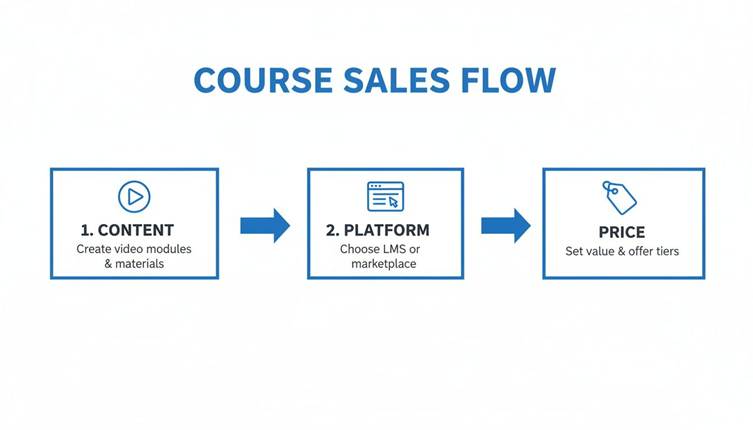
As the diagram shows, you can't succeed without all three pieces working together. Great content needs a solid platform and smart pricing to actually sell.
Engineer a High-Converting Sales Page
Your sales page has one job and one job only: convince the right person that your course is the absolute best solution to their specific problem. Think of it as your 24/7 salesperson. Every single element, from the headline to the button text, needs to be optimised to convert.
Don't make the classic mistake of just listing your course modules and calling it a day. That's a syllabus, not a sales pitch.
Instead, structure your page to tell a compelling story:
A Killer Headline: Grab their attention immediately by speaking directly to their biggest pain point or their most desired outcome.
Empathy-Driven Copy: Show them you get it. You understand their struggles because you've been there. Use the exact words and phrases they use to describe their problems.
The Transformation: Paint a crystal-clear picture of what their life, career, or business will look like after they complete your course. This is the real value they're buying.
Social Proof: Nothing sells better than proof that your stuff works. Pepper your page with testimonials, case studies, or even simple screenshots of positive comments from your social media audience.
A Clear Call-to-Action (CTA): Use bold, action-focused buttons like "Enrol Now" or "Get Instant Access." Make it physically impossible for them to miss it.
Pro Tip: Your sales page copy should sound like a one-on-one conversation with your ideal student. Before you write a single word, spend an hour scrolling through comments, DMs, and forum posts from your audience. The best copy is almost always borrowed directly from them.
Master Your Marketing Channels
Once your sales page is polished and ready to go, you need to drive the right kind of traffic to it. To nail this and get your first students in the door, building an effective content distribution strategy is crucial. For creators in India, a few channels consistently punch well above their weight.
Content marketing is your best long-term play. Create genuinely valuable, free content on platforms where your ideal students already hang out. A YouTube tutorial that solves a small piece of the bigger puzzle your course tackles is a perfect lead-in. An Instagram Reel sharing a quick, actionable tip can generate massive awareness.
Once you've validated your offer (meaning, people are actually buying it), consider putting some money into targeted paid ads. Running ads on platforms like Facebook and Instagram can be incredibly powerful, especially when you retarget people who have already visited your sales page but didn't enrol.
Finally, never, ever underestimate the power of collaboration. Partner up with other creators in your niche who serve a similar audience but aren't direct competitors. Hosting a joint webinar or a live session together can introduce your course to a brand-new, highly relevant audience practically overnight. This strategic approach turns marketing from a guessing game into a predictable system for growth.
Engaging Students and Scaling Your Online Academy
Getting a student to click "enrol" is a fantastic milestone, but it’s really only halfway there. The true measure of an online course isn’t the sale; it’s the transformation it delivers for the student. Your focus has to pivot from just getting students in the door to keeping them engaged and seeing them through to the finish line.
An unengaged student is a quiet problem. They’re unlikely to complete your course, which means they won’t buy from you again or, just as importantly, tell their friends about their great experience. This is the difference between selling a one-off product and building a sustainable online academy. The trick is to create systems that foster connection and support growth without demanding every second of your day.
Fostering a Thriving Student Community
Let's be honest, online learning can feel lonely. A dedicated student community is the antidote, turning a solitary activity into a shared, motivating journey. This isn’t just a nice little add-on; for top-tier academies, it's a core feature.
When students can ask questions, celebrate their wins, and get honest feedback from people on the same path, they feel seen and supported. That sense of belonging is an incredibly powerful driver of course completion.
Here are a few proven ways to build that community vibe:
Host Live Q&A Sessions: Scheduling regular live calls gives students a direct line to you. It’s their chance to get unstuck, feel heard, and reinforces the value you offer beyond just a library of pre-recorded videos.
Create a Dedicated Forum: It could be a private Facebook group, a Slack channel, or a community feature built right into your course platform. The important thing is giving students a central hub where they can connect 24/7.
Encourage Peer-to-Peer Support: Actively encourage students to jump in and help each other. When one student answers another's question, it reinforces their own learning and helps build a self-sustaining, supportive culture.
Key Insight: Your community quickly becomes one of your biggest assets. The connections students make and the support they give each other creates a layer of value that keeps them engaged long after they've watched the final lesson.
Protecting Your Content and Intellectual Property
As your academy grows, so does the unfortunate risk of piracy. Your course content is your most valuable asset, and you have to protect it. Simply uploading your videos to an unprotected webpage is like leaving the keys in your car.
Thankfully, modern course platforms offer robust security features designed to safeguard your hard work. This isn't just a precaution; it's a fundamental business practice. Look for platforms that provide digital rights management (DRM) and dynamic watermarking, which cleverly overlays user-specific information onto videos to deter screen recording and illegal sharing.
Scaling Support with Smart Technology
Providing amazing support is crucial, but you can’t be available 24/7. That's just not scalable, especially when you have hundreds or thousands of students. This is where technology becomes your most valuable team member. An AI Teaching Assistant, for example, can be an absolute game-changer.
Trained specifically on your own course materials—your videos, your PDFs, your unique frameworks—an AI assistant can instantly answer common student questions with incredible accuracy, often using a tone that mimics your own teaching style. This frees you up from answering the same five questions over and over, so you can focus on creating new content or engaging with students on a deeper level.
The impact of these tools is massive. The e-learning market in India, currently valued at USD 12,247.8 million, is absolutely booming, with interactive and game-based learning leading the charge. Platforms incorporating AI Teaching Assistants have been shown to slash support tickets by as much as 80% while pushing student satisfaction scores above 90%.
What's more, courses that integrate assessments and certificates see completion rates jump to around 65%, a huge leap from the typical 30% for courses without them. You can dig deeper into the Indian e-learning market trends on Grand View Research.
By weaving together community, strong content protection, and smart support systems, you create an environment where students don't just enrol—they thrive. This leads to better outcomes, glowing testimonials, and a scalable foundation that lets you turn your expertise into a flourishing online business.
Common Questions About Selling Courses Online
Stepping into the world of online courses always sparks a few questions, especially for first-time creators in India. That’s perfectly normal. You’re not just building a course; you’re building a business, and that means figuring out a few new things, from legal nuts and bolts to the day-to-day reality of running it all.
Think of these questions as your pre-flight checklist. Getting these sorted upfront gives you the confidence to launch strong and scale without hitting surprise roadblocks later.
What Are the Legal Requirements to Sell Courses in India?
This is usually the first big question on everyone's mind, and for good reason. To sell courses online legally in India, you’ll generally need two things: a business registration and a GST registration.
While you can start as a sole proprietor, registering your business adds a layer of professionalism and is often a prerequisite for activating payment gateways. GST becomes mandatory once your annual turnover crosses ₹20 lakhs (₹10 lakhs in some states), but you'll find most payment processors like Razorpay or PayU ask for it from day one. My advice? Chat with a chartered accountant right from the start. They'll help you get the structure right and avoid headaches down the line.
How Much Time Does It Really Take to Create a Course?
Let’s be honest—building a truly great course is a marathon, not a sprint. The time it takes really boils down to the depth of your course and how much content you already have prepared. A comprehensive, multi-module course can easily take between 100 to 200 hours of solid, focused work.
Here’s a rough breakdown of where that time goes:
Outlining and Structuring: 15-20 hours
Content Creation (Recording/Writing): 50-100 hours
Editing and Production: 30-50 hours
Building Your Sales Page & Platform Setup: 10-20 hours
A quick tip from experience: Don't let those numbers intimidate you. The secret is to batch your tasks. Dedicate specific days to scripting, others to recording, and so on. This keeps you in the flow and stops the whole project from feeling overwhelming.
How Should I Handle Payments and Refunds?
Nothing says "professional" like smooth payment processing and a crystal-clear refund policy. For payments in India, integrating a reliable gateway like Razorpay or PayU is non-negotiable. This lets you accept payments through UPI, credit/debit cards, and net banking, making it dead simple for your students to buy.
Your refund policy needs to be stated clearly on your sales page. A 7, 14, or 30-day money-back guarantee is a common practice that builds massive trust. It might sound counterintuitive, but removing the risk for the buyer can actually boost your sales. Just make sure to lay out the conditions, like requiring the student to have completed less than a certain percentage of the course to be eligible.
How Can I Keep My Course Content Updated?
Your field is always evolving, and your course should too. Keeping your content fresh is crucial for maintaining its value and protecting your reputation as an expert. I recommend scheduling an annual or bi-annual review of your entire course.
During the review, hunt for outdated stats, broken links, or new industry best practices you need to include. You can then re-record a few lessons or add new bonus modules. This is also a fantastic excuse to re-engage past students and market the "new and improved" version of your course to a whole new audience.
Ready to build an online academy that not only teaches but also provides world-class, scalable support? With Skolasti, you can launch your courses with a powerful AI Teaching Assistant trained on your unique content, ensuring your students get instant answers 24/7. Start your free trial today and see how Skolasti can help you teach smarter.
Before you pour months of your life into creating a course, you have to answer one critical question: will people in India actually pay for it?
Let's be real. The secret to selling courses online successfully isn't a flashy launch or slick marketing. It's validating market demand before you build a single lesson. This means getting solid proof that your idea solves a real problem for a specific audience—an audience that is ready and willing to pull out their wallets for a solution.
Validating Your Course Idea in the Indian Market
I’ve seen so many creators make this mistake. They get a brilliant idea, fall in love with it, and jump straight into recording videos. It's like building a house without checking if the ground is stable. That initial excitement is powerful, but you need to channel it into research first. This is how you build a sustainable business, not just a passion project that goes nowhere.
The opportunity in India is massive, but only for those who get this right. India's e-learning market was valued at USD 3.6 billion and is projected to explode to USD 23.9 billion by 2034. This isn't just a trend; it's a seismic shift driven by over 900 million internet users and a massive hunger for skill-based courses, especially in Tier 2 and 3 cities.
Define Your Ideal Student Profile
Who are you really teaching? Get specific here. "Working professionals" is not an answer—it's a recipe for failure. A detailed student profile, or avatar, is the compass for every decision you make, from your teaching style to your marketing copy.
Ask yourself these questions to build your profile:
Demographics: How old are they? Where do they live (which city tier)? What do they do for a living?
Goals & Aspirations: What are they trying to achieve? Is it a promotion, a new job, or mastering a personal hobby?
Pain Points & Frustrations: What specific problem keeps them up at night? What have they already tried that failed them?
Online Habits: Where do they hang out online? Are they scrolling LinkedIn, Instagram, or lurking in specific forums?
For example, instead of targeting "home bakers," you might zoom in on "30-45 year old women in Mumbai and Bengaluru who want to start a home bakery business but are stuck on professional cake decorating and how to price their products." See the difference? That level of specificity is your secret weapon.
Key Takeaway: Don't create a course for everyone. Create it for someone. A laser-focused student profile makes your marketing magnetic because it feels like you're speaking directly to them.
Uncover Profitable Niches with Simple Research
Once you know who you're serving, you need to find out what they're desperately searching for. You don't need fancy, expensive tools for this. Some smart, simple digging will tell you everything you need to know about demand and competition.
Start by spying on your direct competitors. What are they teaching? What's included in their courses, how are they priced, and what are students saying in the reviews? Pay very close attention to the negative feedback—that's pure gold. What are students complaining about? What's missing from the curriculum? That gap is exactly where your unique course can thrive.
Next, use free keyword research tools to listen to the market. Type in broad topics from your area of expertise and look at the long-tail keywords that pop up. Phrases like "how to learn Python for data analysis in India" or "advanced Canva design course for social media managers" are flashing signs of specific, high-intent demand. This simple process helps you sharpen your course topic to solve a problem people are already trying to pay their way out of.
Feel free to browse some existing online courses to see how other successful creators have carved out their space in different niches.
To keep yourself on track, use this simple checklist. It forces you to get honest answers before you commit.
Course Idea Validation Checklist
This isn't about ticking boxes; it's about gathering real evidence. If you can confidently answer "yes" to these questions, you're on the right track.
Validation Step | Key Question to Answer | Success Indicator |
Problem Identification | Does my course solve a specific, urgent, or expensive problem? | People are actively searching for solutions online (forums, search data). |
Audience Specificity | Do I know exactly who my ideal student is? | You can describe them in a full paragraph, including their fears and goals. |
Market Demand | Are people already paying for solutions to this problem? | Competitors exist and are making sales (a good sign!), or people are paying for 1:1 help. |
Competitive Gap | Can I offer something better, different, or more focused? | You've identified weaknesses in competitor offerings (e.g., poor support, outdated content). |
Creator-Market Fit | Am I genuinely the right person to teach this topic? | You have proven results, unique experience, or a passionate community. |
Monetisation Potential | Is the audience willing and able to pay for this solution? | The problem impacts their career, income, or a high-value hobby. |
If you find yourself struggling with any of these steps, don't see it as a failure. See it as a critical course correction that just saved you months of wasted effort. Go back, refine your idea, and test again. This is the foundation of a successful online course business.
Building a High-Impact Learning Experience
You’ve validated your course idea. Now the real fun begins: crafting an educational experience that actually delivers the transformation you promised.
Let’s be clear. Selling courses online isn't about dumping a folder of videos on your students and wishing them luck. It's about designing a structured journey that takes them from where they are to where they want to be. The goal is to create something so impactful that your students not only finish it but become your most passionate advocates.
It all starts with deciding how you'll deliver your material. The format you choose sets the stage for everything that follows.
Choosing Your Course Delivery Model
The way you structure your course directly impacts how engaged your students are—and how much work is on your plate. There’s no single "best" model here. The right choice hinges on your topic’s complexity, what your students actually need, and your own teaching style.
Self-Paced Courses: This is the classic "on-demand" model. Students get access to a library of pre-recorded lessons and materials to consume at their own pace. It offers ultimate flexibility but often struggles with low completion rates unless it's designed to be incredibly engaging.
Cohort-Based Courses: Here, a group of students (a "cohort") progresses through the material together over a fixed timeframe. This usually involves live sessions, group projects, and a shared community space. It’s a high-touch approach that skyrockets accountability and completion rates.
Blended (Hybrid) Learning: This model mixes the best of both worlds. Students work through self-paced content on their own schedule but also join scheduled live Q&As, workshops, or group coaching calls. It provides flexibility with a strong layer of support and community.
Think about it this way: a technical coding course might be perfect as a cohort-based program where students can debug problems together in real-time. On the other hand, a course on sourdough baking could be ideal as a self-paced offering, letting people fit lessons around their busy lives. For a deeper dive, check out these excellent online course design best practices.
Structuring Content for Engagement and Completion
Simply recording hours of video is a fast track to overwhelming your students. The best online courses break down complex topics into a logical, step-by-step framework that guides the learner from A to Z without any guesswork.
Think in terms of modules and lessons. A module is a major section of your course that covers a key pillar of your topic. A lesson is a single, bite-sized piece of content within that module—usually one video teaching a specific skill or concept.
Keep your lessons short. Seriously. Aim for 5 to 15 minutes. This helps students maintain focus and feel a sense of momentum.
To make the learning truly stick, go beyond just video.
Downloadable Workbooks and Checklists: These give students a tangible way to apply what they’re learning. A checklist for a "Getting Started with SEO" course might outline the exact steps for an initial website audit.
Interactive Quizzes: Short quizzes at the end of a module are great for reinforcing key ideas and giving students a quick win.
Practical Assignments: Give them a task that forces them to use their new skills. In a graphic design course, this could be creating a social media graphic using the principles you just taught.
Key Insight: A student's progress is your product's success. Structure everything to provide small, consistent wins. This builds the motivation they need to cross the finish line and get the results you promised.
Achieving Professional Production Quality on a Budget
Forget the Hollywood studio. Creating a professional-looking course today is more about clarity than cinematic effects. Honestly, you only need to nail two things: clear audio and good lighting.
Students will forgive a video that isn't perfectly crisp, but they will click away instantly if they can't hear you properly. A decent USB microphone is a non-negotiable investment and can make a world of difference.
Likewise, simple lighting—like a ring light or even just facing a bright window—gets rid of distracting shadows and makes your videos look instantly more polished.
Focus on being a clear, confident teacher. Your authenticity and expertise will always be more valuable than fancy production. If you’re looking for more practical pointers, we've collected some helpful online course creation advice to help you out. At the end of the day, a high-impact experience comes from thoughtful design, not a massive budget.
Choosing Your Platform and Pricing for Profit
Your fantastic course content deserves a professional home, and let's be honest, your business needs a revenue strategy that actually works. This is where your educational product meets its business engine. Picking the right tech and setting a price that screams value are two of the most critical moves you'll make.
The platform you choose is so much more than a place to dump your videos. It is the student experience. It dictates how they engage with your content, how you run your business, and how well your hard work is protected. Getting this right is fundamental to making a real go of it.
Selecting the Right Home for Your Course
Your first big choice comes down to a course marketplace versus an all-in-one platform.
Think of a marketplace like renting a stall in a giant, chaotic market. Sure, you get immediate foot traffic, but you're squeezed between competitors, and you have almost zero control over your brand or how much you can charge.
An all-in-one platform, on the other hand, is like building your own boutique shop. It gives you complete brand control—from custom themes to branded certificates—and you keep the lion's share of the revenue. This is how you build a real relationship with your students and create a learning environment that’s uniquely yours.
Here's a quick breakdown to make the choice clearer:
Online Course Platform Comparison
Feature | Marketplace (e.g., Udemy) | All-in-One Platform (e.g., Skolasti) |
Branding Control | Very limited; your course lives on their site. | Full control over your website, brand, and student experience. |
Pricing Control | Restricted; platform often runs deep discounts. | You set your prices and keep most of the revenue. |
Student Data | You don't own the student relationship or data. | You own your student list and can communicate directly. |
Revenue Share | Can take a significant cut (30-75%). | Typically a flat monthly fee with 0% commission on sales. |
Marketing Tools | Limited to the platform's ecosystem. | Integrates with your own email marketing and sales funnels. |
Best For | Lead generation and brand awareness. | Building a long-term, profitable online academy. |
Marketplaces can be a good starting point for visibility, but a white-label platform is where you build a sustainable business.
When you're shopping around for a platform, don't get distracted by flashy features. Focus on what actually matters for a business in India:
Secure Payment Gateways: Does it play nice with Indian payment processors like Razorpay or PayU? This is non-negotiable.
Content Protection: Your course is your biggest asset. Look for secure delivery, watermarking, and domain restrictions to shut down pirates.
Student Analytics: You need to know where students are succeeding and where they're getting stuck. Good data helps you make your course better over time.
Marketing Integrations: The platform must connect to your email marketing software and other tools. Your business depends on it.
Key Insight: Don't just choose a platform for today; choose one that can grow with you. As you add more courses or build a community, the last thing you want is a painful migration because your "starter" platform couldn't keep up.
Crafting a Smart Pricing Strategy
Pricing your course can feel like throwing darts in the dark, but a structured approach takes the guesswork out of it. The biggest mistake I see is people looking at what their competitors charge and then knocking a few rupees off. Don’t do that. Anchor your price to the value and transformation you deliver.
The professional online courses segment in India is forecasted to explode by a staggering USD 6.17 billion by 2030. Market research shows that courses priced under ₹5,000-10,000 have the highest conversion rates, especially with the 25-35 year-old crowd. This is your sweet spot for volume.
Let's look at some models that actually work:
Value-Based Pricing: Frame the price based on the outcome. If your course helps someone land a job with a ₹1,00,000 salary bump, a ₹10,000 price tag is an incredible return on their investment. It's a no-brainer.
Tiered Packages: Don't just sell one thing. Offer multiple versions at different price points. A "Basic" tier could be just the video content. A "Premium" tier could add community access, live Q&A calls, and your personal feedback. This lets you serve different budgets and needs.
Subscription or Membership: If you plan on adding new content regularly, a recurring subscription is the holy grail for predictable revenue. This works brilliantly for topics that are always changing, like digital marketing or AI.
Bundling is another powerful way to boost perceived value. A "Complete Digital Marketing" course priced at ₹7,999 sounds good. But it sounds amazing when you bundle it with bonuses like "Canva Design Templates" (valued at ₹1,500) and "Monthly Expert Q&A Calls" (valued at ₹2,000). You're no longer selling just a course; you're selling a complete solution.
For a deeper dive into structuring these kinds of irresistible offers, check out our guide on course pricing. This kind of strategic packaging justifies a higher price and makes the decision to buy so much easier for your students.
Marketing Your Course to Your First 100 Students
Let's be blunt: a brilliant course with zero students is just a very well-organised folder of files on your computer. To actually sell your course online, you need a marketing engine that consistently finds and converts the right people. Getting those first 100 enrolments isn't about luck; it's about building a system you can repeat.
This whole process starts way before you even think about hitting "publish." The most successful creators I know all do one thing exceptionally well: they build anticipation. They don't launch to an empty room. They open the doors to a crowd that's already lined up and waiting.
Build Your Pre-Launch Waitlist
Honestly, the single best way to guarantee a successful launch is to have a list of eager, potential students ready to buy the second you go live. Your goal here is simple: collect email addresses from people who are genuinely interested in what you have to teach. This is your warm audience, and they are infinitely more likely to buy than some random person who sees an ad.
Start teasing your course on your social media channels, whether that's Instagram, YouTube, or LinkedIn. Share some behind-the-scenes clips of you creating the content. Run polls asking which topics they're most excited to learn about. Talk constantly about the transformation your course delivers.
The call-to-action for every single post should be the same: "Join the waitlist to get early-bird access and an exclusive discount."
This simple flow—from content to platform to price—is the core of your sales strategy.
As the diagram shows, you can't succeed without all three pieces working together. Great content needs a solid platform and smart pricing to actually sell.
Engineer a High-Converting Sales Page
Your sales page has one job and one job only: convince the right person that your course is the absolute best solution to their specific problem. Think of it as your 24/7 salesperson. Every single element, from the headline to the button text, needs to be optimised to convert.
Don't make the classic mistake of just listing your course modules and calling it a day. That's a syllabus, not a sales pitch.
Instead, structure your page to tell a compelling story:
A Killer Headline: Grab their attention immediately by speaking directly to their biggest pain point or their most desired outcome.
Empathy-Driven Copy: Show them you get it. You understand their struggles because you've been there. Use the exact words and phrases they use to describe their problems.
The Transformation: Paint a crystal-clear picture of what their life, career, or business will look like after they complete your course. This is the real value they're buying.
Social Proof: Nothing sells better than proof that your stuff works. Pepper your page with testimonials, case studies, or even simple screenshots of positive comments from your social media audience.
A Clear Call-to-Action (CTA): Use bold, action-focused buttons like "Enrol Now" or "Get Instant Access." Make it physically impossible for them to miss it.
Pro Tip: Your sales page copy should sound like a one-on-one conversation with your ideal student. Before you write a single word, spend an hour scrolling through comments, DMs, and forum posts from your audience. The best copy is almost always borrowed directly from them.
Master Your Marketing Channels
Once your sales page is polished and ready to go, you need to drive the right kind of traffic to it. To nail this and get your first students in the door, building an effective content distribution strategy is crucial. For creators in India, a few channels consistently punch well above their weight.
Content marketing is your best long-term play. Create genuinely valuable, free content on platforms where your ideal students already hang out. A YouTube tutorial that solves a small piece of the bigger puzzle your course tackles is a perfect lead-in. An Instagram Reel sharing a quick, actionable tip can generate massive awareness.
Once you've validated your offer (meaning, people are actually buying it), consider putting some money into targeted paid ads. Running ads on platforms like Facebook and Instagram can be incredibly powerful, especially when you retarget people who have already visited your sales page but didn't enrol.
Finally, never, ever underestimate the power of collaboration. Partner up with other creators in your niche who serve a similar audience but aren't direct competitors. Hosting a joint webinar or a live session together can introduce your course to a brand-new, highly relevant audience practically overnight. This strategic approach turns marketing from a guessing game into a predictable system for growth.
Engaging Students and Scaling Your Online Academy
Getting a student to click "enrol" is a fantastic milestone, but it’s really only halfway there. The true measure of an online course isn’t the sale; it’s the transformation it delivers for the student. Your focus has to pivot from just getting students in the door to keeping them engaged and seeing them through to the finish line.
An unengaged student is a quiet problem. They’re unlikely to complete your course, which means they won’t buy from you again or, just as importantly, tell their friends about their great experience. This is the difference between selling a one-off product and building a sustainable online academy. The trick is to create systems that foster connection and support growth without demanding every second of your day.
Fostering a Thriving Student Community
Let's be honest, online learning can feel lonely. A dedicated student community is the antidote, turning a solitary activity into a shared, motivating journey. This isn’t just a nice little add-on; for top-tier academies, it's a core feature.
When students can ask questions, celebrate their wins, and get honest feedback from people on the same path, they feel seen and supported. That sense of belonging is an incredibly powerful driver of course completion.
Here are a few proven ways to build that community vibe:
Host Live Q&A Sessions: Scheduling regular live calls gives students a direct line to you. It’s their chance to get unstuck, feel heard, and reinforces the value you offer beyond just a library of pre-recorded videos.
Create a Dedicated Forum: It could be a private Facebook group, a Slack channel, or a community feature built right into your course platform. The important thing is giving students a central hub where they can connect 24/7.
Encourage Peer-to-Peer Support: Actively encourage students to jump in and help each other. When one student answers another's question, it reinforces their own learning and helps build a self-sustaining, supportive culture.
Key Insight: Your community quickly becomes one of your biggest assets. The connections students make and the support they give each other creates a layer of value that keeps them engaged long after they've watched the final lesson.
Protecting Your Content and Intellectual Property
As your academy grows, so does the unfortunate risk of piracy. Your course content is your most valuable asset, and you have to protect it. Simply uploading your videos to an unprotected webpage is like leaving the keys in your car.
Thankfully, modern course platforms offer robust security features designed to safeguard your hard work. This isn't just a precaution; it's a fundamental business practice. Look for platforms that provide digital rights management (DRM) and dynamic watermarking, which cleverly overlays user-specific information onto videos to deter screen recording and illegal sharing.
Scaling Support with Smart Technology
Providing amazing support is crucial, but you can’t be available 24/7. That's just not scalable, especially when you have hundreds or thousands of students. This is where technology becomes your most valuable team member. An AI Teaching Assistant, for example, can be an absolute game-changer.
Trained specifically on your own course materials—your videos, your PDFs, your unique frameworks—an AI assistant can instantly answer common student questions with incredible accuracy, often using a tone that mimics your own teaching style. This frees you up from answering the same five questions over and over, so you can focus on creating new content or engaging with students on a deeper level.
The impact of these tools is massive. The e-learning market in India, currently valued at USD 12,247.8 million, is absolutely booming, with interactive and game-based learning leading the charge. Platforms incorporating AI Teaching Assistants have been shown to slash support tickets by as much as 80% while pushing student satisfaction scores above 90%.
What's more, courses that integrate assessments and certificates see completion rates jump to around 65%, a huge leap from the typical 30% for courses without them. You can dig deeper into the Indian e-learning market trends on Grand View Research.
By weaving together community, strong content protection, and smart support systems, you create an environment where students don't just enrol—they thrive. This leads to better outcomes, glowing testimonials, and a scalable foundation that lets you turn your expertise into a flourishing online business.
Common Questions About Selling Courses Online
Stepping into the world of online courses always sparks a few questions, especially for first-time creators in India. That’s perfectly normal. You’re not just building a course; you’re building a business, and that means figuring out a few new things, from legal nuts and bolts to the day-to-day reality of running it all.
Think of these questions as your pre-flight checklist. Getting these sorted upfront gives you the confidence to launch strong and scale without hitting surprise roadblocks later.
What Are the Legal Requirements to Sell Courses in India?
This is usually the first big question on everyone's mind, and for good reason. To sell courses online legally in India, you’ll generally need two things: a business registration and a GST registration.
While you can start as a sole proprietor, registering your business adds a layer of professionalism and is often a prerequisite for activating payment gateways. GST becomes mandatory once your annual turnover crosses ₹20 lakhs (₹10 lakhs in some states), but you'll find most payment processors like Razorpay or PayU ask for it from day one. My advice? Chat with a chartered accountant right from the start. They'll help you get the structure right and avoid headaches down the line.
How Much Time Does It Really Take to Create a Course?
Let’s be honest—building a truly great course is a marathon, not a sprint. The time it takes really boils down to the depth of your course and how much content you already have prepared. A comprehensive, multi-module course can easily take between 100 to 200 hours of solid, focused work.
Here’s a rough breakdown of where that time goes:
Outlining and Structuring: 15-20 hours
Content Creation (Recording/Writing): 50-100 hours
Editing and Production: 30-50 hours
Building Your Sales Page & Platform Setup: 10-20 hours
A quick tip from experience: Don't let those numbers intimidate you. The secret is to batch your tasks. Dedicate specific days to scripting, others to recording, and so on. This keeps you in the flow and stops the whole project from feeling overwhelming.
How Should I Handle Payments and Refunds?
Nothing says "professional" like smooth payment processing and a crystal-clear refund policy. For payments in India, integrating a reliable gateway like Razorpay or PayU is non-negotiable. This lets you accept payments through UPI, credit/debit cards, and net banking, making it dead simple for your students to buy.
Your refund policy needs to be stated clearly on your sales page. A 7, 14, or 30-day money-back guarantee is a common practice that builds massive trust. It might sound counterintuitive, but removing the risk for the buyer can actually boost your sales. Just make sure to lay out the conditions, like requiring the student to have completed less than a certain percentage of the course to be eligible.
How Can I Keep My Course Content Updated?
Your field is always evolving, and your course should too. Keeping your content fresh is crucial for maintaining its value and protecting your reputation as an expert. I recommend scheduling an annual or bi-annual review of your entire course.
During the review, hunt for outdated stats, broken links, or new industry best practices you need to include. You can then re-record a few lessons or add new bonus modules. This is also a fantastic excuse to re-engage past students and market the "new and improved" version of your course to a whole new audience.
Ready to build an online academy that not only teaches but also provides world-class, scalable support? With Skolasti, you can launch your courses with a powerful AI Teaching Assistant trained on your unique content, ensuring your students get instant answers 24/7. Start your free trial today and see how Skolasti can help you teach smarter.
Before you pour months of your life into creating a course, you have to answer one critical question: will people in India actually pay for it?
Let's be real. The secret to selling courses online successfully isn't a flashy launch or slick marketing. It's validating market demand before you build a single lesson. This means getting solid proof that your idea solves a real problem for a specific audience—an audience that is ready and willing to pull out their wallets for a solution.
Validating Your Course Idea in the Indian Market
I’ve seen so many creators make this mistake. They get a brilliant idea, fall in love with it, and jump straight into recording videos. It's like building a house without checking if the ground is stable. That initial excitement is powerful, but you need to channel it into research first. This is how you build a sustainable business, not just a passion project that goes nowhere.
The opportunity in India is massive, but only for those who get this right. India's e-learning market was valued at USD 3.6 billion and is projected to explode to USD 23.9 billion by 2034. This isn't just a trend; it's a seismic shift driven by over 900 million internet users and a massive hunger for skill-based courses, especially in Tier 2 and 3 cities.
Define Your Ideal Student Profile
Who are you really teaching? Get specific here. "Working professionals" is not an answer—it's a recipe for failure. A detailed student profile, or avatar, is the compass for every decision you make, from your teaching style to your marketing copy.
Ask yourself these questions to build your profile:
Demographics: How old are they? Where do they live (which city tier)? What do they do for a living?
Goals & Aspirations: What are they trying to achieve? Is it a promotion, a new job, or mastering a personal hobby?
Pain Points & Frustrations: What specific problem keeps them up at night? What have they already tried that failed them?
Online Habits: Where do they hang out online? Are they scrolling LinkedIn, Instagram, or lurking in specific forums?
For example, instead of targeting "home bakers," you might zoom in on "30-45 year old women in Mumbai and Bengaluru who want to start a home bakery business but are stuck on professional cake decorating and how to price their products." See the difference? That level of specificity is your secret weapon.
Key Takeaway: Don't create a course for everyone. Create it for someone. A laser-focused student profile makes your marketing magnetic because it feels like you're speaking directly to them.
Uncover Profitable Niches with Simple Research
Once you know who you're serving, you need to find out what they're desperately searching for. You don't need fancy, expensive tools for this. Some smart, simple digging will tell you everything you need to know about demand and competition.
Start by spying on your direct competitors. What are they teaching? What's included in their courses, how are they priced, and what are students saying in the reviews? Pay very close attention to the negative feedback—that's pure gold. What are students complaining about? What's missing from the curriculum? That gap is exactly where your unique course can thrive.
Next, use free keyword research tools to listen to the market. Type in broad topics from your area of expertise and look at the long-tail keywords that pop up. Phrases like "how to learn Python for data analysis in India" or "advanced Canva design course for social media managers" are flashing signs of specific, high-intent demand. This simple process helps you sharpen your course topic to solve a problem people are already trying to pay their way out of.
Feel free to browse some existing online courses to see how other successful creators have carved out their space in different niches.
To keep yourself on track, use this simple checklist. It forces you to get honest answers before you commit.
Course Idea Validation Checklist
This isn't about ticking boxes; it's about gathering real evidence. If you can confidently answer "yes" to these questions, you're on the right track.
Validation Step | Key Question to Answer | Success Indicator |
Problem Identification | Does my course solve a specific, urgent, or expensive problem? | People are actively searching for solutions online (forums, search data). |
Audience Specificity | Do I know exactly who my ideal student is? | You can describe them in a full paragraph, including their fears and goals. |
Market Demand | Are people already paying for solutions to this problem? | Competitors exist and are making sales (a good sign!), or people are paying for 1:1 help. |
Competitive Gap | Can I offer something better, different, or more focused? | You've identified weaknesses in competitor offerings (e.g., poor support, outdated content). |
Creator-Market Fit | Am I genuinely the right person to teach this topic? | You have proven results, unique experience, or a passionate community. |
Monetisation Potential | Is the audience willing and able to pay for this solution? | The problem impacts their career, income, or a high-value hobby. |
If you find yourself struggling with any of these steps, don't see it as a failure. See it as a critical course correction that just saved you months of wasted effort. Go back, refine your idea, and test again. This is the foundation of a successful online course business.
Building a High-Impact Learning Experience
You’ve validated your course idea. Now the real fun begins: crafting an educational experience that actually delivers the transformation you promised.
Let’s be clear. Selling courses online isn't about dumping a folder of videos on your students and wishing them luck. It's about designing a structured journey that takes them from where they are to where they want to be. The goal is to create something so impactful that your students not only finish it but become your most passionate advocates.
It all starts with deciding how you'll deliver your material. The format you choose sets the stage for everything that follows.
Choosing Your Course Delivery Model
The way you structure your course directly impacts how engaged your students are—and how much work is on your plate. There’s no single "best" model here. The right choice hinges on your topic’s complexity, what your students actually need, and your own teaching style.
Self-Paced Courses: This is the classic "on-demand" model. Students get access to a library of pre-recorded lessons and materials to consume at their own pace. It offers ultimate flexibility but often struggles with low completion rates unless it's designed to be incredibly engaging.
Cohort-Based Courses: Here, a group of students (a "cohort") progresses through the material together over a fixed timeframe. This usually involves live sessions, group projects, and a shared community space. It’s a high-touch approach that skyrockets accountability and completion rates.
Blended (Hybrid) Learning: This model mixes the best of both worlds. Students work through self-paced content on their own schedule but also join scheduled live Q&As, workshops, or group coaching calls. It provides flexibility with a strong layer of support and community.
Think about it this way: a technical coding course might be perfect as a cohort-based program where students can debug problems together in real-time. On the other hand, a course on sourdough baking could be ideal as a self-paced offering, letting people fit lessons around their busy lives. For a deeper dive, check out these excellent online course design best practices.
Structuring Content for Engagement and Completion
Simply recording hours of video is a fast track to overwhelming your students. The best online courses break down complex topics into a logical, step-by-step framework that guides the learner from A to Z without any guesswork.
Think in terms of modules and lessons. A module is a major section of your course that covers a key pillar of your topic. A lesson is a single, bite-sized piece of content within that module—usually one video teaching a specific skill or concept.
Keep your lessons short. Seriously. Aim for 5 to 15 minutes. This helps students maintain focus and feel a sense of momentum.
To make the learning truly stick, go beyond just video.
Downloadable Workbooks and Checklists: These give students a tangible way to apply what they’re learning. A checklist for a "Getting Started with SEO" course might outline the exact steps for an initial website audit.
Interactive Quizzes: Short quizzes at the end of a module are great for reinforcing key ideas and giving students a quick win.
Practical Assignments: Give them a task that forces them to use their new skills. In a graphic design course, this could be creating a social media graphic using the principles you just taught.
Key Insight: A student's progress is your product's success. Structure everything to provide small, consistent wins. This builds the motivation they need to cross the finish line and get the results you promised.
Achieving Professional Production Quality on a Budget
Forget the Hollywood studio. Creating a professional-looking course today is more about clarity than cinematic effects. Honestly, you only need to nail two things: clear audio and good lighting.
Students will forgive a video that isn't perfectly crisp, but they will click away instantly if they can't hear you properly. A decent USB microphone is a non-negotiable investment and can make a world of difference.
Likewise, simple lighting—like a ring light or even just facing a bright window—gets rid of distracting shadows and makes your videos look instantly more polished.
Focus on being a clear, confident teacher. Your authenticity and expertise will always be more valuable than fancy production. If you’re looking for more practical pointers, we've collected some helpful online course creation advice to help you out. At the end of the day, a high-impact experience comes from thoughtful design, not a massive budget.
Choosing Your Platform and Pricing for Profit
Your fantastic course content deserves a professional home, and let's be honest, your business needs a revenue strategy that actually works. This is where your educational product meets its business engine. Picking the right tech and setting a price that screams value are two of the most critical moves you'll make.
The platform you choose is so much more than a place to dump your videos. It is the student experience. It dictates how they engage with your content, how you run your business, and how well your hard work is protected. Getting this right is fundamental to making a real go of it.
Selecting the Right Home for Your Course
Your first big choice comes down to a course marketplace versus an all-in-one platform.
Think of a marketplace like renting a stall in a giant, chaotic market. Sure, you get immediate foot traffic, but you're squeezed between competitors, and you have almost zero control over your brand or how much you can charge.
An all-in-one platform, on the other hand, is like building your own boutique shop. It gives you complete brand control—from custom themes to branded certificates—and you keep the lion's share of the revenue. This is how you build a real relationship with your students and create a learning environment that’s uniquely yours.
Here's a quick breakdown to make the choice clearer:
Online Course Platform Comparison
Feature | Marketplace (e.g., Udemy) | All-in-One Platform (e.g., Skolasti) |
Branding Control | Very limited; your course lives on their site. | Full control over your website, brand, and student experience. |
Pricing Control | Restricted; platform often runs deep discounts. | You set your prices and keep most of the revenue. |
Student Data | You don't own the student relationship or data. | You own your student list and can communicate directly. |
Revenue Share | Can take a significant cut (30-75%). | Typically a flat monthly fee with 0% commission on sales. |
Marketing Tools | Limited to the platform's ecosystem. | Integrates with your own email marketing and sales funnels. |
Best For | Lead generation and brand awareness. | Building a long-term, profitable online academy. |
Marketplaces can be a good starting point for visibility, but a white-label platform is where you build a sustainable business.
When you're shopping around for a platform, don't get distracted by flashy features. Focus on what actually matters for a business in India:
Secure Payment Gateways: Does it play nice with Indian payment processors like Razorpay or PayU? This is non-negotiable.
Content Protection: Your course is your biggest asset. Look for secure delivery, watermarking, and domain restrictions to shut down pirates.
Student Analytics: You need to know where students are succeeding and where they're getting stuck. Good data helps you make your course better over time.
Marketing Integrations: The platform must connect to your email marketing software and other tools. Your business depends on it.
Key Insight: Don't just choose a platform for today; choose one that can grow with you. As you add more courses or build a community, the last thing you want is a painful migration because your "starter" platform couldn't keep up.
Crafting a Smart Pricing Strategy
Pricing your course can feel like throwing darts in the dark, but a structured approach takes the guesswork out of it. The biggest mistake I see is people looking at what their competitors charge and then knocking a few rupees off. Don’t do that. Anchor your price to the value and transformation you deliver.
The professional online courses segment in India is forecasted to explode by a staggering USD 6.17 billion by 2030. Market research shows that courses priced under ₹5,000-10,000 have the highest conversion rates, especially with the 25-35 year-old crowd. This is your sweet spot for volume.
Let's look at some models that actually work:
Value-Based Pricing: Frame the price based on the outcome. If your course helps someone land a job with a ₹1,00,000 salary bump, a ₹10,000 price tag is an incredible return on their investment. It's a no-brainer.
Tiered Packages: Don't just sell one thing. Offer multiple versions at different price points. A "Basic" tier could be just the video content. A "Premium" tier could add community access, live Q&A calls, and your personal feedback. This lets you serve different budgets and needs.
Subscription or Membership: If you plan on adding new content regularly, a recurring subscription is the holy grail for predictable revenue. This works brilliantly for topics that are always changing, like digital marketing or AI.
Bundling is another powerful way to boost perceived value. A "Complete Digital Marketing" course priced at ₹7,999 sounds good. But it sounds amazing when you bundle it with bonuses like "Canva Design Templates" (valued at ₹1,500) and "Monthly Expert Q&A Calls" (valued at ₹2,000). You're no longer selling just a course; you're selling a complete solution.
For a deeper dive into structuring these kinds of irresistible offers, check out our guide on course pricing. This kind of strategic packaging justifies a higher price and makes the decision to buy so much easier for your students.
Marketing Your Course to Your First 100 Students
Let's be blunt: a brilliant course with zero students is just a very well-organised folder of files on your computer. To actually sell your course online, you need a marketing engine that consistently finds and converts the right people. Getting those first 100 enrolments isn't about luck; it's about building a system you can repeat.
This whole process starts way before you even think about hitting "publish." The most successful creators I know all do one thing exceptionally well: they build anticipation. They don't launch to an empty room. They open the doors to a crowd that's already lined up and waiting.
Build Your Pre-Launch Waitlist
Honestly, the single best way to guarantee a successful launch is to have a list of eager, potential students ready to buy the second you go live. Your goal here is simple: collect email addresses from people who are genuinely interested in what you have to teach. This is your warm audience, and they are infinitely more likely to buy than some random person who sees an ad.
Start teasing your course on your social media channels, whether that's Instagram, YouTube, or LinkedIn. Share some behind-the-scenes clips of you creating the content. Run polls asking which topics they're most excited to learn about. Talk constantly about the transformation your course delivers.
The call-to-action for every single post should be the same: "Join the waitlist to get early-bird access and an exclusive discount."
This simple flow—from content to platform to price—is the core of your sales strategy.
As the diagram shows, you can't succeed without all three pieces working together. Great content needs a solid platform and smart pricing to actually sell.
Engineer a High-Converting Sales Page
Your sales page has one job and one job only: convince the right person that your course is the absolute best solution to their specific problem. Think of it as your 24/7 salesperson. Every single element, from the headline to the button text, needs to be optimised to convert.
Don't make the classic mistake of just listing your course modules and calling it a day. That's a syllabus, not a sales pitch.
Instead, structure your page to tell a compelling story:
A Killer Headline: Grab their attention immediately by speaking directly to their biggest pain point or their most desired outcome.
Empathy-Driven Copy: Show them you get it. You understand their struggles because you've been there. Use the exact words and phrases they use to describe their problems.
The Transformation: Paint a crystal-clear picture of what their life, career, or business will look like after they complete your course. This is the real value they're buying.
Social Proof: Nothing sells better than proof that your stuff works. Pepper your page with testimonials, case studies, or even simple screenshots of positive comments from your social media audience.
A Clear Call-to-Action (CTA): Use bold, action-focused buttons like "Enrol Now" or "Get Instant Access." Make it physically impossible for them to miss it.
Pro Tip: Your sales page copy should sound like a one-on-one conversation with your ideal student. Before you write a single word, spend an hour scrolling through comments, DMs, and forum posts from your audience. The best copy is almost always borrowed directly from them.
Master Your Marketing Channels
Once your sales page is polished and ready to go, you need to drive the right kind of traffic to it. To nail this and get your first students in the door, building an effective content distribution strategy is crucial. For creators in India, a few channels consistently punch well above their weight.
Content marketing is your best long-term play. Create genuinely valuable, free content on platforms where your ideal students already hang out. A YouTube tutorial that solves a small piece of the bigger puzzle your course tackles is a perfect lead-in. An Instagram Reel sharing a quick, actionable tip can generate massive awareness.
Once you've validated your offer (meaning, people are actually buying it), consider putting some money into targeted paid ads. Running ads on platforms like Facebook and Instagram can be incredibly powerful, especially when you retarget people who have already visited your sales page but didn't enrol.
Finally, never, ever underestimate the power of collaboration. Partner up with other creators in your niche who serve a similar audience but aren't direct competitors. Hosting a joint webinar or a live session together can introduce your course to a brand-new, highly relevant audience practically overnight. This strategic approach turns marketing from a guessing game into a predictable system for growth.
Engaging Students and Scaling Your Online Academy
Getting a student to click "enrol" is a fantastic milestone, but it’s really only halfway there. The true measure of an online course isn’t the sale; it’s the transformation it delivers for the student. Your focus has to pivot from just getting students in the door to keeping them engaged and seeing them through to the finish line.
An unengaged student is a quiet problem. They’re unlikely to complete your course, which means they won’t buy from you again or, just as importantly, tell their friends about their great experience. This is the difference between selling a one-off product and building a sustainable online academy. The trick is to create systems that foster connection and support growth without demanding every second of your day.
Fostering a Thriving Student Community
Let's be honest, online learning can feel lonely. A dedicated student community is the antidote, turning a solitary activity into a shared, motivating journey. This isn’t just a nice little add-on; for top-tier academies, it's a core feature.
When students can ask questions, celebrate their wins, and get honest feedback from people on the same path, they feel seen and supported. That sense of belonging is an incredibly powerful driver of course completion.
Here are a few proven ways to build that community vibe:
Host Live Q&A Sessions: Scheduling regular live calls gives students a direct line to you. It’s their chance to get unstuck, feel heard, and reinforces the value you offer beyond just a library of pre-recorded videos.
Create a Dedicated Forum: It could be a private Facebook group, a Slack channel, or a community feature built right into your course platform. The important thing is giving students a central hub where they can connect 24/7.
Encourage Peer-to-Peer Support: Actively encourage students to jump in and help each other. When one student answers another's question, it reinforces their own learning and helps build a self-sustaining, supportive culture.
Key Insight: Your community quickly becomes one of your biggest assets. The connections students make and the support they give each other creates a layer of value that keeps them engaged long after they've watched the final lesson.
Protecting Your Content and Intellectual Property
As your academy grows, so does the unfortunate risk of piracy. Your course content is your most valuable asset, and you have to protect it. Simply uploading your videos to an unprotected webpage is like leaving the keys in your car.
Thankfully, modern course platforms offer robust security features designed to safeguard your hard work. This isn't just a precaution; it's a fundamental business practice. Look for platforms that provide digital rights management (DRM) and dynamic watermarking, which cleverly overlays user-specific information onto videos to deter screen recording and illegal sharing.
Scaling Support with Smart Technology
Providing amazing support is crucial, but you can’t be available 24/7. That's just not scalable, especially when you have hundreds or thousands of students. This is where technology becomes your most valuable team member. An AI Teaching Assistant, for example, can be an absolute game-changer.
Trained specifically on your own course materials—your videos, your PDFs, your unique frameworks—an AI assistant can instantly answer common student questions with incredible accuracy, often using a tone that mimics your own teaching style. This frees you up from answering the same five questions over and over, so you can focus on creating new content or engaging with students on a deeper level.
The impact of these tools is massive. The e-learning market in India, currently valued at USD 12,247.8 million, is absolutely booming, with interactive and game-based learning leading the charge. Platforms incorporating AI Teaching Assistants have been shown to slash support tickets by as much as 80% while pushing student satisfaction scores above 90%.
What's more, courses that integrate assessments and certificates see completion rates jump to around 65%, a huge leap from the typical 30% for courses without them. You can dig deeper into the Indian e-learning market trends on Grand View Research.
By weaving together community, strong content protection, and smart support systems, you create an environment where students don't just enrol—they thrive. This leads to better outcomes, glowing testimonials, and a scalable foundation that lets you turn your expertise into a flourishing online business.
Common Questions About Selling Courses Online
Stepping into the world of online courses always sparks a few questions, especially for first-time creators in India. That’s perfectly normal. You’re not just building a course; you’re building a business, and that means figuring out a few new things, from legal nuts and bolts to the day-to-day reality of running it all.
Think of these questions as your pre-flight checklist. Getting these sorted upfront gives you the confidence to launch strong and scale without hitting surprise roadblocks later.
What Are the Legal Requirements to Sell Courses in India?
This is usually the first big question on everyone's mind, and for good reason. To sell courses online legally in India, you’ll generally need two things: a business registration and a GST registration.
While you can start as a sole proprietor, registering your business adds a layer of professionalism and is often a prerequisite for activating payment gateways. GST becomes mandatory once your annual turnover crosses ₹20 lakhs (₹10 lakhs in some states), but you'll find most payment processors like Razorpay or PayU ask for it from day one. My advice? Chat with a chartered accountant right from the start. They'll help you get the structure right and avoid headaches down the line.
How Much Time Does It Really Take to Create a Course?
Let’s be honest—building a truly great course is a marathon, not a sprint. The time it takes really boils down to the depth of your course and how much content you already have prepared. A comprehensive, multi-module course can easily take between 100 to 200 hours of solid, focused work.
Here’s a rough breakdown of where that time goes:
Outlining and Structuring: 15-20 hours
Content Creation (Recording/Writing): 50-100 hours
Editing and Production: 30-50 hours
Building Your Sales Page & Platform Setup: 10-20 hours
A quick tip from experience: Don't let those numbers intimidate you. The secret is to batch your tasks. Dedicate specific days to scripting, others to recording, and so on. This keeps you in the flow and stops the whole project from feeling overwhelming.
How Should I Handle Payments and Refunds?
Nothing says "professional" like smooth payment processing and a crystal-clear refund policy. For payments in India, integrating a reliable gateway like Razorpay or PayU is non-negotiable. This lets you accept payments through UPI, credit/debit cards, and net banking, making it dead simple for your students to buy.
Your refund policy needs to be stated clearly on your sales page. A 7, 14, or 30-day money-back guarantee is a common practice that builds massive trust. It might sound counterintuitive, but removing the risk for the buyer can actually boost your sales. Just make sure to lay out the conditions, like requiring the student to have completed less than a certain percentage of the course to be eligible.
How Can I Keep My Course Content Updated?
Your field is always evolving, and your course should too. Keeping your content fresh is crucial for maintaining its value and protecting your reputation as an expert. I recommend scheduling an annual or bi-annual review of your entire course.
During the review, hunt for outdated stats, broken links, or new industry best practices you need to include. You can then re-record a few lessons or add new bonus modules. This is also a fantastic excuse to re-engage past students and market the "new and improved" version of your course to a whole new audience.
Ready to build an online academy that not only teaches but also provides world-class, scalable support? With Skolasti, you can launch your courses with a powerful AI Teaching Assistant trained on your unique content, ensuring your students get instant answers 24/7. Start your free trial today and see how Skolasti can help you teach smarter.