How to Start a Coaching Centre in India Your Complete Guide
How to Start a Coaching Centre in India Your Complete Guide
How to Start a Coaching Centre in India Your Complete Guide
Feb 18, 2026
Feb 18, 2026
Feb 18, 2026

Before you even think about lesson plans or enrolling your first student, the real work begins. This is the bedrock of your entire coaching business, and frankly, it's where most new ventures go wrong.
People often rush this part, ending up with a generic service that struggles to find its audience. But if you get this foundation right, you set yourself up for clarity, focus, and real growth from day one.
The journey starts with some honest reflection and a hard look at the market. What's the unique expertise only you can offer? Who are the students desperately looking for that exact knowledge? Answering these questions is the first real step to building a coaching centre that actually stands out.
Finding Your Profitable Niche
A niche isn't just a subject. It's the specific problem you solve for a specific group of people.
Think about it. "Maths tutoring" is vague and forgettable. But "JEE Advanced maths coaching for repeat aspirants"? That’s powerful. It instantly tells you who the student is, what their pain point is, and what they hope to achieve.
When you're zeroing in on your niche, weigh these three things carefully:
Your Expertise and Passion: What do you not only know inside-out but genuinely love teaching? Your enthusiasm is a massive differentiator; it’s contagious and keeps students engaged.
Market Demand: Is there a real, tangible need for what you teach? Are people actively searching for help in this area? A quick search on Google or forums can tell you a lot.
Profitability: Can the people you want to teach actually afford your services? A niche is only a business if it can sustain itself financially.
The sweet spot is where all three overlap. For example, a seasoned software developer might see huge demand for corporate training in a new programming language. This nails all three: their expertise, a clear market need, and a client base (corporations) with a dedicated training budget.
Developing Your Business Plan
Your business plan is your roadmap. It’s not about writing a 100-page document to impress investors; it’s about turning your vision into a concrete, actionable strategy. A lean, focused plan is always more effective.
At a minimum, your plan needs to cover:
Mission and Vision: Why are you doing this? What impact do you want your centre to have?
Ideal Student Profile: Go deeper than just age and location. What are their goals? Their fears? What motivates them to seek help?
Service Offerings: Get specific. Detail the exact courses, workshops, or one-on-one sessions you’ll provide.
Financial Projections: Be realistic. Estimate your startup costs, ongoing operational expenses, and what you aim to earn in the first one to three years.
A solid business plan does more than just look good on paper. It forces you to stress-test your ideas, anticipate roadblocks, and set milestones you can actually hit. It's what separates a serious business from a side hobby.
This whole foundational process can be boiled down to a simple flow.
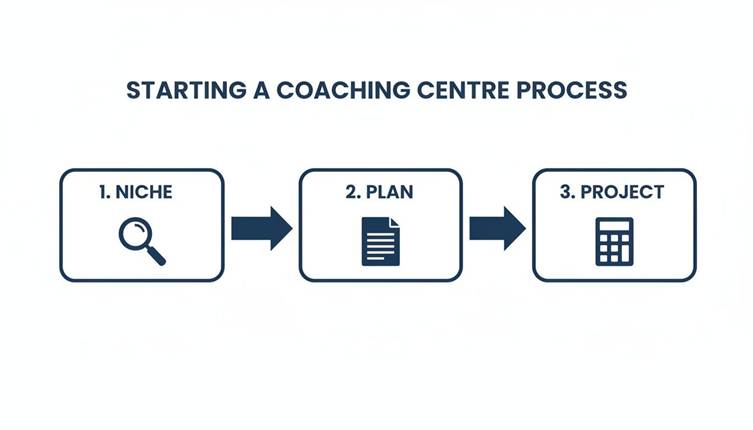
This Niche > Plan > Project approach keeps you grounded and ensures every decision you make aligns with your core strategy.
And the timing couldn't be better. The coaching institute market in India is massive—valued at a staggering USD 6.50 billion in 2024—and it's projected to explode to USD 17.40 billion by 2033. This incredible growth, highlighted in a report from IMARC Group, signals a huge opportunity for new "edupreneurs," especially with platforms like Skolasti making it easier than ever to launch your own white-label online academy.
Choosing Your Model: Physical, Online, or Hybrid?
Once your niche and plan are locked in, you need to decide how you'll deliver your coaching. Each model—physical, online-only, or a hybrid blend—comes with its own set of trade-offs. There's no single "best" answer; the right choice depends entirely on your niche, target students, and financial runway.
This table breaks down the key differences to help you decide.
Coaching Centre Model Comparison Physical vs Online vs Hybrid
Factor | Physical Centre | Online-Only (e.g., via Skolasti) | Hybrid Model |
Startup Costs | High: Rent deposit, furniture, utilities, hardware. | Low: Platform subscription, basic recording gear. | Moderate to High: Combines costs of both models. |
Scalability | Limited: Capped by classroom size and geography. | High: Reach global students with minimal extra cost. | Moderate: Online portion can scale, but physical is limited. |
Operational Overheads | High: Rent, electricity, staff salaries, maintenance. | Low: Platform fees, marketing spend. | High: Managing both physical and digital operations. |
Student Reach | Local/Regional: Restricted to a specific geographic area. | Global: Anyone with an internet connection is a potential student. | Global & Local: Best of both, but more complex to manage. |
Flexibility | Low: Fixed class schedules and location. | High: Asynchronous learning, flexible live classes. | Moderate: Offers both fixed and flexible options. |
Best For | Niche, high-touch coaching where in-person interaction is critical. | Educators targeting a wide audience with a focus on scalability and low overheads. | Established centres looking to expand their reach or online coaches adding a local presence. |
As you can see, an online model built on a platform like Skolasti dramatically lowers the barrier to entry, offering incredible scalability from day one. A physical centre provides a traditional, high-touch experience but comes with significant costs and limitations. The hybrid model offers versatility but demands more complex management.
Choosing the right model from the start will have a massive impact on your finances, marketing strategy, and day-to-day operations. Weigh these factors carefully against your business plan before moving forward.
Getting Your Legal and Operational House in Order

With a solid business plan in hand, it's time to make it official. This is where your idea gets its legal identity—a critical step that transforms a concept into a real, sustainable coaching centre in India.
Getting the legal and operational framework right from day one isn't just about ticking boxes. It protects you, builds trust with students and parents, and lays a professional foundation for everything that follows. The paperwork might seem intimidating, but if you break it down, it's perfectly manageable.
Choosing Your Business Structure
Your first big decision is how to structure your business legally. This choice will define your personal liability, how you file taxes, and your ability to raise money down the road. For anyone starting a coaching centre in India, there are a few well-trodden paths.
Think about your long-term vision. Are you a solo "edupreneur" flying solo, or are you teaming up with a partner?
Sole Proprietorship: This is the simplest and quickest way to start, perfect for an individual founder. You and your business are one and the same in the eyes of the law. Setup is fast with minimal fuss, but the catch is unlimited personal liability—your personal assets are on the line if the business runs into debt.
Partnership Firm: If you're launching with a co-founder, a partnership makes sense. You'll need a formal partnership deed that clearly lays out everyone's roles, responsibilities, and how profits will be shared. Remember, all partners share liability.
Limited Liability Partnership (LLP): The LLP is a smart hybrid. It gives you the operational flexibility of a partnership but—crucially—it limits your personal liability. Your personal assets are protected from business debts, making it a popular choice for professional services like coaching.
Private Limited Company: This is the most formal structure. It creates a completely separate legal entity, but comes with more compliance paperwork. This is the path to take if you have serious plans to seek investment or scale up in a big way.
Securing Essential Registrations and Permits
Once you've picked a structure, you need to register it. The specific permits you'll need can vary slightly from state to state, but some registrations are non-negotiable across India. Skipping these can lead to fines or, worse, force you to shut down just as you're getting started.
A smart first move is to check the website of your local municipal corporation for a checklist. This simple, proactive step can save you a world of headaches later.
Compliance isn't just a legal chore—it's a trust signal. When parents and students see a properly registered centre, it tells them you're serious and professional. It gives them the confidence to choose you over the competition.
Here are the common registrations you'll likely need:
Business Registration: This depends entirely on the structure you chose (e.g., registering your LLP with the Ministry of Corporate Affairs).
Shops and Establishment Act Registration: Almost every commercial business, including coaching centres, needs to register under this state-level act. It governs things like working hours, conditions, and employee rights.
GST Registration: This is mandatory if your annual turnover is expected to cross the government's threshold (currently ₹20 lakh for services in most states).
Building Your Operational Backbone
With the legal side moving forward, it's time to build the actual environment where the teaching will happen. This is where your business model—physical or online—really starts to take shape.
For a physical centre, the mission is to find the right premises. You need a location that's accessible, safe, and creates a positive atmosphere for learning. Think about public transport links, parking availability, and how close you are to your target students.
For an online coaching centre, your "premises" is your technology stack. It’s your virtual classroom, your content library, and your admin office all in one. Picking the right platform is probably the single most important operational decision you'll make.
Instead of trying to stitch together a dozen different tools for video, payments, and student messaging, an all-in-one platform like Skolasti can streamline everything. It lets you build a fully white-label online academy that carries your brand, delivers your content securely, and handles all the payment workflows seamlessly. This frees you up to do what you actually love—teaching.
Weaving a Learning Journey That Actually Works
Let’s be real. The legal paperwork and business setup are just the skeleton of your coaching centre. The curriculum? That’s its heart and soul.
This is where you create the real magic—the stuff that turns curious visitors into successful students who rave about you to their friends. A powerful learning experience isn't just a giant folder of information; it’s a carefully crafted journey that solves a very specific problem for your students.
Too many new coaching centre owners fall into the trap of creating a "content dump." They overwhelm students with everything they know, leaving them confused and without a clear path forward. Your goal isn't just to teach; it's to guide. A well-designed curriculum is the map that makes this journey feel achievable and keeps learners fired up from start to finish.
Structuring Your Curriculum for Real Impact
Before you record a single video or design a single worksheet, stop and ask yourself: what is the one specific, measurable transformation I'm promising my students? Once you nail that down, you can work backwards and build a logical, step-by-step path to get them there.
A huge part of this is knowing how to develop training curriculum that makes sense. You need to break down that big, ambitious promise into smaller, more manageable modules or units.
For instance, if your coaching centre is all about "Digital Marketing for Small Business Owners," your curriculum map might look like this:
Module 1: Your Online Footprint (Website & Branding Essentials)
Module 2: Conquering Social Media (Strategies for Each Platform)
Module 3: The Magic of Content & SEO (Getting Found on Google)
Module 4: Your First Paid Ads (Running Campaigns That Convert)
Module 5: Analytics & Optimization (Knowing Your Numbers)
See how that works? It creates a clear roadmap, prevents overwhelm, and gives students a sense of progress as they tick off each section.
Crafting Learning Materials That Don’t Bore People to Tears
With your modules mapped out, it's time to create the actual content. To keep students hooked, you absolutely must use a mix of formats. If you only rely on text-based PDFs, you're practically begging for high dropout rates from sheer boredom.
A blended approach keeps things fresh and caters to how different people learn. Think about weaving these assets into your curriculum:
Video Lessons: Short, pre-recorded videos are perfect for explaining core concepts. My rule of thumb? Keep them under 10 minutes to hold attention spans.
Live Sessions: Group coaching calls or live Q&A sessions are invaluable. They build a sense of community and give students direct access to you.
Worksheets & Action Guides: These are critical. They push students from passively watching to actively doing.
Quizzes & Assessments: Use these to reinforce key ideas and check for understanding. They also provide those little dopamine hits of accomplishment.
Your curriculum isn’t just about delivering information. It's about engineering "aha!" moments and creating a series of small wins that build momentum and keep your students moving forward.
Using Technology to Create a Seamless Experience
Modern platforms can completely change the game for your students. Instead of forcing them to juggle links for videos, calendars for calls, and email for worksheets, an all-in-one solution brings everything under one roof. It makes the entire experience feel professional and streamlined.
This is where a platform like Skolasti really shines. It lets you build your own white-label online academy that houses everything in one place. You can explore the various Skolasti features designed to boost engagement, like adding badges for milestones or setting up automated emails to nudge students who are falling behind.
Ultimately, your goal is to create a supportive and motivating environment where every single student feels like they have what it takes to cross the finish line.
Building Your Team and Attracting Your First Students
Think of your curriculum and setup as the engine of your coaching centre. But what's the fuel? Your team and your students. Without fantastic instructors and a steady stream of learners, even the most brilliant plans will grind to a halt.
This is the point where you shift from planning to actual growth. It’s all about putting together a team that lives and breathes your coaching philosophy while rolling out a marketing strategy that brings the right people through your virtual or physical door, day in and day out.
Assembling Your Instructional and Support Team
Even if you're kicking things off as a solo "edupreneur," it's smart to think about your future team from day one. This isn't just about hiring staff; it's about building a support system that guarantees a top-notch experience for every single student.
When you start looking for people, focus on two non-negotiable qualities: deep subject matter expertise and a genuine passion for teaching. A brilliant expert who can’t explain concepts clearly is far less valuable than a great communicator who can actually inspire students to learn.
Your team might eventually include:
Lead Instructors: The experts who will deliver your core coaching and instruction.
Teaching Assistants: People who can handle grading, answer basic questions, and provide support during group sessions.
Administrative Staff: Someone to manage admissions, scheduling, and student communications, freeing you up to focus on teaching and big-picture strategy.
Technology can be your most valuable and cost-effective team member. An AI-powered tool can work 24/7 without needing a break, handling repetitive queries and giving students instant support.
For example, a platform like Skolasti comes with a built-in AI Teaching Assistant that learns from your course material. It can instantly answer common student questions, acting as a tireless support agent and making sure learners never feel stuck. This frees up your human team to focus on high-value interactions like personalized feedback and live coaching.
Crafting a Student Acquisition Strategy
Once your core team is in place, your focus has to shift to attracting that first cohort of students. A scattergun approach rarely works. You need a thoughtful, targeted strategy that combines online and offline tactics to build awareness and drive enrolments.
This isn’t just about running a few ads. It’s about building a brand story that connects with the specific dreams and pain points of your ideal student. Every marketing touchpoint, from a social media post to a local workshop, should reinforce the unique value you offer.
The most powerful acquisition strategies blend wide digital reach with deep local community building.
Digital Marketing: Your Online Hub
Your digital presence is your modern-day storefront. Start with a simple, professional website or landing page that clearly explains who you help, what you teach, and the transformation students can expect.
From there, concentrate your energy on the few key channels where your ideal students are already spending their time:
Content Marketing: Start a blog. Write genuinely helpful articles that answer the exact questions your potential students are typing into Google. Providing real value upfront is the fastest way to build trust.
Targeted Social Media Ads: Platforms like Facebook and Instagram let you run incredibly specific ad campaigns. You can target users by their interests, location, and demographics, ensuring your message lands in front of the right people.
Email Marketing: An email list is one of the most valuable assets you'll ever build. Offer a freebie—like a checklist or a short video lesson—in exchange for an email address. This gives you a direct line to nurture potential students.
This digital-first approach is incredibly powerful, especially with the massive shift towards online learning. The online coaching segment in India is projected to rocket from USD 437.64 million in 2024 to an astonishing USD 1,934.11 million by 2033. That’s a nearly four-fold leap, driven by new learning habits, and it signals a huge opportunity for digital-first coaching centres.
Offline Marketing: Building Local Buzz
Don't underestimate the power of face-to-face connection, particularly if you have a physical or hybrid centre. Local marketing builds deep community trust and can spark powerful word-of-mouth referrals.
Host Free Workshops: Offer a free, one-hour introductory workshop at a local library or community centre. It’s a low-risk way for people to experience your teaching style and for you to build personal connections.
Partner with Schools or Businesses: If you teach academic subjects, connect with local schools. If you offer professional skills, reach out to local businesses to see if they need training for their employees.
Implement a Referral Program: Your happiest students are your best marketers. For attracting students effectively, explore how small business referral programs can turn your satisfied clients into enthusiastic advocates. Offer a discount or a small bonus for every new student they bring in.
To get started, we recommend exploring our comprehensive guide with actionable online course tips to market your programs. By combining these online and offline tactics, you create a robust system for attracting and enrolling students, setting your coaching centre on a path to sustainable growth.
Launching Strong and Scaling for the Long Haul

A powerful launch isn't a one-day event; it's a meticulously planned campaign designed to build serious momentum. The initial buzz and rush of enrolments can fuel your coaching centre for months, giving you the early revenue and social proof you absolutely need to get established.
But a great start is just that—a start. The real test is knowing when to shift gears from the chaos of launch mode to a sustainable, long-term growth mindset.
Executing a High-Impact Launch
The groundwork for a killer launch starts weeks, sometimes months, before you even think about opening for enrolment. It's all about building anticipation and nurturing a community of potential students who are genuinely excited for what you’re building. You have to warm up the audience before the main event.
A phased approach always works best. Start by sharing genuinely valuable, free content related to your niche—think blog posts, a free webinar, or a short email course. This isn't just marketing; it's positioning. You're building trust and establishing your expertise long before you ask for a single rupee.
As your launch day gets closer, it's time to create urgency. Roll out an early-bird offer. A limited-time discount for the first 20 students not only gets people to act fast but also helps you secure that critical first cohort. These early adopters are gold; their feedback and testimonials will become your most potent marketing tools.
Shifting to a Sustainable Growth Mindset
Once the launch confetti settles, your focus has to pivot to long-term health and scalability. This is where so many new centre owners get it wrong. They get so hooked on the adrenaline of launching that they forget to stop and analyze what actually worked.
Sustainable growth isn't about guesswork; it's about data.
You have to become obsessed with understanding your students and their journey. Tracking the right Key Performance Indicators (KPIs) is the only way to get a clear, unbiased picture of your business's health.
A data-driven feedback loop is the engine of a scalable coaching business. It transforms subjective feelings into objective insights, allowing you to refine your courses, optimize your marketing, and build a centre that lasts.
Tracking the Right KPIs for Success
Don't get distracted by vanity metrics like social media likes. You need to focus on the numbers that directly impact your bottom line and your students' success. For a new coaching centre, a handful of core metrics will tell you almost everything you need to know.
Below is a table outlining the essential metrics to start with.
Key Metrics for Coaching Centre Success
Metric | What It Measures | Why It's Important | How to Track It |
Student Acquisition Cost (SAC) | The average marketing and sales cost to acquire one new student. | Keeps your budget in check and ensures profitability. | Total Marketing Spend / New Students |
Student Satisfaction Score | How happy students are with their learning experience. | A leading indicator of renewals, referrals, and brand reputation. | Simple post-course surveys (e.g., Net Promoter Score). |
Course Completion Rate | The percentage of enrolled students who finish the course. | Low rates can signal problems with content, engagement, or support. | Your LMS or platform's analytics dashboard. |
Student Lifetime Value (LTV) | The total revenue a student generates over their entire time with you. | Your LTV must be significantly higher than your SAC to be sustainable. | Average Course Price x Avg. Number of Courses Purchased |
Tracking these numbers gives you a real-time health check on your business.
Platforms like Skolasti make this process infinitely simpler by providing a built-in analytics dashboard. You can see student progress at a glance, pinpoint where they're getting stuck, and use that information to make immediate improvements. You can explore how different Skolasti pricing plans support this as you grow.
Leveraging Data for Strategic Scaling
Your KPIs aren't just numbers on a screen; they're your road map for making smart decisions.
Is your Course Completion Rate dipping? Maybe it’s time to break down long video lectures into shorter, more digestible lessons. Is the Student Satisfaction Score dropping after a specific module? That’s your cue to go back and rework that content immediately.
This data-first approach is especially crucial in high-growth sectors. Take India's digital health coaching market—it hit USD 541.2 million in 2024 and is projected to more than double by 2030. This explosion, driven by demand for nutrition and mental wellness coaching, is a massive opportunity. The coaches who win will be the ones who use data to constantly refine their programs and stand out from the noise. You can read the full research on India's digital health coaching market to see the potential.
By constantly monitoring your data, gathering student feedback, and making small, iterative improvements, you create a powerful cycle. Better courses lead to happier students. Happier students provide stronger testimonials. And stronger testimonials make acquiring the next wave of students easier and more profitable. That’s how you build a business that thrives long after the launch.
Frequently Asked Questions
As you map out your journey to launch a coaching centre, questions are bound to pop up. Let's tackle some of the most common ones with direct, no-nonsense answers to help you move forward.
How Much Capital Do I Need to Start a Coaching Centre?
There's no single magic number here. The initial investment swings wildly depending on the model you choose—online, offline, or a blend of both.
An online-only coaching centre has a much friendlier entry point. With an all-in-one platform like Skolasti, you can get your academy live with a minimal budget. We're talking a few thousand rupees to cover your platform subscription, some content tools, and your first marketing push.
Now, if you're setting up a physical centre in a metro city like Mumbai or Bengaluru, that's a different financial league altogether. The costs can easily climb into several lakhs of rupees. You'll need to budget for major expenses like:
Rent Deposits: Landlords often ask for three to six months' rent upfront.
Infrastructure: Think desks, chairs, whiteboards, projectors, and reception furniture.
Licensing and Permits: Navigating municipal and state-level registrations comes with its own set of fees.
Your business plan needs to break these costs down to the last rupee to give you a clear, realistic funding target.
Is It Necessary to Have a Teaching Background?
While a formal teaching degree is a plus, it's absolutely not a deal-breaker. Your credibility doesn't come from a certificate; it comes from your deep expertise in the subject you teach.
Whether your niche is Python programming, UPSC exam prep, or digital marketing, what students really care about is your knowledge and your ability to help them achieve their goals.
You can always hire experienced teachers with formal credentials to handle the day-to-day classes. This frees you up to focus on what you do best: building the business and ensuring student success.
At the end of the day, a genuine passion for your subject and a relentless commitment to your students' outcomes are what truly matter. These are the qualities that build a loyal following, not a specific degree.
How Do I Set the Right Price for My Courses?
Pricing is more art than science, a delicate dance between what the market will bear and the actual value you deliver. The biggest mistake new coaches make is just copying what their competitors are doing. Don't do that.
Start with market research, yes, but only to get a feel for the general price range in your niche. Your final pricing needs to stand on its own two feet.
Calculate Your Costs: First, get your numbers straight. Add up all your fixed expenses (like rent or platform fees) and your variable costs (like marketing). Then, decide on a healthy profit margin you want to add on top.
Price Based on Value: This is the most critical piece. Don't charge based on the number of videos or the hours of instruction. Price based on the transformation you provide. A course that helps someone land a high-paying job is worth far more than one teaching a weekend hobby.
Offer Flexible Options: Not everyone can pay a large sum upfront. Consider creating pricing tiers (like Basic, Premium, and VIP) or offering payment plans. This makes your programmes accessible to more people without cheapening your brand.
Ready to build your own professional online academy without the technical headaches? With Skolasti, you can create, market, and sell your courses from a single, powerful platform. Launch your coaching business with Skolasti today.
Before you even think about lesson plans or enrolling your first student, the real work begins. This is the bedrock of your entire coaching business, and frankly, it's where most new ventures go wrong.
People often rush this part, ending up with a generic service that struggles to find its audience. But if you get this foundation right, you set yourself up for clarity, focus, and real growth from day one.
The journey starts with some honest reflection and a hard look at the market. What's the unique expertise only you can offer? Who are the students desperately looking for that exact knowledge? Answering these questions is the first real step to building a coaching centre that actually stands out.
Finding Your Profitable Niche
A niche isn't just a subject. It's the specific problem you solve for a specific group of people.
Think about it. "Maths tutoring" is vague and forgettable. But "JEE Advanced maths coaching for repeat aspirants"? That’s powerful. It instantly tells you who the student is, what their pain point is, and what they hope to achieve.
When you're zeroing in on your niche, weigh these three things carefully:
Your Expertise and Passion: What do you not only know inside-out but genuinely love teaching? Your enthusiasm is a massive differentiator; it’s contagious and keeps students engaged.
Market Demand: Is there a real, tangible need for what you teach? Are people actively searching for help in this area? A quick search on Google or forums can tell you a lot.
Profitability: Can the people you want to teach actually afford your services? A niche is only a business if it can sustain itself financially.
The sweet spot is where all three overlap. For example, a seasoned software developer might see huge demand for corporate training in a new programming language. This nails all three: their expertise, a clear market need, and a client base (corporations) with a dedicated training budget.
Developing Your Business Plan
Your business plan is your roadmap. It’s not about writing a 100-page document to impress investors; it’s about turning your vision into a concrete, actionable strategy. A lean, focused plan is always more effective.
At a minimum, your plan needs to cover:
Mission and Vision: Why are you doing this? What impact do you want your centre to have?
Ideal Student Profile: Go deeper than just age and location. What are their goals? Their fears? What motivates them to seek help?
Service Offerings: Get specific. Detail the exact courses, workshops, or one-on-one sessions you’ll provide.
Financial Projections: Be realistic. Estimate your startup costs, ongoing operational expenses, and what you aim to earn in the first one to three years.
A solid business plan does more than just look good on paper. It forces you to stress-test your ideas, anticipate roadblocks, and set milestones you can actually hit. It's what separates a serious business from a side hobby.
This whole foundational process can be boiled down to a simple flow.
This Niche > Plan > Project approach keeps you grounded and ensures every decision you make aligns with your core strategy.
And the timing couldn't be better. The coaching institute market in India is massive—valued at a staggering USD 6.50 billion in 2024—and it's projected to explode to USD 17.40 billion by 2033. This incredible growth, highlighted in a report from IMARC Group, signals a huge opportunity for new "edupreneurs," especially with platforms like Skolasti making it easier than ever to launch your own white-label online academy.
Choosing Your Model: Physical, Online, or Hybrid?
Once your niche and plan are locked in, you need to decide how you'll deliver your coaching. Each model—physical, online-only, or a hybrid blend—comes with its own set of trade-offs. There's no single "best" answer; the right choice depends entirely on your niche, target students, and financial runway.
This table breaks down the key differences to help you decide.
Coaching Centre Model Comparison Physical vs Online vs Hybrid
Factor | Physical Centre | Online-Only (e.g., via Skolasti) | Hybrid Model |
Startup Costs | High: Rent deposit, furniture, utilities, hardware. | Low: Platform subscription, basic recording gear. | Moderate to High: Combines costs of both models. |
Scalability | Limited: Capped by classroom size and geography. | High: Reach global students with minimal extra cost. | Moderate: Online portion can scale, but physical is limited. |
Operational Overheads | High: Rent, electricity, staff salaries, maintenance. | Low: Platform fees, marketing spend. | High: Managing both physical and digital operations. |
Student Reach | Local/Regional: Restricted to a specific geographic area. | Global: Anyone with an internet connection is a potential student. | Global & Local: Best of both, but more complex to manage. |
Flexibility | Low: Fixed class schedules and location. | High: Asynchronous learning, flexible live classes. | Moderate: Offers both fixed and flexible options. |
Best For | Niche, high-touch coaching where in-person interaction is critical. | Educators targeting a wide audience with a focus on scalability and low overheads. | Established centres looking to expand their reach or online coaches adding a local presence. |
As you can see, an online model built on a platform like Skolasti dramatically lowers the barrier to entry, offering incredible scalability from day one. A physical centre provides a traditional, high-touch experience but comes with significant costs and limitations. The hybrid model offers versatility but demands more complex management.
Choosing the right model from the start will have a massive impact on your finances, marketing strategy, and day-to-day operations. Weigh these factors carefully against your business plan before moving forward.
Getting Your Legal and Operational House in Order
With a solid business plan in hand, it's time to make it official. This is where your idea gets its legal identity—a critical step that transforms a concept into a real, sustainable coaching centre in India.
Getting the legal and operational framework right from day one isn't just about ticking boxes. It protects you, builds trust with students and parents, and lays a professional foundation for everything that follows. The paperwork might seem intimidating, but if you break it down, it's perfectly manageable.
Choosing Your Business Structure
Your first big decision is how to structure your business legally. This choice will define your personal liability, how you file taxes, and your ability to raise money down the road. For anyone starting a coaching centre in India, there are a few well-trodden paths.
Think about your long-term vision. Are you a solo "edupreneur" flying solo, or are you teaming up with a partner?
Sole Proprietorship: This is the simplest and quickest way to start, perfect for an individual founder. You and your business are one and the same in the eyes of the law. Setup is fast with minimal fuss, but the catch is unlimited personal liability—your personal assets are on the line if the business runs into debt.
Partnership Firm: If you're launching with a co-founder, a partnership makes sense. You'll need a formal partnership deed that clearly lays out everyone's roles, responsibilities, and how profits will be shared. Remember, all partners share liability.
Limited Liability Partnership (LLP): The LLP is a smart hybrid. It gives you the operational flexibility of a partnership but—crucially—it limits your personal liability. Your personal assets are protected from business debts, making it a popular choice for professional services like coaching.
Private Limited Company: This is the most formal structure. It creates a completely separate legal entity, but comes with more compliance paperwork. This is the path to take if you have serious plans to seek investment or scale up in a big way.
Securing Essential Registrations and Permits
Once you've picked a structure, you need to register it. The specific permits you'll need can vary slightly from state to state, but some registrations are non-negotiable across India. Skipping these can lead to fines or, worse, force you to shut down just as you're getting started.
A smart first move is to check the website of your local municipal corporation for a checklist. This simple, proactive step can save you a world of headaches later.
Compliance isn't just a legal chore—it's a trust signal. When parents and students see a properly registered centre, it tells them you're serious and professional. It gives them the confidence to choose you over the competition.
Here are the common registrations you'll likely need:
Business Registration: This depends entirely on the structure you chose (e.g., registering your LLP with the Ministry of Corporate Affairs).
Shops and Establishment Act Registration: Almost every commercial business, including coaching centres, needs to register under this state-level act. It governs things like working hours, conditions, and employee rights.
GST Registration: This is mandatory if your annual turnover is expected to cross the government's threshold (currently ₹20 lakh for services in most states).
Building Your Operational Backbone
With the legal side moving forward, it's time to build the actual environment where the teaching will happen. This is where your business model—physical or online—really starts to take shape.
For a physical centre, the mission is to find the right premises. You need a location that's accessible, safe, and creates a positive atmosphere for learning. Think about public transport links, parking availability, and how close you are to your target students.
For an online coaching centre, your "premises" is your technology stack. It’s your virtual classroom, your content library, and your admin office all in one. Picking the right platform is probably the single most important operational decision you'll make.
Instead of trying to stitch together a dozen different tools for video, payments, and student messaging, an all-in-one platform like Skolasti can streamline everything. It lets you build a fully white-label online academy that carries your brand, delivers your content securely, and handles all the payment workflows seamlessly. This frees you up to do what you actually love—teaching.
Weaving a Learning Journey That Actually Works
Let’s be real. The legal paperwork and business setup are just the skeleton of your coaching centre. The curriculum? That’s its heart and soul.
This is where you create the real magic—the stuff that turns curious visitors into successful students who rave about you to their friends. A powerful learning experience isn't just a giant folder of information; it’s a carefully crafted journey that solves a very specific problem for your students.
Too many new coaching centre owners fall into the trap of creating a "content dump." They overwhelm students with everything they know, leaving them confused and without a clear path forward. Your goal isn't just to teach; it's to guide. A well-designed curriculum is the map that makes this journey feel achievable and keeps learners fired up from start to finish.
Structuring Your Curriculum for Real Impact
Before you record a single video or design a single worksheet, stop and ask yourself: what is the one specific, measurable transformation I'm promising my students? Once you nail that down, you can work backwards and build a logical, step-by-step path to get them there.
A huge part of this is knowing how to develop training curriculum that makes sense. You need to break down that big, ambitious promise into smaller, more manageable modules or units.
For instance, if your coaching centre is all about "Digital Marketing for Small Business Owners," your curriculum map might look like this:
Module 1: Your Online Footprint (Website & Branding Essentials)
Module 2: Conquering Social Media (Strategies for Each Platform)
Module 3: The Magic of Content & SEO (Getting Found on Google)
Module 4: Your First Paid Ads (Running Campaigns That Convert)
Module 5: Analytics & Optimization (Knowing Your Numbers)
See how that works? It creates a clear roadmap, prevents overwhelm, and gives students a sense of progress as they tick off each section.
Crafting Learning Materials That Don’t Bore People to Tears
With your modules mapped out, it's time to create the actual content. To keep students hooked, you absolutely must use a mix of formats. If you only rely on text-based PDFs, you're practically begging for high dropout rates from sheer boredom.
A blended approach keeps things fresh and caters to how different people learn. Think about weaving these assets into your curriculum:
Video Lessons: Short, pre-recorded videos are perfect for explaining core concepts. My rule of thumb? Keep them under 10 minutes to hold attention spans.
Live Sessions: Group coaching calls or live Q&A sessions are invaluable. They build a sense of community and give students direct access to you.
Worksheets & Action Guides: These are critical. They push students from passively watching to actively doing.
Quizzes & Assessments: Use these to reinforce key ideas and check for understanding. They also provide those little dopamine hits of accomplishment.
Your curriculum isn’t just about delivering information. It's about engineering "aha!" moments and creating a series of small wins that build momentum and keep your students moving forward.
Using Technology to Create a Seamless Experience
Modern platforms can completely change the game for your students. Instead of forcing them to juggle links for videos, calendars for calls, and email for worksheets, an all-in-one solution brings everything under one roof. It makes the entire experience feel professional and streamlined.
This is where a platform like Skolasti really shines. It lets you build your own white-label online academy that houses everything in one place. You can explore the various Skolasti features designed to boost engagement, like adding badges for milestones or setting up automated emails to nudge students who are falling behind.
Ultimately, your goal is to create a supportive and motivating environment where every single student feels like they have what it takes to cross the finish line.
Building Your Team and Attracting Your First Students
Think of your curriculum and setup as the engine of your coaching centre. But what's the fuel? Your team and your students. Without fantastic instructors and a steady stream of learners, even the most brilliant plans will grind to a halt.
This is the point where you shift from planning to actual growth. It’s all about putting together a team that lives and breathes your coaching philosophy while rolling out a marketing strategy that brings the right people through your virtual or physical door, day in and day out.
Assembling Your Instructional and Support Team
Even if you're kicking things off as a solo "edupreneur," it's smart to think about your future team from day one. This isn't just about hiring staff; it's about building a support system that guarantees a top-notch experience for every single student.
When you start looking for people, focus on two non-negotiable qualities: deep subject matter expertise and a genuine passion for teaching. A brilliant expert who can’t explain concepts clearly is far less valuable than a great communicator who can actually inspire students to learn.
Your team might eventually include:
Lead Instructors: The experts who will deliver your core coaching and instruction.
Teaching Assistants: People who can handle grading, answer basic questions, and provide support during group sessions.
Administrative Staff: Someone to manage admissions, scheduling, and student communications, freeing you up to focus on teaching and big-picture strategy.
Technology can be your most valuable and cost-effective team member. An AI-powered tool can work 24/7 without needing a break, handling repetitive queries and giving students instant support.
For example, a platform like Skolasti comes with a built-in AI Teaching Assistant that learns from your course material. It can instantly answer common student questions, acting as a tireless support agent and making sure learners never feel stuck. This frees up your human team to focus on high-value interactions like personalized feedback and live coaching.
Crafting a Student Acquisition Strategy
Once your core team is in place, your focus has to shift to attracting that first cohort of students. A scattergun approach rarely works. You need a thoughtful, targeted strategy that combines online and offline tactics to build awareness and drive enrolments.
This isn’t just about running a few ads. It’s about building a brand story that connects with the specific dreams and pain points of your ideal student. Every marketing touchpoint, from a social media post to a local workshop, should reinforce the unique value you offer.
The most powerful acquisition strategies blend wide digital reach with deep local community building.
Digital Marketing: Your Online Hub
Your digital presence is your modern-day storefront. Start with a simple, professional website or landing page that clearly explains who you help, what you teach, and the transformation students can expect.
From there, concentrate your energy on the few key channels where your ideal students are already spending their time:
Content Marketing: Start a blog. Write genuinely helpful articles that answer the exact questions your potential students are typing into Google. Providing real value upfront is the fastest way to build trust.
Targeted Social Media Ads: Platforms like Facebook and Instagram let you run incredibly specific ad campaigns. You can target users by their interests, location, and demographics, ensuring your message lands in front of the right people.
Email Marketing: An email list is one of the most valuable assets you'll ever build. Offer a freebie—like a checklist or a short video lesson—in exchange for an email address. This gives you a direct line to nurture potential students.
This digital-first approach is incredibly powerful, especially with the massive shift towards online learning. The online coaching segment in India is projected to rocket from USD 437.64 million in 2024 to an astonishing USD 1,934.11 million by 2033. That’s a nearly four-fold leap, driven by new learning habits, and it signals a huge opportunity for digital-first coaching centres.
Offline Marketing: Building Local Buzz
Don't underestimate the power of face-to-face connection, particularly if you have a physical or hybrid centre. Local marketing builds deep community trust and can spark powerful word-of-mouth referrals.
Host Free Workshops: Offer a free, one-hour introductory workshop at a local library or community centre. It’s a low-risk way for people to experience your teaching style and for you to build personal connections.
Partner with Schools or Businesses: If you teach academic subjects, connect with local schools. If you offer professional skills, reach out to local businesses to see if they need training for their employees.
Implement a Referral Program: Your happiest students are your best marketers. For attracting students effectively, explore how small business referral programs can turn your satisfied clients into enthusiastic advocates. Offer a discount or a small bonus for every new student they bring in.
To get started, we recommend exploring our comprehensive guide with actionable online course tips to market your programs. By combining these online and offline tactics, you create a robust system for attracting and enrolling students, setting your coaching centre on a path to sustainable growth.
Launching Strong and Scaling for the Long Haul
A powerful launch isn't a one-day event; it's a meticulously planned campaign designed to build serious momentum. The initial buzz and rush of enrolments can fuel your coaching centre for months, giving you the early revenue and social proof you absolutely need to get established.
But a great start is just that—a start. The real test is knowing when to shift gears from the chaos of launch mode to a sustainable, long-term growth mindset.
Executing a High-Impact Launch
The groundwork for a killer launch starts weeks, sometimes months, before you even think about opening for enrolment. It's all about building anticipation and nurturing a community of potential students who are genuinely excited for what you’re building. You have to warm up the audience before the main event.
A phased approach always works best. Start by sharing genuinely valuable, free content related to your niche—think blog posts, a free webinar, or a short email course. This isn't just marketing; it's positioning. You're building trust and establishing your expertise long before you ask for a single rupee.
As your launch day gets closer, it's time to create urgency. Roll out an early-bird offer. A limited-time discount for the first 20 students not only gets people to act fast but also helps you secure that critical first cohort. These early adopters are gold; their feedback and testimonials will become your most potent marketing tools.
Shifting to a Sustainable Growth Mindset
Once the launch confetti settles, your focus has to pivot to long-term health and scalability. This is where so many new centre owners get it wrong. They get so hooked on the adrenaline of launching that they forget to stop and analyze what actually worked.
Sustainable growth isn't about guesswork; it's about data.
You have to become obsessed with understanding your students and their journey. Tracking the right Key Performance Indicators (KPIs) is the only way to get a clear, unbiased picture of your business's health.
A data-driven feedback loop is the engine of a scalable coaching business. It transforms subjective feelings into objective insights, allowing you to refine your courses, optimize your marketing, and build a centre that lasts.
Tracking the Right KPIs for Success
Don't get distracted by vanity metrics like social media likes. You need to focus on the numbers that directly impact your bottom line and your students' success. For a new coaching centre, a handful of core metrics will tell you almost everything you need to know.
Below is a table outlining the essential metrics to start with.
Key Metrics for Coaching Centre Success
Metric | What It Measures | Why It's Important | How to Track It |
Student Acquisition Cost (SAC) | The average marketing and sales cost to acquire one new student. | Keeps your budget in check and ensures profitability. | Total Marketing Spend / New Students |
Student Satisfaction Score | How happy students are with their learning experience. | A leading indicator of renewals, referrals, and brand reputation. | Simple post-course surveys (e.g., Net Promoter Score). |
Course Completion Rate | The percentage of enrolled students who finish the course. | Low rates can signal problems with content, engagement, or support. | Your LMS or platform's analytics dashboard. |
Student Lifetime Value (LTV) | The total revenue a student generates over their entire time with you. | Your LTV must be significantly higher than your SAC to be sustainable. | Average Course Price x Avg. Number of Courses Purchased |
Tracking these numbers gives you a real-time health check on your business.
Platforms like Skolasti make this process infinitely simpler by providing a built-in analytics dashboard. You can see student progress at a glance, pinpoint where they're getting stuck, and use that information to make immediate improvements. You can explore how different Skolasti pricing plans support this as you grow.
Leveraging Data for Strategic Scaling
Your KPIs aren't just numbers on a screen; they're your road map for making smart decisions.
Is your Course Completion Rate dipping? Maybe it’s time to break down long video lectures into shorter, more digestible lessons. Is the Student Satisfaction Score dropping after a specific module? That’s your cue to go back and rework that content immediately.
This data-first approach is especially crucial in high-growth sectors. Take India's digital health coaching market—it hit USD 541.2 million in 2024 and is projected to more than double by 2030. This explosion, driven by demand for nutrition and mental wellness coaching, is a massive opportunity. The coaches who win will be the ones who use data to constantly refine their programs and stand out from the noise. You can read the full research on India's digital health coaching market to see the potential.
By constantly monitoring your data, gathering student feedback, and making small, iterative improvements, you create a powerful cycle. Better courses lead to happier students. Happier students provide stronger testimonials. And stronger testimonials make acquiring the next wave of students easier and more profitable. That’s how you build a business that thrives long after the launch.
Frequently Asked Questions
As you map out your journey to launch a coaching centre, questions are bound to pop up. Let's tackle some of the most common ones with direct, no-nonsense answers to help you move forward.
How Much Capital Do I Need to Start a Coaching Centre?
There's no single magic number here. The initial investment swings wildly depending on the model you choose—online, offline, or a blend of both.
An online-only coaching centre has a much friendlier entry point. With an all-in-one platform like Skolasti, you can get your academy live with a minimal budget. We're talking a few thousand rupees to cover your platform subscription, some content tools, and your first marketing push.
Now, if you're setting up a physical centre in a metro city like Mumbai or Bengaluru, that's a different financial league altogether. The costs can easily climb into several lakhs of rupees. You'll need to budget for major expenses like:
Rent Deposits: Landlords often ask for three to six months' rent upfront.
Infrastructure: Think desks, chairs, whiteboards, projectors, and reception furniture.
Licensing and Permits: Navigating municipal and state-level registrations comes with its own set of fees.
Your business plan needs to break these costs down to the last rupee to give you a clear, realistic funding target.
Is It Necessary to Have a Teaching Background?
While a formal teaching degree is a plus, it's absolutely not a deal-breaker. Your credibility doesn't come from a certificate; it comes from your deep expertise in the subject you teach.
Whether your niche is Python programming, UPSC exam prep, or digital marketing, what students really care about is your knowledge and your ability to help them achieve their goals.
You can always hire experienced teachers with formal credentials to handle the day-to-day classes. This frees you up to focus on what you do best: building the business and ensuring student success.
At the end of the day, a genuine passion for your subject and a relentless commitment to your students' outcomes are what truly matter. These are the qualities that build a loyal following, not a specific degree.
How Do I Set the Right Price for My Courses?
Pricing is more art than science, a delicate dance between what the market will bear and the actual value you deliver. The biggest mistake new coaches make is just copying what their competitors are doing. Don't do that.
Start with market research, yes, but only to get a feel for the general price range in your niche. Your final pricing needs to stand on its own two feet.
Calculate Your Costs: First, get your numbers straight. Add up all your fixed expenses (like rent or platform fees) and your variable costs (like marketing). Then, decide on a healthy profit margin you want to add on top.
Price Based on Value: This is the most critical piece. Don't charge based on the number of videos or the hours of instruction. Price based on the transformation you provide. A course that helps someone land a high-paying job is worth far more than one teaching a weekend hobby.
Offer Flexible Options: Not everyone can pay a large sum upfront. Consider creating pricing tiers (like Basic, Premium, and VIP) or offering payment plans. This makes your programmes accessible to more people without cheapening your brand.
Ready to build your own professional online academy without the technical headaches? With Skolasti, you can create, market, and sell your courses from a single, powerful platform. Launch your coaching business with Skolasti today.