Scenario-based learning is a powerful way to teach that drops learners right into realistic, interactive situations. Here, they have to make decisions and see the results, good or bad.
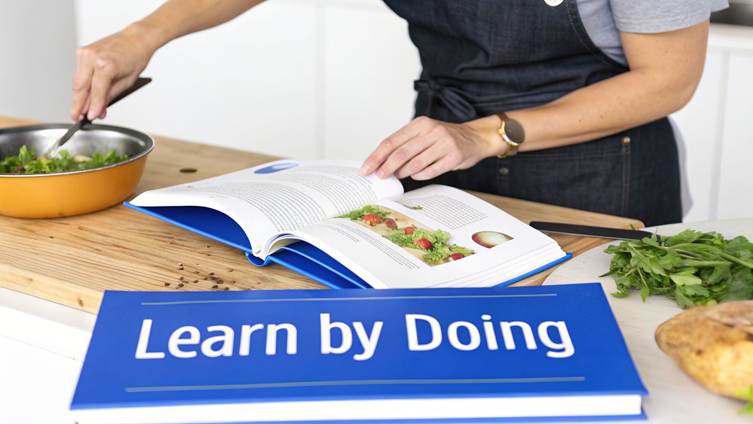
Think of it like this: reading a cookbook gives you the theory, but actually cooking the meal is what builds the skill. Scenario-based learning bridges that same gap between knowing something and being able to apply it under pressure.
So, What Is Scenario-Based Learning Anyway?
At its heart, scenario-based learning is active and experiential. Instead of just sitting back and absorbing information from a lecture, learners are put in the driver's seat of a story that feels real and relevant to their lives.
They’re given a challenge, a few characters, and a series of choices. Every decision they make sends them down a different path with realistic outcomes, giving them instant, contextual feedback. It’s this active problem-solving that makes the knowledge actually stick.
Moving Beyond Passive Learning
Traditional teaching often feels like a one-way street. An instructor delivers information, and students are expected to memorise it. This works fine for foundational knowledge, but it falls apart when people need to use that knowledge in messy, real-world situations.
Scenario-based learning flips this entire model on its head. It’s built on the principle of learning by doing, but in a safe, controlled space where mistakes are just part of the process.
What makes it so effective?
Real-World Contexts: Scenarios are designed to mirror the actual challenges learners will face. This makes the training feel immediately useful and practical.
Active Decision-Making: Learners aren’t just listening. They’re constantly weighing options and making choices that have real consequences inside the simulation.
A Learner-Centred Design: The whole experience is built around the learner's role and their specific challenges. This boosts engagement far more than any generic, one-size-fits-all lesson ever could.
This method gives learners a space to build confidence and sharpen their decision-making skills without the high stakes of real-world failure.
“Scenario-based learning gives learners the chance to practice realistic scenarios in a low-risk virtual environment. It bolsters employee decision-making skills, teaches adaptability, and gives learners valuable feedback on their choices before facing the permanence of reality.”
The Core Components of a Scenario
A great scenario is much more than a multiple-choice quiz with a bit of story thrown in. It’s a carefully built narrative designed to hit a specific learning goal.
Think of it like a short play where the learner is the star. Every good play needs a setting, a conflict, and a resolution. A learning scenario is no different. It needs a clear setup to establish the context, a central problem that needs solving, and branching paths that show the consequences of the learner’s choices.
The goal is to create a simulation that feels authentic. For a business coach, this might be a tough negotiation with a client. For a fitness instructor, it could be a situation where they have to adapt a workout on the fly for a client with an unexpected injury.
It’s that realism that drives deep, lasting learning and makes scenario-based learning a true game changer for any educator serious about delivering real results.
Why Scenarios Completely Change the Way You Teach
Let's be honest. Traditional teaching often forces students to memorise facts for a future they can't quite picture. Scenario-based learning flips that script entirely. It drops them right into the middle of the action from day one.
This isn’t just a small tweak. It’s a fundamental shift from passive listening to active problem-solving, and it’s what makes this method so incredibly effective.
Instead of just talking at them, you build a story where your student is the hero. This simple change makes the material instantly relevant. It’s no longer an abstract concept but a real problem that needs a solution, right now. That’s far more engaging than any slide deck.
A Safe Place to Fail and Grow
One of the biggest blockers to learning a new skill is the fear of messing up. In the real world, a bad move in a client negotiation or a wellness consultation can have serious consequences. Scenarios completely remove that risk.
They create a "sandbox" where learners can experiment, make choices, and see what happens without any real-world fallout. This freedom is where the deep learning happens.
When you let learners safely explore the consequences of their choices, you give them the power to build real confidence. They don't just learn what to do; they understand why it's the best approach.
This safe zone encourages people to tackle tough situations they’d normally shy away from. A business coach can run a simulation of a high-stakes deal, letting a new manager practise until they feel ready for the real thing. A fitness expert can create a scenario where a client suddenly reveals an injury, forcing the trainer to adapt a plan on the fly.
Making Knowledge Stick (and Actually Usable)
Why do we forget so much of what we learn in lectures? Because the information has no anchor. Scenario-based learning solves this by tying knowledge directly to an experience.
When a student makes a decision and sees an immediate result, their brain forges a much stronger connection to that information. This active, hands-on process is a game-changer for retention.
Emotional Connection: Stories and challenges create an emotional response, making the lesson far more memorable than a list of facts.
Contextual Application: Learners don’t just know a concept; they know when and how to use it because they've already done it.
Immediate Feedback: Every choice leads to an outcome. This provides instant, built-in feedback that reinforces the right path or clears up a misunderstanding.
The results speak for themselves. This approach is proven across countless fields, especially where making good decisions under pressure is critical. In healthcare, for example, studies have shown that scenario-based simulations improve the clinical decision-making of professionals by over 30%. You can learn more about how scenario-based training drives real-world results in this in-depth guide.
Moving from Theory to Mastery
At the end of the day, our goal as coaches and creators is to help students become truly competent. That means moving past knowing the theory and into practical mastery. Scenario-based learning is the bridge that gets them there.
It forces learners to pull up information, think on their feet, and apply what they know in a realistic setting. This process strengthens their neural pathways, making skills feel more automatic and reliable when it counts. By putting your students in the driver's seat, you don't just teach them—you prepare them for the real world.
Designing Scenarios That Actually Work
Crafting a scenario that genuinely clicks with a learner is part art, part science. But it's a skill anyone can get the hang of. A truly effective piece of scenario-based learning isn’t just a story; it’s a carefully engineered tool designed to build one specific skill. The secret isn't about making it complicated—it's about clarity and realism.
A powerful scenario drops the learner right into a challenge that feels authentic. It asks them to make choices that lead to meaningful, logical consequences. This is the moment you transform passive knowledge into an active, ready-to-use skill.
Start with a Single Learning Objective
Before you even think about writing your story, you have to nail down its purpose. What is the one thing you want your learner to be able to do after they finish? One of the most common mistakes is trying to teach too much at once, which just leads to confusing and weak training.
Be ruthless with your focus. Don't aim for a fuzzy goal like "improve communication." Instead, get specific: "deliver constructive feedback to a struggling team member without making them defensive." This sharp focus becomes your North Star, guiding every decision you make about the scenario's design.
A great scenario is built on the foundation of one clear, measurable objective. Every character, choice, and consequence should exist only to serve that single learning goal.
This targeted approach means your scenario has a crystal-clear purpose. Learners aren't left guessing what the key takeaway is meant to be; the lesson is baked right into the challenge they're solving.
Build a Relatable Narrative
Once your objective is set, it's time to wrap it in a story that sticks. Authenticity is everything here. The situation has to mirror the real-world problems your audience deals with every day. If it doesn't feel relevant, it won't feel valuable.
Your narrative needs three core ingredients:
A Clear Challenge: Present a problem that demands a decision. This isn’t a simple quiz question but a nuanced situation where the "right" answer isn't immediately obvious.
Compelling Characters: Introduce characters your learners can relate to, even if they're just described in a few sentences. This provides context and gives the learner an emotional stake in what happens next.
Meaningful Decision Points: The choices you offer are the beating heart of scenario-based learning. They must represent genuine dilemmas your learner might actually face in their role.
Imagine a fitness coach creating a scenario where a client, frustrated with slow progress, wants to jump on a risky, unproven workout trend they saw online. The coach’s decision will directly affect the client's trust and safety, making it a powerful, high-stakes learning moment.
Create Realistic Branching Paths
The real magic of a great scenario is in the consequences. Every choice a learner makes has to lead them down a distinct path with a logical outcome. This is how you deliver instant, contextual feedback without yanking them out of the experience.
If a learner makes a poor choice, they shouldn't just be hit with a "Wrong Answer" pop-up. Instead, the story should unfold to show the natural fallout from that decision. This lets them feel the impact of their choice, which is a lesson that sticks far better than any textbook explanation.
To get your branching paths right, think about this:
Logical Consequences: The outcome of a choice has to make sense within the world of your story. If a manager chooses an overly aggressive tone to give feedback, the natural consequence is a defensive, demotivated employee.
Varied Outcomes: Not every path needs to end in total disaster or perfect success. Some choices might lead to neutral, inefficient, or just slightly better outcomes. This reflects the grey areas of real life.
Opportunities for Correction: A well-designed scenario lets learners make a mistake, see what happens, and then gives them a chance to go back and try a different approach. This is what reinforces the learning loop.
To help you map this out, here’s a quick checklist to keep your scenario design on track.
Effective Scenario Design Checklist
Use this checklist to ensure your learning scenarios are structured for maximum impact and engagement.
Design Principle | Key Action | Why It Matters |
Single Objective | Define one specific, measurable skill you want to teach. | Prevents confusion and ensures the entire scenario has a clear purpose. |
Authentic Context | Base the story on a real-world problem your audience faces. | Makes the learning feel relevant and immediately applicable to their job or life. |
Relatable Characters | Create characters that provide context and emotional connection. | Increases learner engagement and makes the consequences feel more significant. |
Meaningful Choices | Offer decision points that represent genuine, non-obvious dilemmas. | Moves learning from passive recall to active problem-solving and critical thinking. |
Logical Consequences | Ensure each choice leads to a realistic outcome that unfolds naturally. | Teaches through experience and shows the why behind the right approach, not just the what. |
Feedback Loop | Allow learners to see the results of their choices and try again. | Reinforces learning by letting them correct mistakes in a safe environment. |
Thinking through each of these points ensures you’re not just telling a story, but building a powerful and memorable learning experience.
Crafting these pathways is what separates a forgettable quiz from an effective training tool. For more practical advice on structuring all your learning content, check out our guide with some of the best online course creation tips you can apply today.
Ultimately, by designing authentic challenges with realistic consequences, you build scenarios that don't just teach—they prepare your learners for reality.
Scenario Based Learning In Action Across Niches
Theory is great, but seeing scenario based learning in action is where its power really clicks. Its biggest strength is its incredible adaptability—it’s not just for corporate compliance or safety drills. Far from it.
Any skill that demands decision-making under pressure can be taught more effectively this way.
Whether you're coaching soft skills or teaching technical know-how, scenarios bridge that critical gap between knowing a concept and actually applying it when it matters. They turn abstract advice into practical, hands-on experience.
To really get a feel for how versatile this is, it’s worth exploring its various use cases across different fields. Below, we’ll walk through three distinct examples to give you a clear blueprint for how you can use this in your own niche.
Example 1: Leadership Coaching
A classic challenge for new managers is learning how to give difficult feedback. It’s a delicate dance—be direct, but be supportive. Reading a book just can't prepare you for the real thing. A scenario is the perfect tool for this.
The Setup: A learner steps into the role of a team leader. They have to address a recurring performance issue with a talented but frequently late employee named Alex. The scene opens with an email from HR flagging Alex's attendance, forcing the manager to take action.
The Decision Points:
Opening the Conversation: How do you start the meeting? Do you get straight to the point and mention the HR email? Do you start with small talk to ease the tension? Or maybe you ask Alex a broad question about how things are going?
Responding to Defensiveness: Alex gets defensive, blaming traffic and a heavy workload. Now what? Do you sympathise, firmly steer the conversation back to the attendance policy, or explore the workload issue first?
Setting Expectations: The final choice is about creating a clear action plan. The manager could set a strict "three strikes" rule, collaboratively build a performance improvement plan (PIP), or simply ask Alex to "try harder."
Each path leads to a different outcome, showing the manager the immediate consequences of their communication style on morale and accountability.
Example 2: Financial Advisory
Financial advisors often have to guide clients through stressful market downturns and prevent panic-driven decisions. A scenario can simulate these high-stakes conversations, giving an advisor a safe space to practise keeping a client’s trust when things get volatile.
The flow diagram below shows the simple, core process for designing these kinds of targeted scenarios.
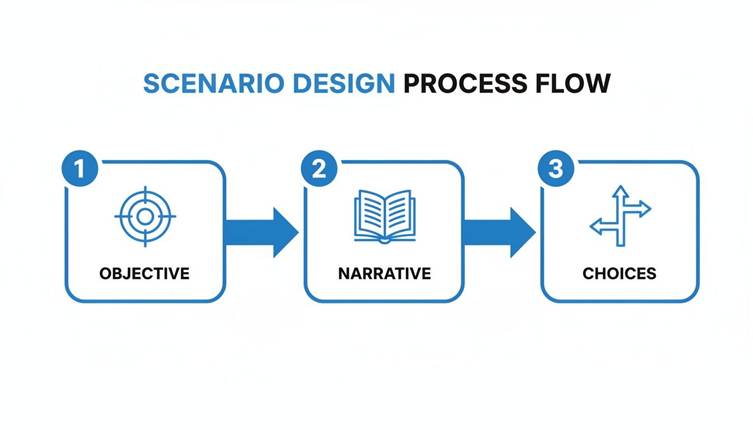
This process really highlights that every good scenario starts with a clear learning goal, is built around a compelling story, and hinges on meaningful choices.
The Setup: A trainee advisor gets a panicked call from a long-term client, Sarah, who is five years from retirement. Her portfolio just dropped 15% in a sudden market correction. She wants to sell everything and move to cash. Right now.
The Decision Points:
Initial Response: How does the advisor handle Sarah's panic? Do they immediately try to talk her out of it, validate her fears first, or schedule a formal meeting to discuss it later?
Presenting Data: The advisor has to explain the risks of selling low. They could show historical data on market recoveries, re-evaluate her risk tolerance profile on the spot, or shift the focus back to her long-term financial plan.
The goal isn’t to find a single "right" answer. It's to practise the communication strategies that build long-term trust, even when the immediate news is bad.
This simulation teaches advisors how to manage client emotions—a critical soft skill that's almost impossible to learn from a textbook. The growing use of AI in education is making these simulations more dynamic and realistic than ever before.
Example 3: Language Instruction
For language learners, navigating real-world social situations is often way more intimidating than conjugating verbs. A scenario can provide priceless practice for those tricky cultural and linguistic moments.
The Setup: A student learning Japanese is invited to a dinner party at their boss's home in Tokyo. This is a situation loaded with subtle cultural etiquette that could easily go wrong.
The Decision Points:
Greeting the Host: Upon arrival, what’s the right greeting? A simple "Konnichiwa"? A more formal bow? A casual handshake?
Receiving a Compliment: The host compliments the student's Japanese. How should they respond? A simple "Arigatou" (Thank you)? A humble "Ie, mada mada desu" (No, I still have a long way to go)? Or should they deflect the compliment?
Refusing a Drink: The host offers another glass of sake, but the student has had enough. They have to choose the most polite way to decline without causing offence.
These examples just scratch the surface, but they all point to one universal truth. No matter your niche, scenario based learning gives your students the one thing they truly need to succeed: a safe place to practise for reality.
Bringing Your Scenarios to Life with Skolasti

Understanding the theory behind powerful scenarios is one thing; actually building them is another. The good news? You don’t need a team of developers or a degree in instructional design to create immersive, effective scenario based learning experiences.
With the right tools, you can move from a great idea to a fully functioning learning simulation, and you can do it fast.
This is where a platform like Skolasti makes all the difference. It gives you the essential building blocks you need to construct branching narratives, measure performance, and even bring your scenarios to life with AI—all inside one system. It’s really about making this advanced teaching method accessible to every single creator.
And the demand for these tools is growing. The global AI-driven scenario-based learning market is on a serious upswing, which just shows how many educators are adopting this method to deliver real results. You can see the full breakdown in this report on AI-driven learning market trends.
Building Your Branching Narrative
At the heart of any scenario are its branching paths, where every choice a learner makes leads to a unique outcome. Skolasti’s course builder is designed to make this process feel intuitive. You can map out your entire scenario visually, treating each decision point and its consequence as a separate lesson or module.
This structure lets you easily connect different pieces of content to create a seamless flow. For example:
A learner makes Choice A and is automatically taken to a video lesson showing the positive outcome.
They pick Choice B and are instead sent to a short text lesson explaining the negative consequences, followed by a chance to try again.
This modular approach takes the headache out of creating complex narratives. It lets you focus on the story and the learning goals, not on wrestling with complicated software.
The goal is to make the technology disappear, so the learner feels completely immersed in the story you've created. A good platform handles the technical connections behind the scenes, letting your narrative shine.
By linking lessons based on learner decisions, you can build everything from simple two-path scenarios to intricate stories with multiple endings. All without writing a single line of code.
Using Quizzes as Interactive Decision Points
Quizzes in Skolasti are much more than simple knowledge checks. They are powerful tools for creating the interactive decision points that drive your scenarios forward. Instead of a standard multiple-choice question, you can frame each option as a distinct action the learner can take.
This simple shift transforms a passive test into an active part of the story. Imagine a sales coaching scenario where a quiz asks: "Your client says your price is too high. What do you do?"
Offer a discount immediately. (This choice leads to a lesson on protecting your margins.)
Ask follow-up questions to understand their budget concerns. (This leads to a best-practice outcome.)
Defend your price by listing features. (This path shows a common but less effective tactic.)
You can set up the quiz to direct the learner to a specific lesson based on their answer. It effectively turns the quiz into the engine that powers your branching narrative.
Leveraging the AI Teaching Assistant
This is where you can truly elevate your scenario based learning. Skolasti's AI Teaching Assistant can play a dynamic role within your simulations, providing personalised feedback and even acting as a character.
Think about a leadership training scenario where a learner needs to practise giving difficult feedback. You can set up the AI to respond as the "employee," reacting realistically to the learner's approach based on the tone and phrasing they use. It creates a dynamic practice environment that feels incredibly real.
The AI can also provide immediate, contextual feedback. If a learner makes a poor choice, the AI can explain why it was a bad move and suggest a better approach, reinforcing the lesson right in the moment. This is a huge step up from static, pre-written feedback—it’s a truly interactive and adaptive learning experience.
To get a better sense of all the tools at your disposal, you can learn more about Skolasti's integrated features.
Common Questions About Scenario-Based Learning
Diving into scenario-based learning can feel like a huge step, but most of the hurdles people worry about are smaller than they seem. Let's tackle these questions head-on so you can feel confident building more powerful, engaging experiences for your students.
The biggest fears? Time and technical skills. But the truth is, you can start small. The core idea is to focus on a single, clear learning goal and build from there.
Is Building Scenarios Too Complicated For A Solo Creator?
Not at all. A powerful scenario doesn’t need a dozen complex branches to hit the mark. The key is to start with one meaningful decision point that leads to two or three logical outcomes. That’s it. That’s the foundation.
Tools like Skolasti are built to make this intuitive, letting you link lessons or quizzes to create different learning paths without touching a single line of code. Just focus on one clear learning objective per scenario. A simple, well-designed simulation is always better than a sprawling, confusing one.
The goal is to create realistic practice, not a blockbuster movie. Keep your focus on the quality of the decision and its consequences, and you'll create a fantastic learning tool.
How Can I Tell If My Scenarios Are Effective?
Measuring success is how you refine your craft. The best way is to mix hard data with direct feedback from your learners to see what’s really landing.
On a platform like Skolasti, you can jump into your analytics to see which paths students choose most often and how they do on any related quizzes. But don’t stop there.
The most valuable insights come from asking your students directly.
Did the scenario feel real and relevant?
Did it help them grasp the concept better?
Could they explain why they made the choices they did?
A truly effective scenario is one where a learner can connect their decision to the outcome and clearly articulate what they learned in the process.
Does SBL Work For Teaching Soft Skills?
Absolutely. In fact, it's one of the best methods out there for it. Soft skills like leadership, communication, and negotiation are all about context, which makes scenario-based learning the perfect training ground. You just can't learn these things from a textbook.
You can build simulations of a difficult client conversation, a tense team conflict, or a high-stakes negotiation. This gives learners a safe space to practise their responses, see the immediate impact of their communication style, and learn from mistakes without real-world consequences.
Ready to build immersive learning experiences that get real results? Skolasti gives you all the tools you need to design, launch, and measure powerful scenarios, complete with an AI Teaching Assistant to make your simulations even more dynamic. Start creating more impactful courses today by exploring the platform at skolasti.