The simulation teaching method is a powerful way to teach where learners get hands-on with a model of a real-world system or challenge. Unlike just reading a textbook, it offers a safe, controlled space to practise skills, make critical decisions, and see the results of those choices—all without any real-world risk.
Understanding the Power of Practice Without Penalty
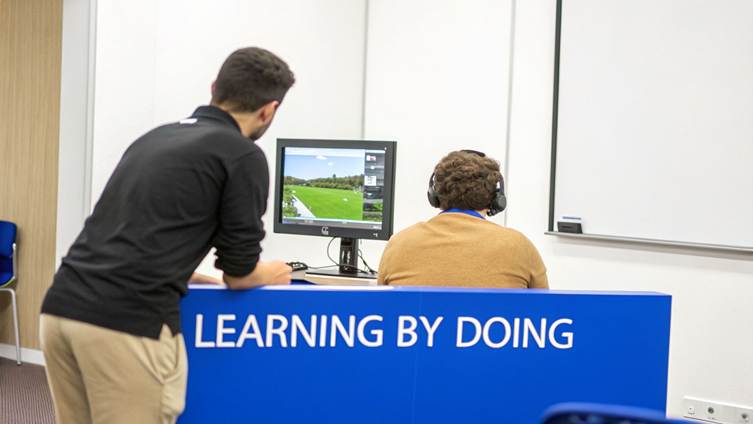
Think about a pilot learning to fly. Before they ever touch the controls of a real plane, they spend hours in a flight simulator. Inside that simulator, they can face engine failures, navigate through terrible weather, and attempt tricky landings, all while safely on the ground.
Every mistake isn't a disaster; it's a lesson. The simulation teaching method brings this exact concept into any classroom or training environment, from medicine to business.
At its heart, this is experiential learning—it’s learning by doing. Instead of just listening to a lecture, students become active participants. They’re dropped into a carefully designed scenario that mirrors a real challenge they’ll one day have to solve on their own.
Moving Beyond Memorisation
This completely changes the goal of learning. It’s no longer about simply remembering facts but about knowing how to apply them. The focus shifts to building practical skills, sharpening critical thinking, and developing good judgement.
It works by creating a loop of action and immediate feedback. For example, in statistics education, simulation-based teaching helps students truly understand complex ideas by letting them interact with data models. You can find more about the educational benefits of this approach over at serc.carleton.edu.
The essence of the simulation teaching method is creating a bridge between theoretical knowledge and practical application. It finally answers the student's age-old question, "When will I ever use this?" by showing them exactly when and how.
Simulation Method vs Traditional Lecturing
To really see the difference, it helps to put the simulation method side-by-side with a traditional lecture. The comparison makes it clear why this is such a major shift in how we think about education.
Here's a quick breakdown of where they differ.
Attribute | Simulation Teaching Method | Traditional Lecturing |
Learner Role | Active participant, decision-maker | Passive recipient of information |
Focus | Skill application, critical thinking | Knowledge acquisition, memorisation |
Feedback | Immediate and consequence-based | Delayed, often via tests or exams |
Failure | A safe and valuable learning tool | An outcome to be avoided |
Engagement | High, driven by interaction | Varies, often depends on speaker |
The table really tells the story. Active learning builds skills, while passive learning focuses on memorisation.
Ultimately, the simulation teaching method prepares people for the messy, unpredictable nature of the real world. By letting them practise in a consequence-free zone, it builds not just competence, but the confidence they need to perform when it really counts.
Why Simulation-Based Learning Actually Works
So, what makes the simulation teaching method so powerful? It's not magic—it's just how our brains are built to learn. Simulations tap directly into our natural ability to learn by doing, creating a potent cycle of action and reflection that builds knowledge that actually sticks.
This method isn't a new-age fad; it’s a practical application of proven learning science, most famously captured in David Kolb's model of Experiential Learning. Instead of just passively listening to a lecture or reading a chapter, learners get their hands dirty. They're not just absorbing facts; they're building mental models by interacting with a situation firsthand.
The Cycle of True Understanding
The best way to think about experiential learning is as a continuous loop. Simulations are perfectly designed to guide learners through this cycle, deepening their understanding at every stage.
Concrete Experience: This is the "doing" part. The learner jumps into the simulation, makes decisions, and takes action within the scenario. They're living the problem, not just reading about it.
Reflective Observation: After the simulation, the learner steps back. They review what happened, why it happened, and what the consequences of their actions were. This is where the "aha!" moments begin.
Abstract Conceptualisation: Here, learners connect the dots between their specific experience and the bigger picture. They start to form new ideas or adjust their old ones based on what they just went through.
Active Experimentation: Finally, the learner takes their newfound insight and plans how they'll tackle the situation next time. This primes them for the next experience, ready to apply what they’ve learned.
This structured process is what transforms learning from a temporary memory into a permanent skill. It’s the difference between reading a book on negotiation and actually navigating a tough conversation with a simulated client. You feel the pressure, make the mistakes, and learn in a way that’s impossible to forget.
By grounding lessons in direct experience, simulations make learning sticky. The brain creates stronger neural pathways when we solve problems ourselves, making knowledge retention far more effective than rote memorisation.
While the benefits are clear, global adoption rates still have a long way to go. Comprehensive regional statistics on simulation-based teaching in India, for instance, are not yet widely available, highlighting a massive opportunity for growth in educational systems around the world. To get a better sense of the global context, you can learn more by reading research on pedagogical tools like these.
Understanding this "why" gives educators the confidence to move beyond traditional methods, knowing they are using a core teaching tool that is grounded in proven cognitive science.
Exploring Different Types of Learning Simulations
The real power of the simulation teaching method is its flexibility. A carpenter wouldn’t use a hammer for every job, and an educator shouldn’t use the same simulation format for every skill. This is not a one-size-fits-all game; the secret is matching the right type of simulation to your specific learning goal.
From simple text-based scenarios to immersive virtual worlds, each format offers a unique way to pull learners in and build skills that stick. Getting a handle on these options is the first step to designing an experience that truly connects with your students and makes your subject come alive.
Role-Playing Simulations
Role-playing simulations are all about the messiness of human interaction. They drop learners into a specific role within a fictional scenario, pushing them to communicate, negotiate, and solve problems from a new perspective.
Imagine a sales coach building a simulation where a trainee has to overcome an objection from a difficult client. The learner doesn't just read about the technique; they have to type out their response, see how the "client" reacts, and learn to adjust their communication style on the fly—all in a safe, no-stakes environment.
These are perfect for honing those crucial soft skills, such as:
Conflict Resolution: A leadership coach could set up a scenario where a manager must mediate a dispute between two team members.
Customer Service: A training consultant might simulate a support call with an angry customer, testing the learner’s empathy and problem-solving skills under pressure.
Negotiation: An instructor can design a simulation where students have to negotiate the terms of a contract with a simulated counterpart.
Case-Based Scenarios
Think of case-based scenarios as interactive stories where your learners are the protagonists. They’re given a detailed situation—a business on the brink, a complex medical diagnosis, an ethical grey area—and must analyse the information to decide on the best path forward.
For example, a business mentor could present a case study of a struggling startup. At each turn, the learner makes strategic decisions about marketing, finance, and operations. Every choice leads to different outcomes and very real consequences for their fictional company.
This method is fantastic for teaching critical thinking and strategic analysis. It forces learners to look past the textbook facts and apply their knowledge to solve messy, multi-layered problems that mirror the ambiguity of the real world.
Computer-Based and Virtual Reality Simulations
When you need to teach technical or procedural skills, computer-based simulations are indispensable. These can be as simple as software that mimics a specific program or as complex as fully immersive virtual reality (VR) experiences. A software instructor, for instance, could use a computer simulation to teach a data analysis tool, letting students practise its functions without needing the actual software installed.
Virtual Reality takes this a huge step further. It offers hands-on training for tasks that are otherwise expensive, dangerous, or just plain difficult to replicate. The data backs this up: studies have shown that more than 80% of participants in some psychiatric nursing courses reported better learning and more confidence after using simulations. The rise of AI in education is now making these powerful tools more accessible than ever before.
How to Design Effective Learning Simulations
A great simulation doesn't just happen; it's meticulously designed. Much like a well-crafted game, it needs clear goals, engaging challenges, and a satisfying feedback loop to really work. Building one yourself requires a thoughtful approach that puts the learner's journey first, moving from a sharp objective to a polished, repeatable experience.
The whole process starts with one crucial question: What should my learners be able to do after this simulation? This isn't about what they should know, but what skill they can actually apply. Pinning down this clear, action-oriented learning objective is the bedrock that guides every other decision you'll make.
Finding the Balance Between Realism and Simplicity
Once you have your objective, the next challenge is creating the scenario. The real art here is balancing authenticity with simplicity. A simulation has to feel real enough to be valuable but not so complex that it overwhelms the learner. If your scenario is cluttered with irrelevant details, it just distracts from the core skill you're trying to build.
For instance, if you're teaching negotiation skills, you need the core tension of a tough conversation. You absolutely do not need to simulate the company's entire financial history. Just focus on the elements essential for practising that one target skill.
The most effective simulations provide a high-fidelity experience of the problem, not necessarily a high-fidelity re-creation of the entire environment. Keep it focused on the decision-making process.
This visual shows how different types of simulations fit different learning needs.
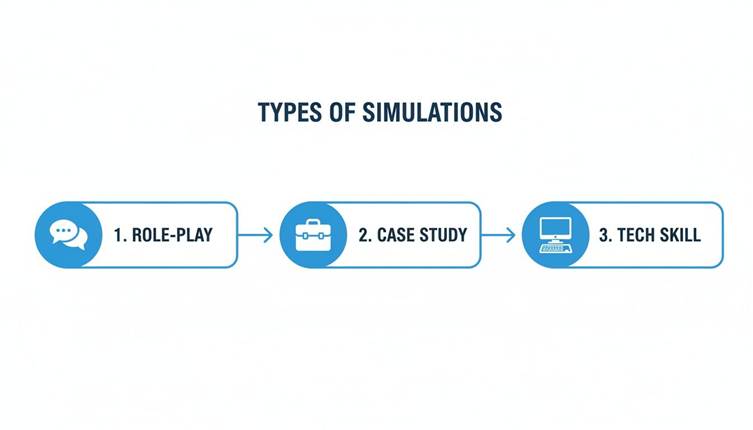
Each format—from role-play to a detailed case study—is a specific tool designed to solve a different kind of learning problem.
Structuring Feedback and Iteration
How learners get feedback is just as important as the simulation itself. Good feedback needs to be immediate and constructive, guiding learners toward improvement without just handing them the answers. It’s all about prompting reflection.
Consider these ways to deliver powerful feedback:
Consequence-Based Feedback: Let the simulation's own outcomes do the talking. A poor decision in a business simulation should lead to a measurable drop in profits. Simple as that.
Guided Reflection Prompts: After the simulation, ask sharp questions like, "What would you do differently next time?" or "At which point did you feel most uncertain about your decision?"
Model Comparisons: Let learners see how an expert navigated the same scenario. This allows them to spot the gaps in their own strategy instantly.
The design process itself is rarely a straight line; it's iterative. You build a prototype, test it with a small group, get their feedback, and refine it. This cycle ensures the final product is not just educational but genuinely engaging. For educators looking to explore AI-powered application development, new tools are making it easier to create dynamic simulations that respond to learner choices in real time.
Ultimately, designing a powerful learning experience, whether it's a simulation or a full programme, follows similar principles. For more practical advice, check out our guide with online course tips.
Assessing Student Performance in Simulations
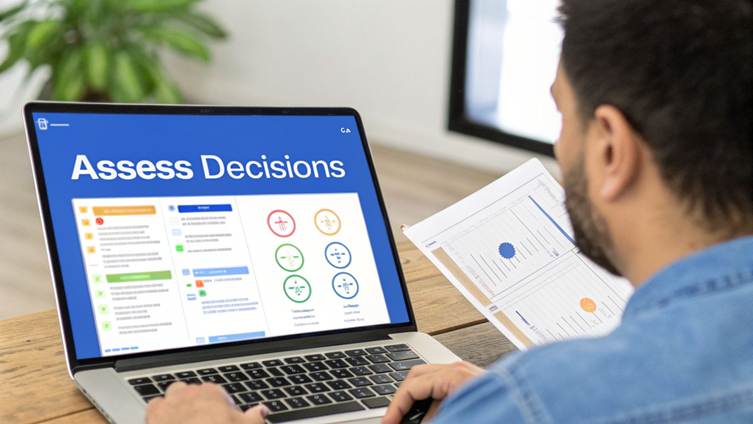
So, when learning gets this dynamic and interactive, how do you actually measure success? Traditional tools like multiple-choice questions just don’t cut it with the simulation teaching method. Assessing performance in a simulation demands a fundamental shift—away from just the final outcome and towards the decision-making process itself.
The goal isn't just to see if a student got the "right" answer. It’s to understand how they got there. This approach gives you far richer insights into their real-world grasp of the material and their ability to apply skills under pressure. It's the difference between testing memory and evaluating genuine competence.
Moving Beyond Simple Scores
To really capture the complexity of a student's performance, educators need more nuanced tools. A well-designed rubric is probably one of the most powerful instruments for the job. Instead of just slapping a grade on the final result, a rubric lets you assess the critical steps a learner took along the way.
Take a project management simulation, for example. You’d be evaluating key behaviours:
Resource Allocation: Did they assign the budget and team members effectively?
Problem-Solving: How did they react when an unexpected delay popped up?
Communication: Did they keep stakeholders in the loop at critical moments?
This kind of process-oriented assessment opens a window into a student’s thought process, shining a light on both their strengths and the areas where they need more practice. It turns assessment from a final judgement into a valuable part of the learning journey itself.
By tracking the choices a learner makes, you gain a clear window into their strategic thinking. The most valuable data isn't whether they succeeded or failed, but the quality of their decisions at each critical juncture.
The Power of the Debrief
The assessment doesn't stop when the simulation ends. In fact, a structured post-simulation debrief is often where the most profound learning clicks into place. This is a guided conversation where learners reflect on what just happened, explain their choices, and connect their actions to the outcomes they saw.
An effective debrief forces reflection and cements understanding. For educators managing large cohorts, tracking participation and reflection can be simplified with the right tools. With a platform like Skolasti, for instance, you can explore features that support structured assessments and track learner progress at scale, making the whole process manageable.
Ultimately, assessing performance in the simulation teaching method is all about observing, guiding, and refining a student’s ability to think critically and act decisively.
Frequently Asked Questions
When you start digging into the simulation teaching method, a few practical questions almost always come up. How is this really different from other teaching styles? Where does it actually work best?
Let's clear up some of the most common questions we hear from educators who are thinking about bringing this hands-on approach into their own teaching.
Are Simulations and Gamification the Same Thing?
It's a great question because they can look similar on the surface, but their DNA is completely different.
Gamification is about adding game-like features—like points, leaderboards, or badges—to a regular task to make it more engaging. Think of it as a motivational layer. A simulation, on the other hand, is all about accurately recreating a real-world system or process so someone can learn by doing.
The main goal of a simulation is realism and learning from consequences. A game, even an educational one, is built around rules and engagement, with learning often being a happy byproduct.
Is This Method Only for Technical Subjects?
Not at all. While simulations are famous in high-stakes technical fields like aviation and medicine, they are incredibly powerful for teaching soft skills.
Role-playing simulations are perfect for sales training, leadership development, or practising difficult conversations in conflict resolution.
Any subject that involves a process, a system, or complex human dynamics can be taught brilliantly with a simulation. It’s a flexible tool that’s just as effective for business strategy and ethical decision-making as it is for customer service.
What Skills Do I Need to Create a Simulation?
This really depends on how complex you want to get. You don't need to be a coder to get started.
A simple text-based role-play or a case study with branching choices can often be built using the tools you already have. The technical skill needed is minimal.
If you're aiming for more advanced computer-based simulations, you might need specific software. But many modern platforms are designed to make creation simple, letting you focus on the learning design, not the code. The secret is to start with a clear learning goal and then pick the simplest tool that gets the job done.
Ready to build your own high-impact courses with secure, engaging simulations? Skolasti gives you all the tools you need—from a white-label platform to a built-in AI Teaching Assistant—to protect your content and deliver an incredible learning experience. Start your 30-day trial and see just how easy it is to teach smarter.