In India, we produce lakhs of graduates every year. Yet employers consistently say one thing — technical knowledge is not the problem. Communication, adaptability, and confidence are. As trainers, we cannot ignore this gap anymore. This guide is built for you—the coach who is the vital link in solving this very paradox.
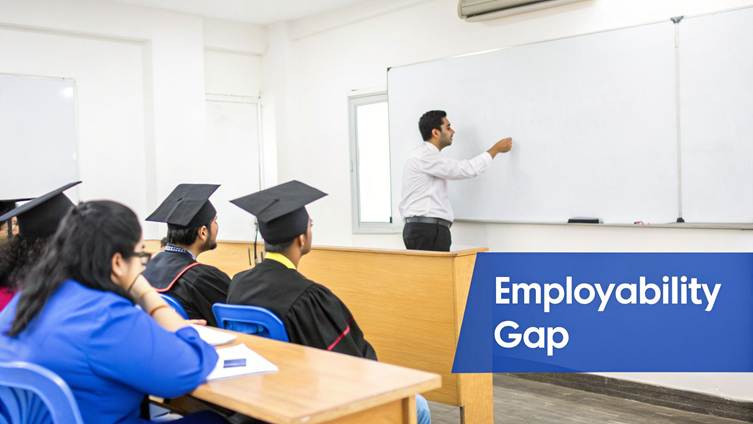
The disconnect between academic achievement and workplace readiness isn't just a feeling; it's a well-documented reality. It all comes down to understanding the difference between Soft Skills vs Hard Skills. Our education system is fantastic at teaching hard skills (the 'what' of a job), but it often skips over the soft skills (the 'how').
This gap has serious economic consequences. The India Skills Report 2024 paints a stark picture: out of 3.88 lakh candidates assessed, only 47% of graduates had market-ready soft skills. Effectively teaching soft skills is no longer a 'nice-to-have'—it's the core competency needed to bridge the gap between holding a degree and building a successful career.
Why Soft Skills Training Fails in Many Indian Institutions
As trainers, we’ve all seen it happen. An institution puts on a one-day workshop on "communication skills," students sit through a PowerPoint, and a week later, absolutely nothing has changed. When coaches read this, they will feel: 👉 “Yes, this is exactly what I see.”
The heart of the problem is treating soft skills like another academic subject to be memorised. But skills like teamwork, public speaking, and critical thinking aren't theories you learn from a slide deck. They are practical abilities that must be built through action.
Several deep-rooted issues stop this from happening in a typical training session:
Soft skills are taught as theory: The focus is on knowing concepts, not on doing them. Students learn the 'what' but never practice the 'how'.
One-time workshop approach: A single event might spark awareness, but it will never build a skill. True competence only comes from practice, feedback, and reinforcement over time.
No practice-based reinforcement: Once a workshop is over, there's almost never any follow-up. Students go right back to their normal curriculum with no structured way to apply what they’ve supposedly learned.
Students fear making mistakes in English: For a huge number of students, the fear of making a grammatical error or being judged for their accent is a massive barrier. They'd rather stay silent than risk looking foolish.
Hierarchical classroom culture prevents open discussion: The traditional Indian classroom, where the teacher talks and students listen, kills any chance for open discussion. Students are often too hesitant to ask questions.
This cycle of theory-only learning, combined with a fear-based environment, guarantees that students leave with awareness but zero actual ability. If you're curious about new ways to break this pattern, exploring the role of AI in education can offer some powerful ideas for creating personalised, safe spaces for practice. To make a real impact, we have to shatter this cycle for good.
The SPEAK Framework: A Model for Indian Coaches
Let’s be honest. We’ve all seen it happen. You run a fantastic workshop, deliver powerful theory, and everyone leaves feeling inspired. A week later? It’s like nothing ever happened. The old way of teaching soft skills is broken. Real skills aren’t built on theory alone; they’re forged through consistent, guided practice. When you create a model, your article becomes premium.
This is exactly why we developed the SPEAK Framework. It’s a five-part model designed for trainers in India who are serious about getting results for their learners. Think of it not as a theory, but as a practical roadmap that turns abstract goals into a concrete action plan.
The traditional approach often fails because it ignores the biggest hurdle: the fear of real-world application.
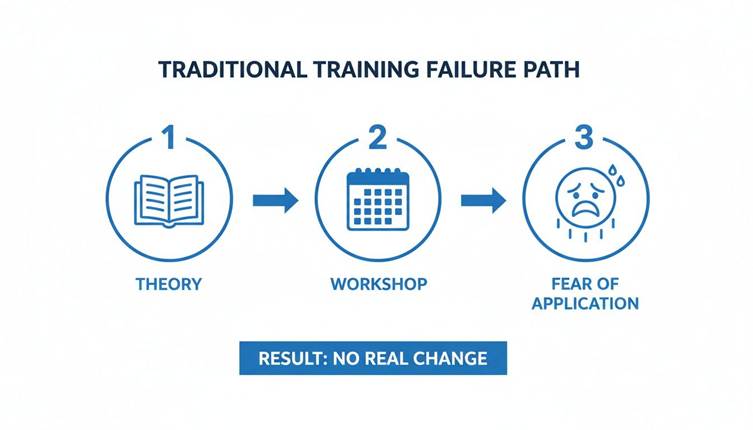
As you can see, the gap between learning and doing is where skills go to die. The SPEAK framework is engineered to bridge that exact gap.
The Five Pillars of the SPEAK Model
Each part of the SPEAK framework is designed to tackle a specific weakness in the old, ineffective model. It creates a complete, cyclical system for genuine skill development.
S – Simulation: This is where theory gets its hands dirty. Instead of just talking about job interviews, your learners will actually go through them. Simulation creates a safe, low-stakes environment to practice high-pressure situations.
P – Peer feedback: You can’t be the only one giving feedback. The Peer Feedback pillar builds a culture where learners give and receive constructive criticism, sharpening their own communication skills.
E – Exposure: Confidence isn’t built by thinking; it’s built by doing. This pillar is all about gradual, systematic exposure to the very things that cause anxiety, like weekly public speaking drills.
A – Application: This is the secret to making skills stick. Learners don’t just learn how to write a professional email; they start using that format for all course communication. This turns an exercise into a habit.
K – Knowledge reinforcement: We all know that one-time learning leads to forgetting. The final pillar uses consistent drills and smart tech to lock in the learning, ensuring that skills become second nature.
The SPEAK Framework fundamentally shifts the focus from "knowing" to "doing." It creates an active, iterative learning cycle where students practice, get feedback, and improve continuously. To fix this, we need to shift our focus from just delivering content to showing students methods on how to learn effectively.
By adopting a model like this, you give your learners a clear, organised path to success. To see how you can build these principles directly into your programmes, take a look at our guide on how to structure high-impact online courses.
Practical Training Methods That Deliver Results (The Gold Section)
A framework gives you structure, but the real transformation happens during practice. This is your gold section—a toolkit of implementation-heavy training methods you can start using in your very next session. These techniques are designed to be practical and effective in the Indian context.
✔ Role-play Interviews (Weekly)
For many Indian graduates, the job interview is a huge source of anxiety. A one-off workshop is useless. They need consistent, simulated practice.
Simulate real Indian HR interviews: Use actual job descriptions and prepare a list of common behavioural questions like, “Tell me about a time you handled a conflict in your team.”
Assign Roles: Have one student play the interviewer, another the interviewee, and the rest act as observers with a feedback rubric. This weekly ritual transforms the interview from a dreaded event into a familiar process.
✔ Daily 5-Minute Speaking Drill
The fear of public speaking, especially in English, is a major hurdle. The key is frequent, low-stakes practice.
Pick a random topic (e.g., "My favourite street food," "A movie that changed my perspective").
A student speaks for 2 minutes without preparation.
The goal is to get students comfortable with thinking on their feet. After a few weeks, you'll see a visible boost in fluency. For more inspiration on creating engaging activities, check out these valuable online course tips.
✔ Email Writing Correction Sessions
Written communication is just as critical. Many students struggle with professional tone and grammar. Instead of just marking up assignments, hold live writing clinics.
Using a screen-sharing tool, project a student's email draft and edit it collaboratively as a group. Correcting grammar & tone live is far more impactful than red marks on a page.
✔ Group Debate with Rules
To build critical thinking and the ability to disagree respectfully, use structured debates.
Choose a current topic and divide the class into "For" and "Against."
Set clear rules: fixed speaking time, evidence-based points, no personal attacks.
This encourages structured disagreement and teaches learners how to articulate their views professionally.
✔ Feedback Sandwich Method
Teach your students how to give and receive feedback respectfully, a crucial skill for teamwork. The method is simple:
Start with a specific and genuine positive comment.
Provide constructive criticism on what could be improved.
End with another positive, encouraging comment.
This technique makes feedback easier to hear and apply, fostering a supportive learning environment.
Understanding Indian Psychology in the Classroom
If you want to truly excel at teaching soft skills in India, you need to go far deeper than standard techniques. Generic advice from the West often falls flat because it misses the unspoken cultural and psychological dynamics of the Indian classroom. This is where you stand out.
The Fear of Public Embarrassment & English Anxiety
In Indian classrooms, students hesitate to speak because they fear being judged. The fear of "losing face" or making a mistake in English is an incredibly powerful force. It’s not that they don't know the answer; they’re terrified of being judged by their peers and the instructor. Over-dependence on marks reinforces this fear of failure.
A coach must normalize mistakes. Your primary job isn't to teach a skill. It's to create an environment where it's safe to fail at learning that skill.
Navigating Respect for Authority
This fear is complicated by a deep cultural respect for authority. The traditional classroom is hierarchical. The teacher speaks, students listen. This discourages questions or challenges.
To counter these forces, a coach must create safe environments.
Position yourself as a facilitator, not an expert. Use phrases like, "What are your thoughts on this?"
Use small-group activities. A student who would never speak in front of the whole class is often comfortable with just two or three peers.
Implement anonymous feedback channels. Use digital tools like Mentimeter or simple feedback boxes where students can ask questions without revealing their identity. This removes the fear of judgement.
Case Example: A Hyderabad Institute's Success Story
Theory is one thing, but real-world results add credibility. Let's look at a hypothetical case study.

A training institute in Hyderabad was working with final-year engineering students who were brilliant on paper but fumbled during interviews. The trainer implemented weekly mock presentations and peer feedback sessions for 3 months.
Initially, students hesitated. The trainer reinforced that mistakes were part of the process and provided simple rubrics for constructive feedback. By week 5, there was a shift. By week 8, the change was undeniable.
The Results After Three Months:
Participation increased by 70% as students grew more comfortable.
Placement interview confidence improved significantly, with students reporting less anxiety.
Recruiters noted the cohort’s clear communication and professional poise.
The lesson is clear: practical, consistent application is what turns anxious students into confident professionals. This is critical in a market that's booming; you can read the full research on India's booming soft skills market to grasp just how massive this opportunity is.
Your Role in Building India's Future Confidence
The path to teaching soft skills effectively isn't about memorising new theories. It's about a fundamental shift toward practical, psychologically-aware coaching.
Your role as a coach goes far beyond just delivering a curriculum. You aren't simply teaching communication; you are the architect of a student's confidence. You're building safe spaces where young Indians can find their voice, dare to lead, and prepare to innovate on a global stage. The methods we’ve explored—from the SPEAK Framework to immersive role-playing drills—are your tools for this vital work.
As coaches and trainers in India, we are not just teaching communication skills. We are building confidence for a global stage. Soft skills are no longer optional modules — they are core competencies.
This is more than a professional duty; it’s a higher calling. Every single student who leaves your session more articulate, more collaborative, and more self-assured is a direct testament to your impact. You are personally tackling the skills gap and shaping the next generation of leaders, one student at a time.
Ready to scale your impact and build a high-calibre online academy? Skolasti provides all the tools you need—from secure course delivery to an AI Teaching Assistant that supports your learners 24/7. Teach smarter, protect your content, and monetize your expertise at https://www.skolasti.com.