What Is Microteaching and How Can It Improve Your Skills
So, what exactly is microteaching?
Imagine a musician practising a single, tricky chord progression over and over, instead of playing an entire song. That’s the essence of microteaching. It's a focused training method where an instructor isolates, practises, and refines one specific teaching skill in a short, low-stakes session that's recorded for review.
Understanding Microteaching and Why It Matters
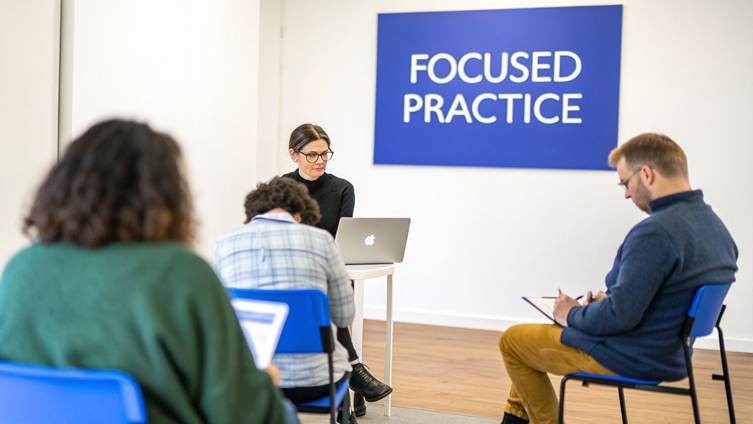
At its heart, microteaching is about closing the gap between knowing the theory and actually doing the teaching. Instead of just reading about effective instructional methods, educators get to actively test them out in a controlled environment. The whole art of teaching, which can feel overwhelmingly complex, is broken down into small, manageable skills.
The process itself is refreshingly simple. An educator plans and delivers a very brief lesson, usually just 5 to 10 minutes long, to a small group of peers or students. This mini-lesson is recorded, which is critical for providing detailed, evidence-based feedback later on. The focus isn’t on the lesson content, but on mastering a single, predetermined skill.
The Core Teach-Feedback-Reteach Cycle
The real power of microteaching comes from its iterative loop. After the initial "micro-lesson," the instructor gets constructive feedback from their observers and through a self-review of the recording. This feedback isn't general; it's targeted specifically at the skill they were working on.
But the most important step comes next. The instructor takes that feedback, revises their approach, and then reteaches the same short lesson, often to a different small group. This immediate chance to apply what they've learned is what solidifies the new skill and builds genuine competence. It's practice with purpose.
By isolating one skill at a time—like asking effective questions or managing classroom transitions—microteaching allows for deep practice without the pressure of a full-length class. It creates a safe space to experiment, fail, and improve.
The Core Components of a Microteaching Session
The structure of a microteaching session is deliberately designed for focused improvement. Below is a quick breakdown of its fundamental elements that make the cycle work.
Component | Description | Purpose |
Specific Skill | The session's goal is clearly defined (e.g., improving vocal variety). | To provide a narrow, measurable focus for practice and feedback. |
Short Lesson | The duration is brief (5-10 minutes) to keep attention on the skill. | To prevent overwhelm and allow for multiple practice-feedback cycles. |
Small Audience | Teaching a handful of peers or students simplifies class dynamics. | To reduce performance anxiety and allow for more focused observation. |
Constructive Feedback | Observers give specific, actionable advice tied to the target skill. | To provide clear, evidence-based guidance for improvement. |
Repetition (Reteach) | The instructor reteaches the lesson after incorporating feedback. | To turn feedback into tangible skill development and build confidence. |
This disciplined approach helps both new and experienced instructors build real, tangible skills and the confidence to use them. In fact, research shows that the opportunity to teach a session multiple times with dedicated reflection is an essential part of the process.
For course creators building an online academy, this is a game-changer. You can use microteaching to practise your on-camera presence, refine how you explain complex ideas, and perfect your delivery before you ever launch a course. It’s a direct path to higher-quality instruction and, ultimately, more successful and satisfied learners.
The Proven Power of Focused Practice
To really get why microteaching works so well, it helps to look at where it came from. It was first developed at Stanford University way back in the 1960s, and it represented a huge shift in how we train teachers. Before microteaching, trainees mostly just sat and watched experts. This new method threw them into the action, focusing on hands-on, active skill building.
The theory behind it is surprisingly simple but incredibly powerful. It’s based on the idea that teaching, like any complex action, is really just a bundle of smaller, individual skills. By isolating and practising one of those skills at a time, a teacher can master it far more quickly than by trying to fix everything at once.
From Theory to Masterable Skills
This whole approach is rooted in the principles of reflective practice. Think of it like this: you could practise a presentation by just reading your notes over and over. Or, you could record yourself, listen back, find those awkward phrases, and deliver it again with targeted improvements. That second method—the one with focused practice plus immediate feedback—always leads to faster progress.
Microteaching takes the fuzzy, abstract "art of teaching" and breaks it down into concrete skills you can actually master. It follows a simple but highly effective cycle:
Plan: Decide on one specific skill to practise, like asking open-ended questions.
Teach: Deliver a short, focused lesson (just 5-10 minutes).
Feedback: Get specific, actionable input from observers and by watching your own recording.
Reflect: Analyse the feedback to pinpoint exactly what needs to change.
Reteach: Apply what you’ve learned and deliver the short lesson again.
This structure completely removes the pressure of managing a full-length class. It gives instructors the freedom to experiment and concentrate entirely on a single goal—whether that’s improving vocal variety, using wait time effectively, or giving clearer instructions.
The core idea is simple but profound. Concentrated practice combined with immediate, specific feedback is one of the fastest routes to skill acquisition. Microteaching applies this principle directly to the craft of instruction.
This is exactly why the method has stuck around for decades. It’s not just another passing educational fad; it's a time-tested methodology that gives educators genuine command over their craft. It builds the confidence and competence needed to make instruction more engaging and effective, whether you're teaching in a physical classroom or an online academy.
Key Skills You Can Master with Microteaching
Microteaching isn’t just some abstract theory—it’s a hands-on tool for sharpening the specific actions that make a great teacher. Instead of trying to fix everything at once, it lets you zoom in on one skill, practise it intensely, and see real, measurable improvement.
This focused approach helps you build a strong teaching toolkit, one skill at a time. The whole idea is to isolate a single element of your teaching, refine it in a low-pressure setting, and then confidently bring it into your full-length lessons or online courses.
Core Instructional Competencies
Certain skills are the absolute backbone of any effective lesson. Microteaching gives you the perfect lab to practise these fundamentals until they move from feeling awkward to being second nature.
Common areas people focus on include:
Lesson Introduction: How do you grab your learners' attention in the first few minutes? You can practise delivering a compelling hook, a crystal-clear objective, or a question that makes them think.
The Skill of Explaining: This is all about breaking down complex topics into simple, digestible steps. You can work on using analogies, clear language, and a logical flow that just makes sense.
Effective Questioning: It’s time to move beyond simple "yes or no" questions. This is where you master the art of asking open-ended, probing questions that spark critical thinking and real discussion.
Managing Transitions: Practise smoothing out those moments between activities. This keeps the lesson flowing and prevents learners from getting disengaged or lost.
Research backs this up. In a landmark survey of 130 trainee teachers in West Bengal, both new and experienced educators said that explaining and introducing a lesson were the two most critical skills to get right.
Interestingly, the same study found that 25% of them felt blackboard or whiteboard writing was a particularly tough skill to perfect, which shows how microteaching can uncover challenges you might not expect. You can find more of these insights in iManager's Journal on School Educational Technology.
Delivery and Presentation Skills
If you're creating online courses, how you show up on camera is just as important as what you teach. Microteaching is an incredible tool for polishing your on-screen presence.
The camera is an unforgiving mirror. Using microteaching with a recording allows you to analyse and improve your body language, vocal tone, and pacing in a way that’s simply not possible during a live, full-length session.
This practice can target specific delivery elements like:
Vocal Variety: Work on modulating your tone, pace, and volume to keep your content engaging and avoid that dreaded monotone delivery.
Body Language and Gestures: Learn to use purposeful movements and expressions to add emphasis and connect with your audience, even through a screen.
Visual Aid Integration: Get better at seamlessly weaving in slides, props, or a whiteboard to support your explanation without distracting from it.
Beyond teaching techniques, the focused practice in microteaching can be applied to all sorts of professional skills, including strategies to help you write faster in essays without dropping in quality. Whether you’re building an online academy or just want to be a better communicator, this method offers a structured path to getting there.
How to Run Your Own Microteaching Session
Alright, let's move from theory to action. Running your own microteaching session is a surprisingly simple process that gives you immediate, practical insights into your own teaching style. This blueprint breaks down the core steps, from planning to reflection, putting you firmly in control of your professional growth.
The whole thing runs on a simple cycle. You pick a target, plan a short lesson, teach it while recording, get focused feedback, and then teach it again to see the improvement. You can do this with a few colleagues or even by yourself with just your smartphone.
Step 1: Define Your Target Skill
First things first: you need to decide on one specific skill you want to work on. If you try to fix everything at once, you’ll just get overwhelmed and frustrated. The key is to narrow your focus to a single, concrete teaching behaviour.
What could that look like? Anything from:
Improving your vocal variety to sound more engaging.
Asking more open-ended questions to get your students thinking.
Using gestures more effectively, especially if you're teaching on camera.
Giving clearer instructions for an activity.
Pick one. Just one. This sharp focus is what makes the feedback you'll get so powerful and easy to act on.
Step 2: Plan and Teach Your Mini-Lesson
With your target skill locked in, it’s time to plan a super-short lesson—we're talking just 5 to 10 minutes long. Honestly, the topic of the lesson isn't nearly as important as creating moments to practise your chosen skill. For instance, if you're working on asking questions, build a few natural pause points into your lesson where you can pose them.
Now, it's showtime. Present your lesson to a small group of peers or a few students. The most critical part of this step? Record the session. There is no substitute for watching yourself teach. It’s the fastest way to catch those little habits and mannerisms you'd otherwise never notice.
Step 3: Gather and Analyse Feedback
This is where the magic really happens. Once your session is done, it's time to gather feedback from your observers. The feedback needs to be specific and directly tied to the skill you were practising. Vague comments like "good job" are nice but useless here. You need constructive, specific input.
Feedback should feel like a diagnosis, not a judgment. The goal is to identify specific areas for improvement, such as, "You asked three great questions, but you could have waited a few more seconds for the answer to the last one."
After hearing what others have to say, it's your turn. Watch the recording and do your own self-assessment. How does what you see line up with the feedback you received? This blend of outside perspective and personal reflection gives you a 360-degree view of your performance.
Step 4: Reteach and Reflect
Armed with actionable feedback, go back and tweak your mini-lesson plan. The final—and most important—step is to reteach the lesson. You can do this with a different small group or even the same one. Applying the feedback right away is what cements the learning and turns a suggestion into a real skill. This structured practice environment is similar to the preparation needed for high-stakes evaluations; you can learn more about these kinds of training approaches by exploring these proven strategies for MMI interviews.
This simple process helps you zero in on foundational skills that can make a huge difference in your teaching.
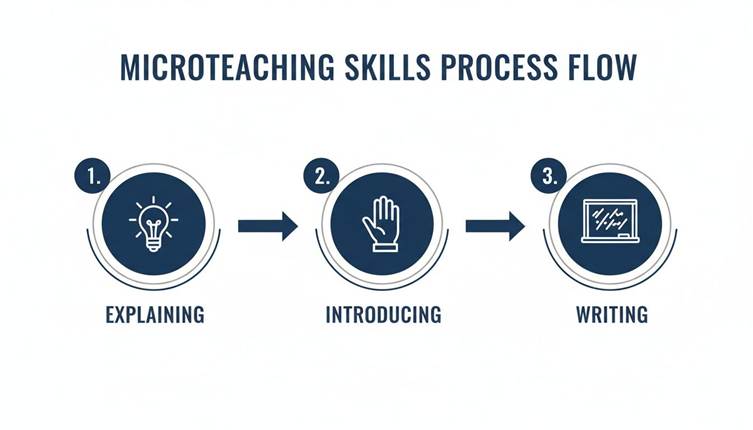
As the flow chart shows, foundational skills like explaining concepts, introducing topics, and writing clearly on a board are common starting points. For more practical ideas, especially in a digital context, check out our guide on tips for creating a successful online course.
By running through this simple but powerful cycle, you create a repeatable system for constant improvement in your teaching.
The Measurable Benefits of Adopting Microteaching
Moving beyond theory, the real power of microteaching lies in its tangible, evidence-backed results. The focused practice and feedback loop doesn't just feel productive; it genuinely builds stronger, more confident educators. The most immediate impact is a dramatic boost in teaching confidence.
When instructors have a safe space to practise a single skill, fail without consequence, and refine their approach, they gain genuine self-assurance. Studies show that when teachers feel more confident, their performance improves, and they are more willing to experiment with new teaching strategies. This confidence directly translates into a more dynamic and effective presence, whether in a classroom or on camera.
Enhanced Skill Acquisition and Retention
Microteaching excels at improving specific, high-impact teaching skills. By isolating behaviours like questioning techniques or clear explanation, it allows for deep practice that leads to mastery. This isn't just a short-term fix; the skills stick around.
The data from various studies is compelling. In India, microteaching has become a key methodology for improving educator competency. Research demonstrates that skills learned during teacher training programmes are directly relevant and beneficial for performance in real classroom settings.
For instance, trained resident doctors who underwent microteaching not only scored significantly higher in their second training session but also performed substantially better than their untrained colleagues in exams held 10 months later. This long-term retention shows that the benefits are sustainable. You can read the full research on how microteaching skills are honing teacher abilities.
This kind of focused practice is part of a larger trend in professional development, where disciplines like AI in education are helping to personalise learning and training pathways.
Better Outcomes for Learners and Your Brand
Ultimately, improved teaching leads to better student outcomes. When instructors are more confident and skilled, their students become more engaged, understand concepts better, and achieve higher levels of learning.
For course creators and entrepreneurs, these benefits directly impact your bottom line:
Higher Student Satisfaction: Effective teaching leads to happier learners who feel they are getting real value.
Stronger Reviews and Testimonials: Satisfied students become powerful advocates for your brand.
Increased Course Completion Rates: Engaging instruction keeps students motivated to see a course through to the end.
By investing in better teaching through methods like microteaching, you are directly investing in the quality of your product and the strength of your brand. It’s a clear path to creating an educational experience that stands out.
Common Challenges and How to Overcome Them
While microteaching offers a powerful path to improvement, let’s be honest—it’s not always a simple journey. Like any training method worth its salt, it comes with a few practical hurdles. Knowing what they are ahead of time is the best way to sidestep them and make your sessions genuinely effective.
One of the biggest obstacles is simply finding the time. The ‘teach-feedback-reteach’ cycle is what makes this whole thing work, but getting everyone back in the same room for that second attempt can be a logistical nightmare. Some educators also worry that focusing so intensely on one or two skills might feel restrictive, boxing them in and stifling their natural teaching style.
These are completely valid concerns. But with the right approach, they are far from deal-breakers.
Making Microteaching Work in the Real World
Successfully bringing microteaching into your training means being smart about both logistics and mindset. The trick is to adapt the framework to your world, not force your world to fit a rigid, inflexible script.
Here are a few practical fixes for the most common issues:
Time Constraints: Don't fight schedules; go asynchronous. Ask instructors to record their sessions and share the video for feedback. This completely removes the headache of aligning calendars for the reteaching phase.
Stifling Creativity: Shift the feedback from performance to principles. Instead of saying, “You should have stood over here,” try framing it as, “Let’s brainstorm a few ways to use movement to keep learners engaged.” This prompts creative thinking, not just blind imitation.
Scaling for Groups: If you’re training a large cohort, don't try to manage feedback all at once. Break them into small peer-feedback pods of three or four. This keeps the process intimate, manageable, and incredibly potent.
The goal of microteaching is not to create instructional clones. It’s a diagnostic tool, designed to help educators find and refine their unique teaching voice by strengthening its core components. True creativity always thrives on a bedrock of strong fundamental skills.
Despite its proven impact, this methodology is still surprisingly underutilised. In India, for instance, a pilot study with resident doctors was a huge success. 100% of participants felt the training improved their teaching, and they massively outperformed their untrained peers in exams 10 months later.
So why isn’t it everywhere? The same old challenges: time constraints and a shortage of trained facilitators. You can dive deeper into these microteaching findings in the National Medical Journal of India. By anticipating these hurdles from the start, you can build a system that makes this powerful technique a sustainable, and invaluable, part of your professional development.
Frequently Asked Questions About Microteaching
As you start to get your head around microteaching, a few practical questions always pop up. Getting those answered is key to moving from theory to actually doing it with confidence. Let's tackle the most common ones.
Can You Do Microteaching by Yourself?
Absolutely. While getting feedback from a colleague or a coach is fantastic, going solo is a powerful form of self-reflection. All you need is your smartphone to record yourself teaching a short, focused lesson.
Watching that playback gives you a totally objective look at your own teaching habits. You can finally see your own pacing, how clear you really are, and what your body language is communicating. It's a surprisingly effective way to work on your craft independently.
How Long Should a Microteaching Session Be?
This is the golden rule: keep it short. The ideal length is just 5 to 10 minutes. This isn't an accident; it's a core principle of the entire method. Keeping it brief forces you to zero in on the one specific skill you want to improve.
This short duration takes the pressure off and makes the "reteach" part of the cycle feel easy and manageable. It’s not about getting through tons of content; it’s about mastering a single teaching behaviour in a low-stakes setting.
Is Microteaching Only for New Teachers?
Not at all. It's a brilliant tool for new educators building their foundational skills, but it's just as valuable for seasoned professionals. I've seen experienced teachers use it to refine advanced techniques, test out a new strategy before taking it to a full class, or figure out how to adapt their style for an online course.
Think of it as a tool for continuous improvement. It helps even veteran instructors polish their craft and stay sharp, no matter how long they've been teaching.
Ready to build and refine your own teaching skills for an online audience? Skolasti gives you the all-in-one platform to create, sell, and protect your courses while our AI Teaching Assistant supports your students 24/7. Start your free 30-day trial today and teach smarter.