So, what exactly is gamification in education?
Let’s get straight to the point. It’s not about turning your course into a video game. Instead, it’s about strategically borrowing the best parts of games—the elements that make them so addictive and engaging—and applying them to a learning environment.
Think points, badges, leaderboards, and progress bars. The goal is simple: use these tools to motivate your learners and drive better results.
The Core Idea Behind Educational Gamification
At its heart, gamification is an instructional strategy designed to make learning more dynamic and interactive. It’s a deliberate shift away from passive, one-way teaching toward an experience that feels rewarding and genuinely engaging for students.
Every game element you add should have a purpose. It’s not about entertainment; it’s about tapping into core human psychology.
Consider a fitness app that gets you to exercise every day using streaks, achievement badges, and friendly competition. Gamification brings that same motivational science into your online course. By integrating these mechanics, you tap into powerful human desires for:
Achievement: Earning points or a new badge provides a tangible, satisfying sense of accomplishment.
Competition: A little friendly rivalry on a leaderboard can be a huge motivator for some learners.
Progression: Seeing a progress bar fill up gives students a clear visual of how far they’ve come. It turns a long journey into manageable steps.
Recognition: Displaying achievements validates a student’s hard work and gives them a reason to feel proud.
Distinguishing Gamification from Game-Based Learning
This is a critical point that trips many people up. It’s easy to confuse gamification with game-based learning, but they are fundamentally different.
Game-based learning is when you use an actual game to teach something. A history class playing a simulation game about ancient civilisations is a perfect example of this.
To make these concepts clearer, let's break them down.
Gamification At a Glance: Key Concepts Explained
This table provides a quick summary to help you distinguish between these important ideas.
Concept | Brief Explanation | Primary Goal in Education |
Gamification | Applying game-like mechanics (points, badges, leaderboards) to an existing, non-game learning environment. | Increase motivation, engagement, and participation in the learning process itself. |
Game-Based Learning | Using a complete, self-contained game as the medium for teaching a specific concept or skill. | Teach a subject through interactive play and problem-solving within the game's world. |
Primary Goal | To make the process of learning more engaging, not to create a separate game for entertainment. | To use the game's narrative and challenges to deliver educational content directly. |
Understanding this distinction is key to getting started.
Gamification, on the other hand, is about layering game mechanics onto your existing course structure. You’re not building a separate game; you’re making the learning process itself more game-like to increase student motivation and participation.
You don't need to be a game developer or a coding expert to pull this off. It’s about being a smart educator who understands what motivates people.
By integrating these proven motivational tools, you can transform your course from a series of passive video lectures into an active journey of skill-building and discovery. You make education feel less like a chore and more like a challenge worth conquering.
The Core Mechanics That Drive Learner Motivation
To really get what gamification in education is all about, we need to pop the hood and look at the psychological engines that make it run. These core mechanics aren't just fun extras; they are powerful tools designed to tap into our basic human drives for achievement, progress, and social recognition.
When you use them right, they can turn learning from a passive chore into an active, engaging journey. At the most basic level, they provide clear and immediate feedback, which is a massive motivator. Instead of waiting weeks for a graded assignment, learners get instant validation, reinforcing good learning habits in real-time.
Points: The Currency of Effort
Points are the most fundamental building block of gamification. Think of them as a simple, clear way to measure a learner's effort and progress. Every time a student finishes a quiz, watches a lesson, or joins a discussion, they earn points.
This system does two things incredibly well. First, it breaks down a big, intimidating course into small, rewarding steps. Second, it delivers a steady stream of positive reinforcement, giving learners a sense of accomplishment with every little action they take.
Badges: Symbols of Mastery
While points are great for tracking small steps, badges represent major milestones. A badge is a visual symbol of achievement, given out when a learner masters a tough module, shows off a new skill, or wraps up a big project.
Unlike points, badges aren't just about quantity; they signal quality and specialisation. For instance, you could award a "Module Master" badge for scoring over 90% on all quizzes in a section, or a "Community Contributor" badge for actively helping others in a forum.
Badges act as tangible evidence of a learner's growing expertise. They are collectable credentials that showcase mastery and build a student's confidence, turning learning into a quest for recognised skills.
Progress Bars: Visualising the Journey
A long, complex course can feel overwhelming. Progress bars fight this feeling by giving learners a clear, visual map of the road ahead. They show students exactly where they are, how far they've come, and what’s left to do.
This simple visual tool is surprisingly effective at easing anxiety and keeping up momentum. It turns an abstract goal like "finish the course" into a concrete, manageable task, encouraging students to keep pushing until that bar hits 100%.
This graphic shows how these core mechanics—points, badges, and progress—all lock together to create a motivating learning experience.
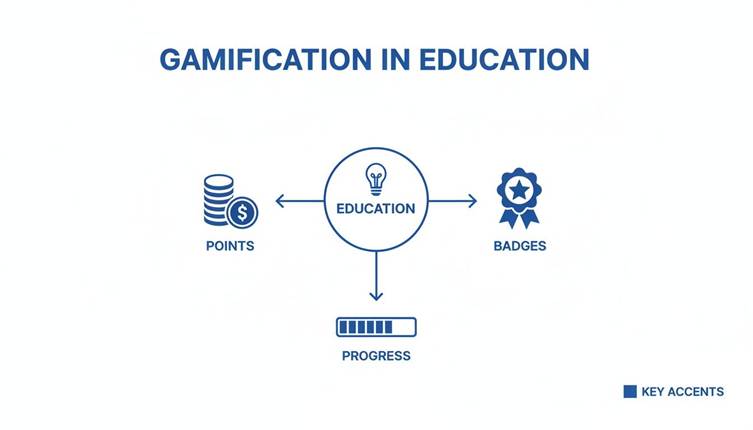
As you can see, each element serves a unique motivational purpose, but they all work together to support the main goal: learning.
Leaderboards: Fostering Healthy Competition
Finally, leaderboards tap into our natural desire for social connection and a bit of friendly competition. By showing the top performers based on points or achievements, leaderboards can spur learners to get more involved.
But you have to be careful with them. To keep them motivating for everyone, try creating leaderboards for specific groups, weekly challenges, or even team-based projects. This builds a sense of community and collaboration instead of just shining a spotlight on the same few high-achievers.
The data backs this up, too. A 2023 pilot in Mumbai and Bangalore schools saw gamified apps boost homework completion by 67% and push concept retention to 90%. In a separate study, engineering students using points and peer competitions improved their performance by 89.45% compared to those in standard lectures. You can discover more about these gamification outcomes.
Building Immersive Learning Journeys
While points and badges are great for a quick motivation boost, the real magic happens when you go deeper. True engagement isn't just about rewarding actions; it's about building a world your learners actually want to explore.
This is where you move from just applying game mechanics to weaving a cohesive, immersive learning journey. It’s about telling a story that gives students a powerful reason to keep pushing forward. To do this, educators can build custom interactive experiences or even explore creating immersive text to speech games to make content delivery more dynamic.
Weave a Compelling Narrative
Think about it: humans are wired for stories. A strong narrative can transform your curriculum from a boring checklist of lessons into a genuine adventure.
Instead of naming a module, "Introduction to Marketing," what if you called it "The Apprentice's First Task: Mastering Market Research"? This simple shift provides context and purpose. Learners aren't just slogging through lessons anymore—they're playing a role, overcoming challenges, and progressing toward a meaningful goal.
Design Engaging Challenges and Quests
Once your story is in place, you can structure your content as a series of challenges and quests. Each lesson or module becomes a mission with a clear objective. This breaks down even the most complex topics into smaller, achievable goals. It feels less like studying and more like an exciting pursuit.
You can mix it up:
Mini-Quests: Think of these as daily or weekly tasks, like contributing to a forum discussion or acing a short quiz.
Major Challenges: These are the big, multi-step projects that round out a module, like building a detailed case study or completing a hands-on assignment.
Structuring content this way creates a natural sense of momentum. Each completed quest delivers a satisfying dopamine hit and shows the learner they're one step closer to mastery.
Provide Immediate Feedback Loops
One of the most addictive elements of any game is instant feedback. You press a button, and something happens immediately. You know right away if you succeeded or failed. This principle is absolutely vital for keeping learners hooked.
Immediate feedback loops help solidify knowledge the moment it's learned. A quiz that shows results instantly, a drag-and-drop exercise that confirms the correct answer, or an AI assistant that answers questions on the spot—all these things help students self-correct without delay and build confidence along the way. Many platforms now offer advanced features that make this kind of interactivity possible.
Unlock Content for a Sense of Discovery
Finally, try structuring your course so that learners unlock new content as they progress. Instead of dumping everything on them at once (which is incredibly overwhelming), you reveal new modules, bonus resources, or expert interviews only after they've completed the prerequisites.
This simple technique creates a powerful "what's next?" curiosity that keeps students coming back for more. It rewards their hard work with access to new and valuable material, making the entire journey feel earned and deeply satisfying.
Real-World Gamification Examples for Any Course

Theory is great, but seeing what gamification in education is looks like in the real world is where the magic happens. The best gamified courses don't just feel like a layer of points and badges; they feel like a natural, exciting part of the learning journey itself.
To help you get inspired, let's break down three practical examples. Think of these as templates you can steal and adapt for your own courses, no matter what you teach.
Example 1: The Language Learning Quest
Imagine a Spanish language course. Instead of dry modules like "Unit 1: Grammar Basics," the entire course is a "World Traveller" quest. The goal? Journey through different Spanish-speaking countries, with each module unlocking a new destination.
Narrative: Learners start as novice travellers in Madrid. As they complete lessons on greetings and basic phrases, they earn ‘Passport Stamps’.
Quests & Points: Vocabulary quizzes become ‘Local Lingo Challenges,’ earning students ‘Travel Miles’ (points). Finishing a module on conversational skills unlocks the next country, like Mexico or Argentina.
Rewards: Collecting enough Passport Stamps could unlock a bonus lesson on regional slang or a fun video cooking class on how to make authentic paella.
Suddenly, grammar drills aren't a chore. They're part of an exciting adventure, giving students a powerful reason to keep pushing forward.
Example 2: The Startup Founder Journey
Now, let's picture a business coaching programme. The entire curriculum is framed as a "Startup Founder" journey, guiding learners from a raw idea to a successful launch.
Mechanics: Completing modules on finance or marketing earns ‘Investment Points’. These points can be used to ‘hire’ virtual team members or ‘invest’ in new tools for their simulated business.
Leaderboard: A ‘Top Founders’ leaderboard showcases who is making the most progress, sparking some friendly competition.
Exclusive Content: Hitting major milestones, like finalising a business plan, could unlock exclusive video interviews with real-life industry experts. This provides massive value and keeps motivation high.
This framework makes abstract business concepts feel tangible and actionable. Students aren’t just learning theory; they are actively building a simulated company, which makes the knowledge stick.
Example 3: The 30-Day Fitness Challenge
For a fitness or wellness course, a "30-Day Transformation Challenge" is a perfect fit. The time-bound structure creates urgency and a powerful sense of community. Participants aren't just following workouts; they're on a collective mission.
Daily Check-ins: Students earn points for daily check-ins, logging their workouts, and sharing healthy meals in a group forum. This builds powerful habits and accountability.
Milestone Badges: Weekly goals, like completing five workouts or hitting a personal best, are celebrated with badges like ‘Week 1 Warrior’ or ‘Consistency Champion’.
Team Challenges: The cohort could be split into teams to compete in weekly step challenges, building camaraderie and making sure everyone feels supported.
Gamification Ideas for Different Course Types
To spark even more ideas, here’s a quick-glance table showing how you can apply these mechanics to different types of courses.
Course Type | Gamification Mechanic | Implementation Example |
Coding & Tech | Coding Streaks | Award badges for students who code for 7, 15, or 30 consecutive days, reinforcing daily practice. |
Competitive Exams | Mock Test Leaderboards | Create weekly mock tests where top scorers are featured on a leaderboard, simulating exam conditions. |
Creative Skills | Project-Based Levels | Structure a design course into levels (e.g., Apprentice, Designer, Master) that unlock as students submit and get feedback on projects. |
Finance & Investing | Virtual Portfolio Challenge | Give students a virtual budget to invest. The student with the highest portfolio value at the end wins a special prize. |
These practical ideas show how thoughtfully gamification can be woven into any subject.
In India, platforms like BYJU'S and Unacademy have seen a 40-50% jump in daily user engagement after integrating quests and leaderboards. Even more impressive, a study showed that gamified math modules boosted test scores by 34% among Class 8 students in Delhi. You can learn more about the growing gamification in education market to see where the industry is headed.
Best Practices for Implementing Gamification
Getting gamification right is about more than just sprinkling some points and badges onto your course. It demands a thoughtful strategy, ensuring every game mechanic actively supports—not distracts from—your learning goals. A well-designed system feels natural and motivating; a poorly executed one just feels like a gimmick.
The first and most critical step? Align every single game element with your learning objectives. You have to ask the hard questions. Does this leaderboard actually encourage collaboration on assignments, or does it just create needless stress? Does this shiny new badge represent true mastery of a tough concept, or is it just a participation trophy? Fun must always serve a purpose.
Know Your Learners and Their Motivations
Next, you have to get inside your learners' heads. What gets a creative professional excited is worlds away from what engages a technical expert or a fitness enthusiast. A cutthroat, competitive leaderboard might be perfect for a sales training course but could completely demotivate learners in a collaborative, skill-building workshop.
Before you build anything, think about what drives your specific audience. Are they motivated by:
Achievement and Mastery? If so, focus on skill-based badges and truly challenging quests.
Social Connection? Use team-based challenges and leaderboards that track group progress.
Exploration and Discovery? Create learning paths where they can unlock new, exciting content.
Maintain a Sense of Balance
One of the biggest mistakes I see is over-gamifying. When every single click is rewarded with points and a dozen badges pop up in every lesson, the whole experience feels forced. It cheapens the value of real achievement. In gamification, less is almost always more.
Instead, save your most meaningful rewards for major milestones. This creates a powerful sense of accomplishment and keeps learners focused on what truly matters. It's also smart to ground your strategy in broader online education best practices that prioritise genuine student success.
The goal is to enhance the learning experience, not to build a distracting game on top of it. Use gamification to highlight progress and celebrate mastery, not to create noise.
Finally, lay out the rules clearly and track your results. Learners need to understand how the "game" works from day one. Explain exactly how points are earned and what each badge represents. Then, dive into your analytics to see what’s actually working. If a particular quest has high engagement, that’s your cue to create more like it. Following these guidelines will help you build a far more powerful course, and you can find more general online course tips to improve your content even further.
The market data backs this up. In India, for instance, gamification is a massive driver of growth in the education sector. Globally, platforms that properly integrate gamification and analytics are seeing a 36.4% compound annual growth rate. Why? Because gamified courses can retain 90% more learners and boost test scores by an average of 34%. This comprehensive gamification market report has more on the numbers.
Measuring the True Impact of Gamification
Adding points and badges is the fun part, but how do you actually know if it's working? To prove your gamified course is more than just a gimmick, you need to look past the surface and measure what really matters for student success.
Good measurement tells a clear story about your return on investment. It separates the elements driving real learning outcomes from those that are just fun distractions. This data is the key to refining your strategy and showing everyone just how powerful it is.
Key Performance Indicators to Track
To get the full picture, you need a mix of hard data (quantitative) and real human feedback (qualitative). Start by tracking these core metrics to see what gamification is really doing for your course.
Course Completion Rates: This is the ultimate test. Are more students actually finishing the course since you introduced game mechanics? A jump here is a massive sign of sustained motivation.
Learner Engagement Metrics: Go deeper than just logins. Look at how often and how intensely students are interacting with the material. Are they re-watching lessons, jumping into forum discussions, or retrying quizzes more than before?
Assessment Scores: Better scores on quizzes and assignments are a clear signal that your gamified approach isn't just entertaining learners—it's actively boosting how much they remember and understand.
Gathering Learner Feedback
Numbers only ever tell half the story. You have to understand the experience from the learner's perspective.
A simple survey or a few short interviews can give you priceless insights. Ask students what they enjoy the most, what truly motivates them, and which parts they find distracting. This is how you fine-tune your approach for maximum impact.
When you combine solid data with personal feedback, you build a powerful case for your gamified strategy. This becomes even more critical as new tools like AI get woven into online learning. You can learn more about the role of AI in education here.
Common Questions About Gamification (and Straightforward Answers)
As you start thinking about what gamification could mean for your courses, a few common questions are bound to pop up. It’s smart to tackle these head-on. Getting clear answers is the key to using these techniques with confidence and making sure they actually help your learners.
Let’s get into the most frequent queries I hear from course creators.
"Is Gamification Only for 'Fun' Topics?"
One of the biggest questions is whether gamification is appropriate for serious or professional subjects. The answer is a definite yes. When you're teaching corporate training or advanced technical skills, gamification isn't about playful themes—it's about driving mastery and real-world application.
Think less about cartoons and more about complex, scenario-based challenges or tracking progress towards a professional certification. The goal is to match the mechanics to the ambitious goals of your audience. This makes the learning journey feel relevant and motivating, not trivial.
"Is This Going to Be Hard to Implement?"
Another common concern is the time and effort involved. And that’s a fair question. The good news is you can start small. You don’t need to build a complex world overnight.
Adding simple elements like points for completing a lesson or a basic progress bar can often be done quickly right inside your course platform. A more elaborate narrative or a system of quests will naturally need more upfront planning, but that’s a choice, not a requirement. A smart approach is to introduce one or two mechanics, see how they land with your students, and then build on what works.
A frequent worry I hear is: “What if gamification backfires and demotivates some learners?” This is a real risk, but it only tends to happen when the design is thoughtless. For example, a heavy emphasis on public leaderboards can easily discourage students who are struggling to keep up.
To avoid this, you need balance. Focus on personal progress with individual goals and private achievement badges. You can also design collaborative challenges where students have to work together to succeed. The secret is to lean into intrinsic motivators like skill mastery and purpose. That’s how you create a supportive and inspiring environment for everyone.
Ready to build a more engaging and effective learning experience? Skolasti provides all the tools you need, including built-in gamification, to create an online academy that captivates your students and drives better results. Start your free 30-day trial and see the difference today!